You’ve just walked out of our Beverly Hills office with that refreshed look, but now you’re likely wondering about what to do after botox and fillers to keep it that way. I see patients who are terrified to touch their face, worried that a simple nap might cause their Botox to migrate or their filler to shift. It’s a valid concern because the hours following your appointment are like the final fitting of a custom gown. This is when your results truly settle into your unique facial architecture.
We all want that immediate, red-carpet glow without the tell-tale signs of a needle. In my practice, I’ve found that the right post-care routine doesn’t just prevent bruising; it actually extends the life of your treatment. Today, I’m sharing my professional protocols to help you master your recovery with zero guesswork. We’ll walk through a clear timeline, identify which skincare ingredients to pause, and explain how to protect your investment so you can step back into your social life with absolute confidence.
Key Takeaways
- Learn why the no-touch rule is the most critical instruction I give in my practice to prevent neurotoxin migration and keep your results precisely where we placed them.
- Follow our specific icing protocol to reduce swelling and inflammation without risking the displacement of your bespoke filler.
- Master the art of what to do after botox and fillers by learning which skincare actives to pause and which to prioritize for a seamless recovery.
- Navigate the two-week settling phase with ease, understanding exactly when initial firmness transforms into a soft and natural feel.
- Discover how pairing injectables with professional treatments like laser skin resurfacing creates a truly harmonious and long-lasting transformation.
The First 24 Hours: Protecting Your Aesthetic Investment
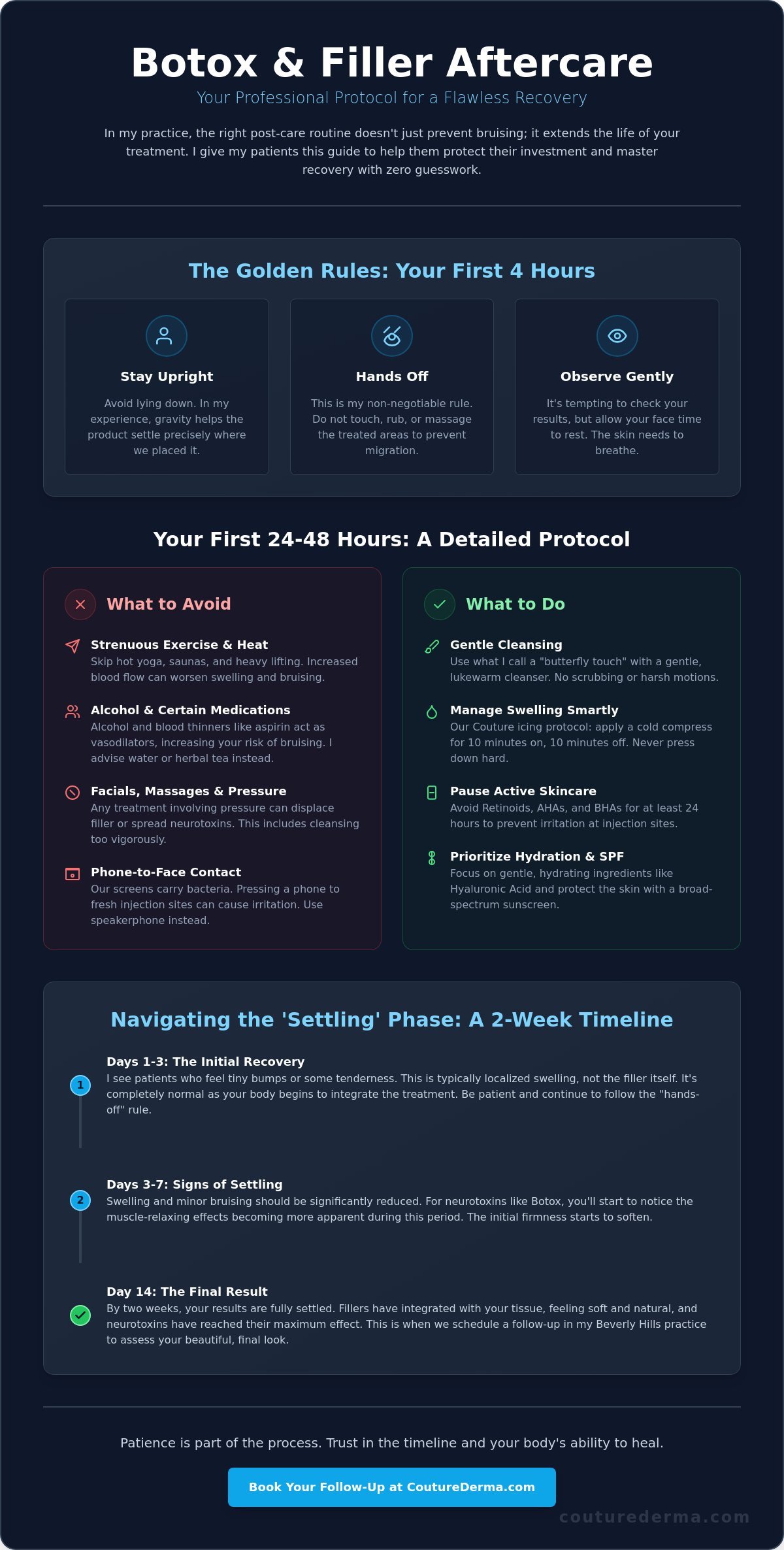
In my practice, the “no-touch” rule is non-negotiable. I see patients who are so excited about their results that they want to feel the new contours of their jawline or check the smoothness of their forehead immediately. But here’s the thing: those first few hours are when your treatment is most vulnerable. When we talk about what to do after botox and fillers, the most important thing is often what you choose *not* to do. Your skin needs a moment to breathe and your body needs time to accept the artistry we’ve just performed.
To better understand this concept, watch this helpful video:
The science of neurotoxin migration is simple but critical. We’ve carefully placed the Botulinum Toxin into specific muscles to achieve a tailored, natural look. If you rub or massage the area, you risk pushing the product into adjacent muscles. This is how “Botox migration” happens, which can lead to a heavy eyelid or an asymmetrical smile. Fillers are slightly different but equally delicate; they need time to integrate with your tissue without being compressed or shifted by external pressure. This is why I tell patients to stay upright for at least four hours post-injection. Gravity plays a role while the product binds to its target receptors.
And let’s be honest about that evening glass of wine. Alcohol is a vasodilator (it opens up your blood vessels), and it can turn a tiny, invisible needle prick into a noticeable bruise by morning. The same goes for blood thinners like aspirin or ibuprofen. If you want to keep your recovery invisible, stick to water and herbal tea for the first 24 hours. It’s a small sacrifice for a seamless result.
Hands Off: The Golden Rule of Injectables
Skip the professional massage or the facial for at least 24 hours. Any treatment that involves sustained pressure on the face can displace your filler or cause neurotoxins to spread. When you wash your face tonight, use a gentle, lukewarm cleanser and barely touch the skin. Think of it as a “butterfly touch” rather than your usual scrub. Also, watch out for the “phone-to-face” trap. Our screens are notoriously dirty, and pressing a bacteria-laden device against fresh injection sites can cause unnecessary irritation or even a small breakout.
Actionable Tip: Clean your phone screen with an alcohol wipe before taking any calls today, or better yet, use your speakerphone to keep the device away from your face entirely.
Exercise and Heat: Why Your Workout Can Wait
Actionable Tip: If you feel a “flush” coming on from the heat, use a handheld fan or sit in a cool, air-conditioned room rather than applying a direct ice pack, which can sometimes apply too much pressure if not done correctly.
Managing Side Effects: The Art of the Couture Recovery
I see patients who wake up the morning after their appointment and panic because they feel a tiny bump near their jawline. It’s completely normal to feel a bit anxious about how your skin reacts to needles. But here’s the thing: most “lumps” you feel in those first 48 hours aren’t actually the filler itself. They’re typically just localized swelling or a small internal bruise. Understanding what to do after botox and fillers means knowing when to be patient and when to take action. Most of these minor issues resolve themselves as your body accepts the treatment.
In our practice, we follow the Couture icing protocol to manage initial inflammation. You should apply a cold compress for ten minutes on and ten minutes off, but you must never press down. We want to soothe the skin without displacing the product we just meticulously placed. Following these Botox aftercare instructions ensures that your recovery is as refined as the treatment itself. I’ve also observed that patients who use Arnica (a homeopathic herb) or Bromelain (an enzyme found in pineapple) often see a faster resolution of minor bruising. It doesn’t work for every single person, but it’s a gentle way to support your body’s natural healing process.
Pinpoint bleeding at the injection site is common and usually stops before you even leave the office. However, if you see a persistent bluish tint under the skin, stay calm. This might be the “Tyndall effect,” which happens when filler is placed in a way that reflects light differently. It’s easily corrected. If you notice any unusual skin blanching (turning white) or intense pain, that is when you should call us immediately. Otherwise, most side effects are just part of the transformative journey.
Bruising: Prevention and Camouflage
My “Bruise-Free” checklist is a staple for my Beverly Hills patients. To minimize marks, stop taking fish oil, vitamin E, and ginkgo seven days before your visit. After the appointment, wait at least 24 hours before applying heavy foundation. If you must cover a mark, use a breathable, mineral-based concealer that won’t clog your pores. For those focusing on their smile, our guide on lip fillers in Beverly Hills offers more specific advice on managing this delicate, high-movement area.
Swelling vs. Asymmetry: The Patience Phase
Patience is your best friend during the first 72 hours. One side of your face might look fuller than the other, but this is rarely true asymmetry. It’s usually just uneven swelling based on how you slept or which side was injected first. Dermal filler is hydrophilic (water-attracting), which means it naturally pulls moisture into the area and can cause some morning puffiness. Over the next two weeks, the Hyaluronic Acid (HA) will integrate with your natural tissues, softening into a seamless, natural feel. If things still feel “off” after fourteen days, schedule a quick follow-up so we can refine your bespoke results.
Actionable Tip: Sleep with your head slightly elevated on two pillows for the first two nights. This simple change uses gravity to reduce fluid buildup and minimizes that “heavy” feeling in the morning.
Skincare Integration: What to Pause and What to Prioritize
Let’s be honest: your 10-step skincare routine needs a temporary “edit” after needles hit the skin. I see patients who are eager to maintain their glow, but knowing what to do after botox and fillers involves more than just avoiding pressure. In my practice, I call this the “Active Pause.” It’s a 48-hour window where we simplify everything to let your skin focus on healing and integration. Your skin is recovering from tiny micro-traumas, and it needs a calm environment to do its best work.
I specifically ask my patients to stop using Tretinoin (a powerful form of Vitamin A) and AHAs (alpha hydroxy acids like glycolic or lactic acid) for at least two days. These ingredients are designed to speed up cell turnover, but on fresh injection sites, they can lead to unnecessary redness or stinging. Instead, prioritize Hyaluronic Acid (HA) serums. Since most dermal fillers are made of HA, applying a topical version helps your skin stay hydrated and makes those results truly shine. It’s about supporting the work we’ve done, not challenging it.
The 48-Hour Skincare Detox
During this detox phase, “gentle” is the only word that should describe your routine. Stick to a basic, fragrance-free cleanser and a bland moisturizer. This isn’t the time to experiment with new products or high-potency serums. If you’re looking for long-term ways to enhance your results, you can explore other skin rejuvenation treatments once your initial settling period is over. We want to keep the skin barrier intact and undisturbed.
Actionable Tip: Wait 20 minutes after cleansing before applying any moisturizer to treated areas. This ensures the skin is completely dry and the tiny injection points have had a moment to “seal,” which reduces the risk of product irritation.
Environmental Shielding in Beverly Hills
In our sunny Beverly Hills climate, sun protection is non-negotiable. A fresh injection site is slightly more prone to hyperpigmentation (dark spots) because the skin is temporarily more sensitive. I always recommend a mineral-based SPF (sunscreen with zinc oxide or titanium dioxide) over chemical versions. Mineral filters sit on top of the skin and reflect UV rays without causing the heat buildup that chemical filters can sometimes trigger. Managing the LA heat is also vital. Stay in the shade and keep cool to prevent vasodilation, which is the widening of blood vessels that can worsen bruising.
Actionable Tip: If you’ve had under-eye injections, wear oversized, UV-protective sunglasses. They provide a physical barrier against the sun and help you avoid squinting, which can put unnecessary pressure on the newly placed product.
The Two-Week Window: Navigating the ‘Settling’ Phase
I see patients who wake up on day four and worry their Botox “didn’t take.” Let’s be honest, neurotoxins don’t have an on switch. It’s a gradual relaxation of the muscles. Understanding what to do after botox and fillers during this phase is mostly about practicing the art of patience. While you might see a change in the mirror quickly, the true transformation happens beneath the surface over a full fourteen days. In my practice, I call this the “curing” phase, where the artistry of the injection meets the biology of your skin.
The “Two-Week Rule” is a strict protocol I follow for a reason. I never perform touch-ups or refinements before the 14-day mark. Why? Because the tissue is still evolving. If we add more product while you still have lingering swelling, we risk an overfilled look once that fluid finally drains. Your final result often looks significantly better than day one because the product has had time to find its permanent home within your facial architecture. It’s a journey of refinement, not a hurried task.
Actionable Tip: Take a “baseline” photo on day one and compare it only on day 14. Use the same room and the same lighting to accurately track how your muscles are relaxing and how your contours are softening.
When Will I See My Botox?
Botox works by temporarily blocking the signals between your nerves and your muscles. This doesn’t happen instantly. By Day 3, you’ll typically notice the first signs of “softening” in the forehead or the glabella (the frown lines between your eyebrows). You might still be able to move the muscles, but they’ll feel heavier or less reactive. By Day 7, most patients see a significant reduction in movement. The full “Couture” effect arrives at Day 14. This is the moment where the skin looks airbrushed and smooth, but you still look like yourself, just more rested.
The Filler Evolution
Filler follows a slightly different path because it occupies physical space immediately. During the first 48 hours, you’re at peak swelling. You might feel “overfilled” or notice that your lips look a bit dramatic. Don’t panic. This is just your body’s natural response to the Hyaluronic Acid (HA) attracting water. By the end of Week 1, the “settling” begins. The product starts to integrate with your facial fat pads (the natural cushions of fat under your skin). By Week 2, the “reveal” happens. The swelling is gone, the product has softened, and the true, bespoke contour is finally visible.
Actionable Tip: If you feel a tiny firm spot during week one, resist the urge to massage or “smooth” it yourself. In most cases, this is just localized fluid that will resolve naturally as the filler integrates with your tissue.
Once you hit that fourteen-day milestone, your results are officially “set.” This is the perfect time to evaluate if we’ve reached your aesthetic goals or if a tiny tweak is needed for perfect harmony. If you’ve reached this point and want to ensure everything is settling perfectly, schedule your two-week refinement to finalize your signature look.
Beyond the Appointment: Sustaining Your Signature Look
I see patients who view their treatment as a one-off transaction, but the most refined results come from a collaborative, long-term journey. Your facial structure is dynamic, and your skin is constantly responding to the environment. In our practice at Couture Dermatology & Laser Beverly Hills, we don’t just look at the lines we’re treating today; we look at how your face will evolve over the next decade. Understanding what to do after botox and fillers means shifting your mindset from “fixing” to “tailoring.” It’s about maintaining the canvas while we refine the details.
One of the most effective ways to elevate your results is to pair injectables with professional laser skin resurfacing. While Botox relaxes muscles and filler restores volume, lasers address the actual texture and pigment of the skin. Think of it as the difference between a well-tailored suit and the quality of the fabric itself. By improving the skin’s surface, your injectables don’t have to work as hard to make you look refreshed. And here’s the thing: when you stay on a consistent maintenance schedule, we often find you need less product over time to achieve the same sophisticated effect.
But we also need to talk about safety. While most side effects are minor, you should know when to call the office. If you experience skin that looks mottled (blotchy or like a net), turns white, or feels intensely painful, you must contact us immediately. This could be a sign of vascular occlusion (a rare blockage of a blood vessel). It’s highly treatable if caught early, but it requires professional attention. Most of what you’ll experience is just the body’s natural healing process, but I want my patients to feel empowered, not anxious, during their recovery.
Actionable Tip: Book your follow-up appointment before you leave the office. For Botox, this is typically every 3 to 4 months; for fillers, it ranges from 6 to 18 months depending on the area treated. Staying ahead of the “wear-off” prevents the return of deep lines and keeps your look consistent.
Maximizing Longevity
Medical-grade skincare is your best insurance policy for your aesthetic investment. Products with antioxidants and peptides help protect the collagen that fillers are designed to support. But your lifestyle plays a massive role too. I’ve noticed that high-intensity athletes often burn through filler faster due to their high metabolic rate. If you have a very active lifestyle or live in the constant Beverly Hills sun, you might need slightly more frequent touch-ups than someone with a more sedentary routine. It’s all part of the customization process.
The Couture Consultation
Our philosophy at Couture Dermatology & Laser Beverly Hills focuses on the long-term tailoring of your face. We aren’t interested in quick, artificial-looking solutions that change your fundamental character. Instead, we plan your visits to ensure a gradual progression toward your goals. This patient approach prevents the “overfilled” look that often comes from rushing the process. Aesthetic harmony is a journey, and we’re here to guide you through every step. Your signature look is a reflection of your confidence, and we take the responsibility of protecting it very seriously.
Embracing the Art of the Settled Result
Walking through the doors of our office is just the first step in a larger, collaborative process. We’ve explored how the first 24 hours determine your safety, how skincare integration supports your glow, and why the two-week settling window is non-negotiable. Knowing what to do after botox and fillers transforms a simple appointment into a long-term investment in your self-assurance. It’s about protecting the meticulous work we’ve done together to ensure your results look effortless and entirely your own.
At Couture Dermatology & Laser Beverly Hills, we believe aesthetic medicine is a fine art that requires both scientific rigor and a keen eye for harmony. I lead this practice with my Harvard-trained expertise as Dr. Chinonso Kagha Abisogun to offer a bespoke “Couture” approach that respects your unique facial architecture. We specialize in treating all skin types and tones, ensuring every patient feels recognized and meticulously cared for. If you are ready to start your journey toward a more refreshed version of yourself, refine your look with a bespoke consultation at Couture Dermatology & Laser Beverly Hills. You deserve a result that is as vibrant and resilient as you are.
Frequently Asked Questions
Can I lie down after Botox or fillers?
You should wait at least four hours before lying down or bending over after your treatment. Staying upright is a critical part of what to do after botox and fillers because it prevents the product from migrating to unintended muscles. For fillers, this posture also helps minimize the initial fluid buildup that causes swelling. In my practice, I suggest staying vertical until you head to bed for the evening to be safe.
How soon can I exercise after getting injectables?
You can resume light activity like a gentle walk after 24 hours, but you should wait a full 48 hours for high-intensity training. Raising your heart rate too soon increases blood flow to the face, which can significantly worsen bruising and swelling. Heat from a vigorous workout also causes blood vessels to dilate. Let your body settle first so your results remain as tailored and refined as possible.
Is it normal to feel lumps after dermal fillers?
Yes, it is very common to feel minor lumps or areas of firmness during the first week. These are typically localized areas of swelling or small internal bruises rather than the filler itself. Hyaluronic Acid (HA) fillers are hydrophilic, meaning they attract water and can feel a bit firm as they integrate. Most of these “lumps” resolve naturally by the 14-day mark as the product softens into your tissue.
What should I avoid eating or drinking after my appointment?
Avoid alcohol and high-sodium foods for at least 24 to 48 hours to keep your recovery seamless. Alcohol acts as a vasodilator that can turn a tiny needle prick into a noticeable bruise by the next morning. Salty foods encourage water retention, which leads to more significant swelling, especially in delicate areas like the lips. Stick to hydrating fluids and lean proteins to support your skin’s natural recovery process.
When can I apply makeup over the injection sites?
You should wait at least 24 hours before applying makeup to any treated areas. This window gives the tiny injection points time to “seal” properly and reduces the risk of introducing bacteria into the skin. When you do reintroduce cosmetics, use a clean brush and a breathable, mineral-based formula. This ensures your recovery remains invisible while your skin heals undisturbed and your signature look begins to emerge.
How do I know if my swelling is a cause for concern?
Normal swelling peaks at 48 hours and then gradually subsides, but persistent, worsening pain or unusual skin discoloration is a red flag. If you notice a “mottled” or net-like pattern on your skin, or if the area turns white or blue-grey, contact us immediately. Knowing what to do after botox and fillers means being aware of these rare signs of vascular occlusion (blocked blood vessel) so we can intervene quickly.
Can I get a facial or massage right after my treatment?
No, you must avoid facials, chemical peels, and facial massages for at least two weeks following your appointment. Sustained pressure on the face can displace dermal fillers or cause neurotoxins like Botox to move into adjacent muscles. In my practice, I suggest waiting until your 14-day follow-up to ensure everything has fully integrated. This patience protects the bespoke architecture we’ve created for your unique facial structure.
Why does my Botox look uneven after only 5 days?
Botox takes a full 14 days to reach its final effect, so unevenness at day five is usually just a sign that some muscles are relaxing faster than others. It is not a cause for alarm. I see patients who worry about a “heavy” brow or an asymmetrical smile during the first week, but these issues almost always balance out by the two-week mark. Wait for the full curing period before considering a touch-up.