You’re considering CO2 resurfacing for acne-scar texture, but you’re concerned about how darker skin might respond. CO2 isn’t automatically unsafe, though safe laser treatments for Fitzpatrick IV-VI skin require careful choices. Skin types IV to VI are more susceptible to burns, hyperpigmentation, or scarring when the technology or treatment approach isn’t suitable.
It’s understandable to weigh potential benefits against those risks. The concern being treated, laser approach, and your health factors all matter. I’ll explain what CO2 may treat, how it compares with non-ablative lasers, and why settings, timing, and careful assessment shape the treatment discussion.
Key Takeaways
- Use the Fitzpatrick scale as a starting point: it groups skin types by how they respond to sun exposure, not by appearance alone.
- For fractional CO2 resurfacing, conservative treatment can mean fewer passes and more time between sessions to limit cumulative heat and allow healing.
- Compare CO2 with non-ablative options by weighing the skin concern, treatment intensity, and recovery involved; one CO2 session is rarely enough, especially with a conservative approach.
- Fitzpatrick skin types V and VI warrant particular caution with intense pulsed light, which the article advises against for these skin types.
- Before treatment, have your skin type assessed and plan for daily broad-spectrum sunscreen during recovery to help reduce the risk of pigment changes.
What Concerns Can CO2 Laser Treat Safely in Darker Skin?
You may be considering CO2 for acne-scar texture while worrying about pigment changes. In my practice, I treat that concern as a discussion about the goal, your skin history, and the laser approach, not a simple yes-or-no decision.
Practitioner Experience with Darker Skin
Practitioner experience includes understanding how darker skin may respond to laser heat and heal. Patients may develop dark marks after irritation, so discuss past reactions and scarring before considering resurfacing. Fitzpatrick types IV to VI can be more susceptible to burns, hyperpigmentation, or scarring when technology or treatment is unsuitable. Your history helps shape a cautious, individualized conversation.
Before a procedure, describe previous responses to acne, skin injury, or laser treatment. For example, mention a dark mark that lingered after a breakout or a scar that became raised. These details help distinguish your main concern from your healing history, both of which matter when considering CO2 for texture or scarring.
FDA-Cleared Lasers and Safety Guidelines
FDA-cleared status alone doesn’t establish whether a device and treatment approach are suitable for your skin type. Ask which device is planned, what it is intended to treat, and how it relates to your concern.
For hair removal, the Candela GentleMax Pro includes a 1064 nm Nd:YAG wavelength and a 755 nm Alexandrite wavelength for addressing a range of skin tones. Ask which wavelength is planned and why it fits your assessment. A cooling system to protect skin is another practical safety point to discuss; its absence is a warning sign.
Treatments for Scars, Melasma, and Rejuvenation
CO2 may be used for acne-scar texture and resurfacing, while the approach for melasma or general rejuvenation requires a separate assessment. Melasma causes patches of darker pigment, and inflammation can affect uneven color. Tell the practitioner which concern you want addressed instead of grouping scars, pigment, and texture together as “rejuvenation.”
For Fitzpatrick IV-VI skin, a conservative CO2 plan may reduce treatment density and fluence. Density determines how many microthermal columns are created in one session; fluence is the energy delivered. Lowering both can limit heat exposure and the intensity of thermal injury, helping reduce pigment-change risk.
To help reduce post-inflammatory hyperpigmentation, or dark marks after inflammation, discuss your history of pigmentation before treatment and use daily broad-spectrum sunscreen during CO2 recovery. Ask for clear aftercare instructions before your session, including when to resume your usual skin-care products. These steps support safer planning without assuming a particular laser is right for every concern.
CO2 versus non-ablative laser options
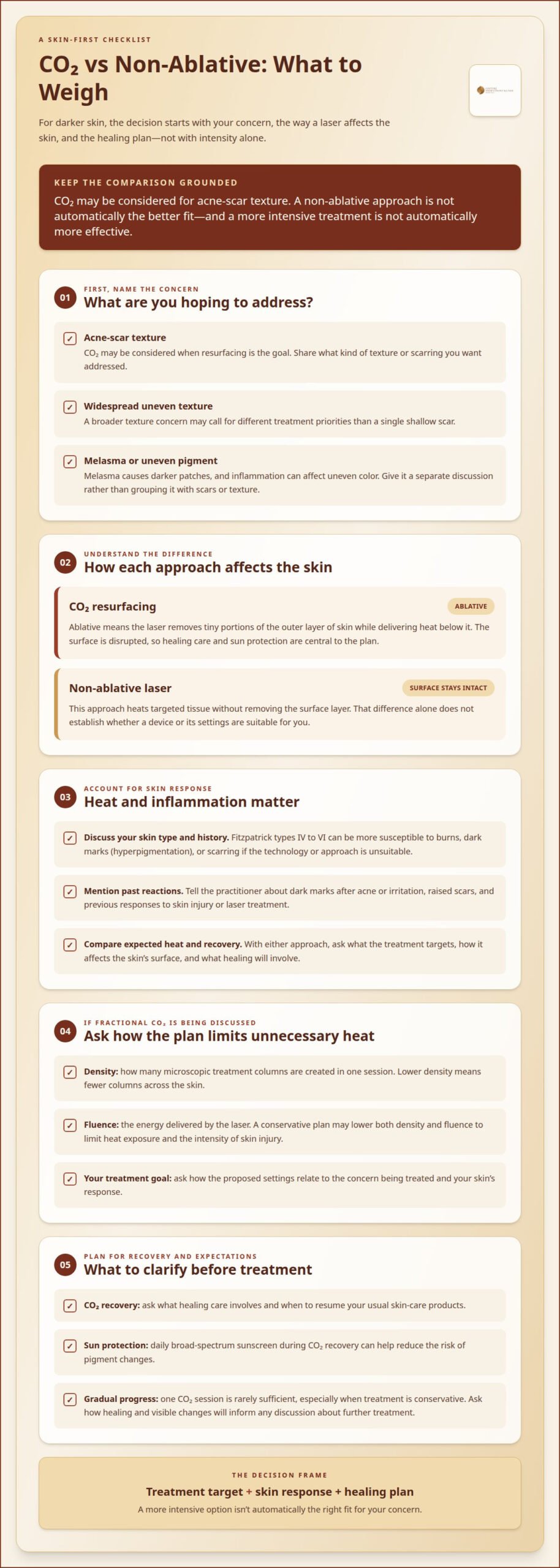
CO2 and non-ablative lasers differ in how they affect the skin, which shapes the treatment and recovery discussion. The best comparison starts with your main concern, such as acne-scar texture, rather than assuming the more intensive option is automatically more effective.
CO2 is ablative, meaning it removes tiny portions of the outer layer while delivering heat below it. Non-ablative lasers heat targeted tissue without removing that surface layer. For darker skin, the amount of heat and inflammation matters with either approach, so the method needs to match both your concern and your skin’s response.
Recovery is another part of the decision. CO2 disrupts the skin surface, making healing care and sun protection central to the plan. Non-ablative treatment leaves the surface intact, but that distinction alone doesn’t establish that a device or setting suits you. Ask what the treatment targets and what recovery will involve.
A single CO2 session is rarely sufficient, especially when treatment is conservative for darker skin types. Set expectations around gradual progress rather than assuming one session will address every scar or texture concern. Ask how healing and visible changes will guide any discussion about further treatment.
How do you decide which approach fits your concern?
Start by naming the change you want to address. A shallow acne scar and widespread uneven texture may call for different treatment priorities. CO2 may be considered when resurfacing is the goal, while a non-ablative option may be discussed when preserving the surface matters to your plan.
Melasma needs its own discussion. Because this pigment concern can be affected by inflammation, don’t assume resurfacing will address it simply because CO2 can improve some surface concerns. Tell the practitioner if melasma is your main concern, and mention any past pigment changes after irritation or injury.
During a consultation, ask what each option is intended to treat, how it affects the skin’s surface, and what recovery involves. These questions clarify practical trade-offs without treating greater intensity as better care.
For darker skin, the comparison should include the treatment target, expected heat exposure, and healing plan. A non-ablative approach isn’t automatically the right choice, just as CO2 isn’t automatically unsuitable. The useful next step is understanding why a particular method fits your concern and how the plan accounts for your skin’s response.
Conservative fractional CO2 laser settings
For Fitzpatrick IV-VI skin, fractional CO2 treatment should be customized and conservative. A plan for safe laser treatments for Fitzpatrick IV-VI skin considers the concern being treated and how the skin responds. The aim is to address the treatment area without creating unnecessary heat or inflammation, which can contribute to pigment changes after skin injury.
Density describes how closely the laser’s microscopic treatment columns are placed across the skin. Lower density means fewer columns in one session and can limit total heat exposure. Fluence is the laser energy delivered over an area; lower fluence reduces the intensity of heat injury. These adjustments may help limit pigment-change risk in darker skin, but they don’t eliminate risk.
Passes are the number of times the laser moves over a treatment area. For Fitzpatrick IV-VI skin, fewer passes can reduce cumulative heat exposure. If acne-scar texture is your concern, ask how the planned passes and density address that area. More passes do not automatically mean better results.
Spacing between sessions matters, too. Allowing more time between CO2 treatments gives darker skin more opportunity to heal and helps reduce ongoing inflammation and pigment risk. The interval should follow the skin’s healing response, rather than a schedule copied from another person. Report lingering redness, irritation, or darkening before another session is planned.
Make the settings discussion specific during your consultation. Ask how the plan will limit heat and how your healing will inform any later treatment. For safe laser treatments for Fitzpatrick IV-VI skin, discuss these considerations:
- Density: Fewer microthermal columns per session can limit overall heat exposure.
- Fluence: Lower energy can reduce the intensity of thermal injury.
- Passes: Fewer passes reduce cumulative heat across the treatment area.
- Spacing: More time between sessions allows healing and helps limit inflammation.
A cited study title reports a low risk of post-inflammatory hyperpigmentation after fractional CO2 treatment in skin types 4 and 5. That finding doesn’t mean every setting or patient has the same risk, and the title refers to types 4 and 5, not Type 6. Treat it as context, not a guarantee of an individual outcome.
After CO2 treatment, daily broad-spectrum sunscreen during recovery helps prevent post-inflammatory hyperpigmentation. Follow the recovery instructions and don’t rush into another session before the skin has healed. Careful choices about density, fluence, passes, and spacing help shape a conservative fractional approach.
Contraindications and reasons to postpone treatment
A Fitzpatrick assessment and a review of the treatment plan are important before laser treatment on darker skin. For Fitzpatrick V-VI skin, intense pulsed light (IPL) warrants particular caution: the guidance for this topic advises against IPL for these skin types. Ask which device is planned, because IPL and laser treatments are not interchangeable terms.
Pause before deciding if your skin type hasn’t been evaluated or the device and treatment goal haven’t been explained. A Fitzpatrick evaluation considers how your skin responds to sun exposure, rather than relying on a skin-tone description alone. This gives your practitioner a clearer basis for discussing the approach, potential pigment changes, and whether the treatment suits your concern.
Cooling matters, too. The absence of a cooling system to protect the skin is identified as a warning sign of unsafe laser practice. Before treatment, ask how the device protects your skin during the session. If cooling isn’t part of the setup, pause rather than treating it as a minor technical detail.
What should you clarify before proceeding?
Use the consultation to connect your Fitzpatrick type, the device, and the concern you want treated. For example, if you’re considering treatment for uneven pigmentation, describe that goal directly rather than calling it only “rejuvenation.” Different concerns may call for different approaches, and a clear goal makes the proposed treatment easier to assess.
Ask these focused questions before agreeing to a procedure:
- Skin assessment: Has my Fitzpatrick type been evaluated before the treatment plan was chosen?
- Device: Is the proposed treatment a laser or IPL, and why does it suit my skin type?
- Cooling: What cooling system protects my skin during the procedure?
- Goal: Is the treatment intended for texture, scars, pigment, or another concern?
These questions are especially relevant if the proposed procedure is IPL and you have Fitzpatrick V or VI skin. The guidance advises against IPL for these types. A device’s general cosmetic use does not establish that it is suitable for your skin tone.
After CO2 resurfacing, daily broad-spectrum sunscreen during recovery helps reduce the risk of post-inflammatory hyperpigmentation, or dark marks after inflammation. Make recovery care part of the decision before treatment, not an afterthought once the procedure is finished. If the plan doesn’t include a clear discussion of skin assessment, device choice, cooling, and recovery, pause and address those points first.
Fitzpatrick skin type classification
The Fitzpatrick scale groups skin into six types, I through VI, based on its response to sun exposure. For laser planning, it gives you and your practitioner a shared starting point for discussing skin response. It doesn’t fully describe your skin, and the type alone doesn’t determine treatment.
Type IV describes olive to medium brown skin that rarely burns and tans well. Type V describes dark brown skin that very rarely burns. Type VI describes deeply pigmented dark brown to black skin that never burns. These distinctions matter because a treatment plan should consider sun response, not appearance alone.
Types I through III are also part of the scale. The key point is that each type reflects a pattern of response to sun exposure. Two people with similar-looking skin may describe different responses, so don’t rely only on appearance or a broad skin-tone label when discussing your classification.
How should you use your type in a laser discussion?
Think of your Fitzpatrick type as one part of the treatment assessment, not a personal safety score. Being Type IV doesn’t mean every laser or setting will suit you. Your practitioner also needs to understand the concern being treated and your history of pigment changes, burns, or scars.
Before a laser consultation, describe how your skin responds to sun exposure. Does it rarely burn and tan well, as in the Type IV description? Does it very rarely burn, as described for Type V? These details make the classification conversation more precise than choosing a type based on skin color alone.
If you’re unsure which of two descriptions fits, say so rather than forcing a match. A Fitzpatrick evaluation before laser treatment is useful, especially when considering options for darker skin. Mention any previous laser or light treatment and how your skin healed. That history adds context the scale cannot capture.
The distinction between Types IV, V, and VI can also inform questions about device choice. For example, the advice to avoid intense pulsed light applies specifically to Fitzpatrick V-VI skin. The scale helps identify that caution, while an assessment connects it to your individual treatment goal.
Use your classification as a prompt for a focused conversation: ask how your sun response affects the proposed approach and what factors shape the plan. If you’re preparing for that discussion, book a consultation to discuss laser treatment and your skin-type assessment.
Couture Dermatology & Laser Beverly Hills: Laser Skin Resurfacing
Couture Dermatology & Laser Beverly Hills offers Laser Skin Resurfacing for patients considering options for texture or acne-scar concerns. If you have Fitzpatrick IV-VI skin, the next step is a personalized discussion of your skin type, treatment goal, and the potential risks of resurfacing. Bring details of past pigment changes or reactions to laser treatments, so these can inform the conversation.
Laser Resurfacing may not suit every concern. A careful assessment can clarify whether it aligns with your goals and what factors to consider before treatment. To discuss your skin and options, visit Couture Dermatology & Laser in Beverly Hills, serving patients in Los Angeles.
Make your next step an informed one
Planning safe laser treatments for Fitzpatrick IV-VI skin starts with a clear conversation about what you want to change and what matters to you during recovery. Bring your questions, describe previous skin reactions, and share the concern you hope to address. These details can help shape a discussion around your priorities rather than a one-size-fits-all plan.
The right approach depends on your skin’s response and the concern being treated. You don’t need to arrive with a decision already made. A consultation at Couture Dermatology & Laser in Beverly Hills can help you discuss your goals and whether a laser approach may fit them.
Contact Couture Dermatology & Laser Beverly Hills to book a consultation and take the next step with thoughtful guidance. You deserve to feel informed and comfortable as you consider your options.
Frequently Asked Questions
Does That Mean CO2 Laser Is Unsafe?
No. CO2 laser isn’t automatically unsafe for darker skin, but it calls for careful patient assessment and conservative treatment choices. The concern is excessive heat or inflammation, which can contribute to burns, dark marks, or scarring. Before deciding, discuss your skin history, treatment goal, and how the clinician will adjust the approach for your skin. A thoughtful assessment helps you weigh potential benefits against the risks relevant to you.
Hyperpigmentation Risk: How Common Is It?
There isn’t one rate that applies to every person with darker skin. The risk can change with the device, treatment intensity, skin response, and healing process. For example, a person who has developed dark marks after irritation should mention that history before treatment. Ask how your plan aims to limit inflammation and what recovery care is recommended. Daily broad-spectrum sunscreen during CO2 recovery can help prevent post-inflammatory hyperpigmentation.
Is CO2 Laser Ever Completely Risk-Free?
No. CO2 treatment involves controlled injury to the skin, so some risk remains even with careful planning. Potential concerns include burns, pigment changes, and scarring, particularly when the approach doesn’t suit your skin. Discuss your previous reactions to procedures, tendency to develop dark marks, and the specific area being treated. These details help make the risk conversation personal, rather than relying on broad claims that a device is safe for everyone.
Is One Session Enough?
One CO2 session is rarely enough, especially when darker skin is treated conservatively. The treatment goal also matters: improving a small area of texture differs from addressing broader acne-scar concerns. Rather than deciding on a course in advance, use your healing and visible response to guide the next discussion. Ask what changes the clinician will look for before considering another session, and avoid treating more sessions as a guarantee of a particular result.
What Is Post-Inflammatory Hyperpigmentation?
Post-inflammatory hyperpigmentation is darkened skin that appears after inflammation or injury. After a laser procedure, it may show up as a brown or darker patch in the treated area. Tell your clinician if acne, irritation, or a previous procedure has left persistent marks. During CO2 recovery, daily broad-spectrum sunscreen helps prevent this pigment change. Follow your aftercare plan and raise new or worsening dark spots during follow-up.
Which laser treatments are safest for Fitzpatrick skin types IV, V, and VI?
No single laser can be called the safest choice for every person or concern. The device and approach should match your skin assessment and treatment goal. For hair removal, the Candela GentleMax Pro includes a 1064 nm Nd:YAG wavelength and a 755 nm Alexandrite wavelength. Intense pulsed light is advised against for Fitzpatrick V-VI skin. Ask which device and wavelength are planned and how they relate to your assessment.
How do fractional non-ablative and ablative lasers compare for darker skin tones?
Ablative lasers remove portions of the outer skin surface, while non-ablative lasers heat tissue without removing that surface. This difference affects the treatment approach and recovery discussion, but doesn’t by itself establish which option is suitable for you. For darker skin, consider the concern being treated, expected heat exposure, and history of pigment changes. Ask how the selected method addresses your goal while limiting unnecessary irritation during healing.
What are the risks of burns, hyperpigmentation, and hypopigmentation from laser treatments on darker skin?
Burns can injure treated skin. Hyperpigmentation means darker patches, while hypopigmentation means lighter patches than the surrounding skin. Unsuitable technology or treatment can also contribute to scarring in Fitzpatrick IV-VI skin. Specific risks vary with the device, settings, and your skin’s response. Before treatment, describe past pigment changes or scars and ask how the plan addresses heat exposure, skin protection, and recovery.