
Imagine you’re sitting at an outdoor lunch in Beverly Hills. The sun is out, but instead of enjoying the breeze, you feel that familiar, hot prickle across your cheeks. You know what’s coming next. By the time the appetizers arrive, your face is a bright, angry red that no amount of concealer can hide. In my practice, I see patients who are exhausted by this cycle. They’re tired of being told it’s just adult acne or that they simply need to stay out of the light. Finding a rosacea specialist los angeles who understands that your skin isn’t a one size fits all puzzle is the first step toward relief.
I know how frustrating it is to feel like your skin is betraying you in social or professional settings. It’s draining to constantly monitor your flushing while everyone else seems to enjoy the Southern California sun. But here’s the thing; you don’t have to settle for a reactive lifestyle. This guide will show you how a customized, medical grade strategy can transform your complexion and restore your self assurance. We will look at why precision laser protocols and new FDA approved medications like Emrosi are the keys to a simplified, non irritating routine that actually works for the long term.
Key Takeaways
- Learn why the intense Southern California sun turns a temporary flush into chronic redness and how to protect your skin year-round.
- Discover how a rosacea specialist los angeles uses elite Vbeam laser technology to target visible blood vessels without damaging the surrounding tissue.
- Understand the “couture” approach to treatment that combines custom medical prescriptions with in-office procedures for a truly personalized result.
- Master a specific cooling protocol and the “20-minute rule” to soothe irritation and prevent new flare-ups before they start.
- Move beyond the confusion of adult acne to achieve a clear, even skin tone through a partnership built on fifteen years of clinical expertise.
Understanding Rosacea in the Los Angeles Climate
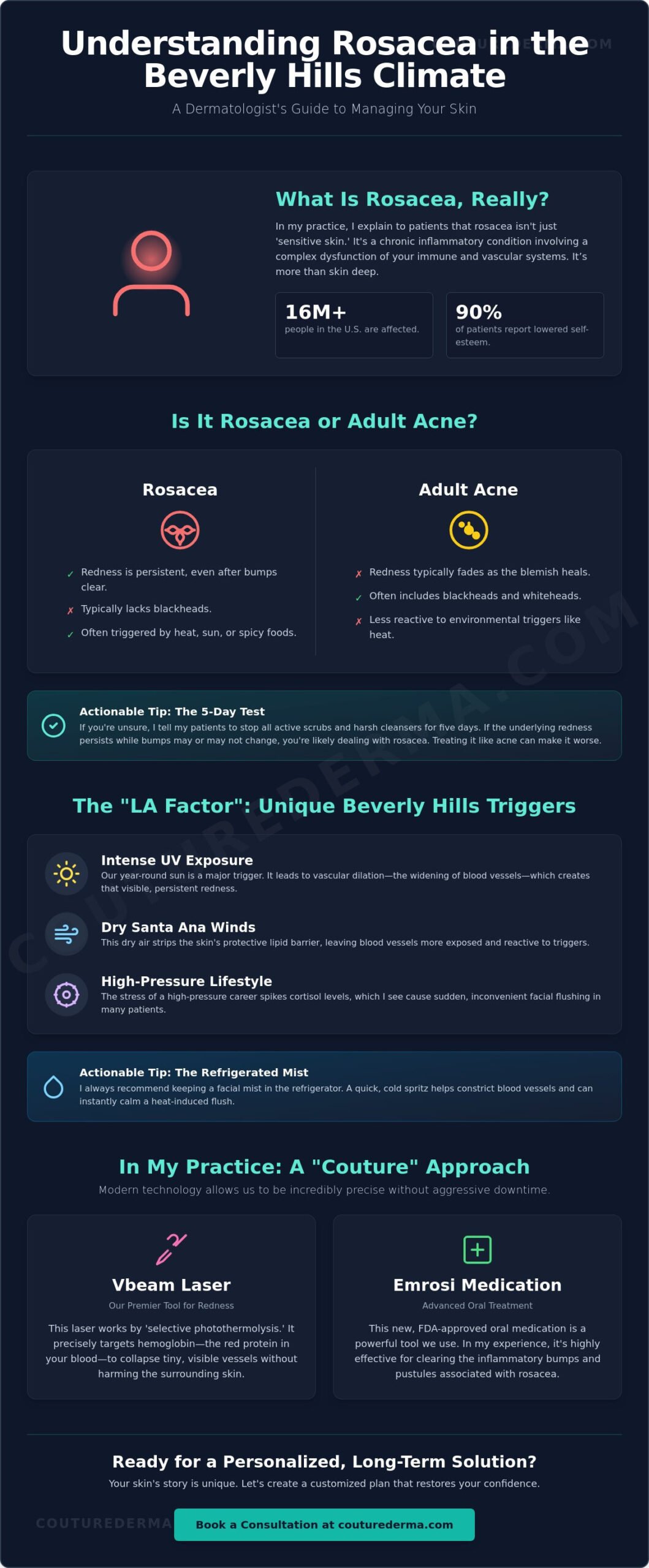
In my Beverly Hills practice, I see patients who have spent years hiding behind heavy foundations and avoiding the bright California sun. They often come to me describing their skin as “perpetually angry” or “unpredictable.” But here’s the thing; rosacea is not just a case of having sensitive skin. It’s a chronic inflammatory condition that affects over 16 million people in the United States. While many think it’s just a cosmetic issue, What is Rosacea? actually involves a complex dysfunction of the immune and vascular systems. In a high-visibility city like Los Angeles, the emotional toll of a “permanent blush” is significant. According to the National Rosacea Society, over 90 percent of patients report that their condition has lowered their self-esteem.
Finding a rosacea specialist los angeles who understands our unique local environment is vital for long-term management. Our city offers a beautiful lifestyle, but the environmental triggers here are relentless. Between the intense UV index and the dry air, your skin is under constant stress. I treat every patient’s face as a bespoke project because no two cases of redness look exactly the same. Some people experience a steady pink glow, while others deal with visible blood vessels or even skin thickening. To better understand how we address these vascular concerns, watch this helpful video:
Is it Rosacea or Just Adult Acne?
Many of my patients arrive confused because they’ve been using harsh benzoyl peroxide or gritty scrubs to treat what they think is late-onset puberty. If you have papulopustular rosacea (a type that causes bumps), your skin will stay red even after a breakout heals. And unlike standard acne, rosacea typically lacks blackheads. Using traditional acne products on this type of skin is like throwing gasoline on a fire; it strips the moisture and triggers a massive flare. Actionable Tip: If you aren’t sure which one you have, stop all active scrubs for five days. If the redness stays while the bumps remain, you likely need a rosacea-specific protocol.
The “LA Factor”: Heat, Sun, and Stress
Living in Southern California presents a specific set of challenges for vascular health. The dry Santa Ana winds are notorious for stripping the skin’s protective barrier, which is the lipid layer that keeps moisture in. When this barrier is compromised, your blood vessels are more exposed to triggers. And while many locals chase a “healthy tan,” that sun exposure is actually a major trigger for vascular dilation (the widening of blood vessels). Even the stress of a high-pressure career in the city spikes your cortisol levels, which can lead to sudden facial flushing before a big meeting. Actionable Tip: Keep your facial mist or a simple rosewater spray in the refrigerator. A cold burst of moisture can help constrict blood vessels during a sudden heat-induced flush.
In my experience, managing this condition is about more than just a single appointment. It’s a collaborative journey. We have to look at everything from your morning hike at Runyon Canyon to the way you handle stress. By the time patients see a rosacea specialist los angeles, they’re often ready for a solution that actually lasts. With new advancements like the oral medication Emrosi, which was FDA approved in late 2024 and became widely available in 2025, we have more tools than ever to clear inflammatory lesions. Success in this climate requires a plan that is as sophisticated and resilient as the people who live here.
The Science of Vascular Refinement: How We Treat Redness
When patients visit me as a rosacea specialist los angeles, they often ask if they’ll have to hide away for weeks after a procedure. Here’s the truth; modern technology allows us to be incredibly precise without the aggressive downtime of the past. In our practice, the Vbeam laser is our premier tool for refining the complexion. It works through a process called selective photothermolysis (targeting specific colors in the skin). By focusing on the hemoglobin (the red protein in your blood), the laser collapses tiny, visible vessels while leaving the surrounding tissue untouched. It’s clinical science meeting artisanal precision.
Let’s be honest about the sensation. Most patients describe it as a quick, cold snap, similar to a rubber band against the skin. It’s manageable, even for those with high sensitivity. And the downtime? That’s largely a myth. While you might have some mild swelling or a slight “sunburned” look for a day or two, most of my clients return to their Beverly Hills lifestyle immediately. We’re aiming for a gradual, elegant transformation rather than a sudden, artificial shift. This approach is a core part of modern rosacea diagnosis and treatment.
Vbeam vs. IPL: Choosing the Right Light
I often see people who have tried IPL (Intense Pulsed Light) elsewhere and felt disappointed. But here’s the thing; IPL is like a flashlight, it sends out a broad spectrum of light that can be too “scattered” for deep, stubborn redness. Vbeam is more like a laser pointer, it’s highly focused. This precision is essential for treating telangiectasia (those tiny, thread-like broken capillaries). We even use these specialized settings for under-eye brightening when prominent veins are creating dark circles. Actionable Tip: If you’ve had three IPL sessions without seeing a change in your redness, it’s time to switch to a pulsed-dye laser like Vbeam.
Why Expertise Matters with Lasers
In my practice, I frequently consult with patients who were over-treated at other clinics because they didn’t see a dedicated rosacea specialist los angeles. Using a laser is a craft, not just a button-pushing task. If the settings aren’t adjusted for your specific skin thickness and tone, you risk “striping” or even superficial burns. I meticulously calibrate the energy levels for every individual. It’s about finding that perfect balance where we achieve vascular refinement without causing unnecessary stress to the skin. If you’re ready to start your journey toward a calmer, clearer complexion, you can schedule a tailored consultation to see which protocol fits your needs.
Tailoring Your Treatment: A Multi-Modal “Couture” Plan
In my practice, I don’t believe in off-the-rack skincare. Every patient who walks through our doors needs a plan that fits their unique biology and lifestyle. I view medical dermatology as a form of high-end tailoring; we layer different modalities to achieve a seamless, natural result. As a rosacea specialist los angeles, I often see patients who have tried one cream or one random laser session and felt let down. But the real transformation happens when we combine these tools strategically.
For some, chronic inflammation leads to skin thickening or uneven texture over time. If your condition has left behind these structural changes, we might incorporate acne scar refinement techniques to smooth the surface while we address the underlying redness. We always move slowly to avoid triggering a fresh flare. It’s about building long-term resilience in the skin, not just forcing a temporary change. Actionable Tip: Always apply your prescribed topical to a completely dry face. Wait at least 15 minutes after washing to minimize the stinging sensation common with rosacea-prone skin.
Prescription Topicals: Beyond the Basics
We often start with foundations like metronidazole or ivermectin to balance the skin microbiome. These aren’t just simple creams. They are targeted treatments that calm the underlying inflammatory response. Let’s be honest, I rarely suggest “just a moisturizer” for moderate cases. While hydration is key, we need active medical intervention to stop the progression of vascular damage. For those high-stakes Beverly Hills events, I might prescribe oxymetazoline (Rhofade) to act as a temporary vascular constrictor. It’s a fantastic tool for a quick fix, but it doesn’t replace the need for a comprehensive routine. Understanding the full range of rosacea treatment options allows us to pick the right ingredients for your specific subtype without the guesswork.
The Role of Oral Medications
Sometimes we need to work from the inside out to get the best results. I often use low-dose doxycycline, which at 40mg acts as a powerful anti-inflammatory rather than a traditional antibiotic. This helps “cool down” the skin’s reactivity before we even start laser work. And here’s the thing; pills are often a temporary bridge to long-term laser maintenance. Once the active inflammation is under control, we typically transition to light-based therapies for lasting clarity. Actionable Tip: If you’re starting an oral anti-inflammatory, take it with a full glass of water and stay upright for 30 minutes to prevent esophageal irritation.
Managing Flare-Ups: Specific Protocols for Sensitive Skin
In my practice, I see patients who feel like they’re walking on eggshells with their own skin. One wrong product or a particularly warm day in Beverly Hills can trigger a weeks-long flare. But managing your condition shouldn’t feel like a full-time job. When you work with a rosacea specialist los angeles, the goal is to move from a state of constant panic to a structured, predictable protocol. If you feel a flare starting, your first move should be to simplify everything. Rinse with lukewarm water, pat dry very gently with a microfiber towel, and apply a basic, bland moisturizer. This “Cooling Protocol” helps reset the skin’s baseline before the inflammation spirals out of control.
Here’s a rule I tell everyone; wait 20 minutes after washing your face before applying any active medications. Your skin is significantly more permeable (absorbent) when it’s damp. For someone with a healthy barrier, that’s great. But for you, it means the medicine penetrates too quickly and causes that stinging, burning sensation. By waiting, you allow your natural oils to provide a slight buffer. Actionable Tip: Set a timer on your phone after your morning shower. Don’t touch your prescription topicals until that 20-minute mark hits. This small change alone often solves the “my medicine hurts” complaint.
Choosing the right protection is also vital. Many chemical sunscreens use ingredients that convert UV light into heat on the skin, which is the last thing a rosacea patient needs. I always recommend mineral-based SPF (zinc oxide or titanium dioxide) because it sits on top of the skin and reflects light away. This prevents the “heat trap” effect that often leads to mid-day flushing. Let’s be honest, “clean beauty” isn’t always the answer either. Many of these products contain essential oils like peppermint or lavender that act as immediate vascular irritants.
The Couture Skincare Routine
I advocate for the “Triple C” rule: Cleanse gently, Calm with medical-grade serums, and Cover with mineral SPF. You should avoid witch hazel, menthol, and harsh physical scrubs at all costs. These strip your lipid barrier (the skin’s natural protective shield) and leave your blood vessels exposed. Actionable Tip: Keep your calming serums or even your moisturizer in the refrigerator. The cold temperature provides a natural vasoconstrictive effect, which means it helps shrink the blood vessels and takes the heat out of your face instantly.
Protecting Your Results in Beverly Hills
Maintaining a clear complexion in our climate requires a bit of strategy. When you’re walking down Rodeo Drive, a standard baseball cap isn’t enough. You need a UPF-rated hat with a wide brim to block the indirect light bouncing off the sidewalk. At dinner parties, be mindful of the “wine trigger.” Red wine is a common culprit, but even the heat from a spicy meal can set you off. I typically suggest having a glass of ice water alongside any cocktail to keep your core temperature down. To keep those stubborn capillaries at bay, I recommend scheduling a maintenance laser treatment every 6 to 12 months. This proactive approach ensures that we catch new vessel growth before it becomes a visible problem again.
Why Dr. Chinonso Abisogun is Your Rosacea Specialist in Los Angeles
Choosing a doctor to manage your chronic redness is a deeply personal decision. In my 15 years of clinical focus at Couture Dermatology & Laser Beverly Hills, I’ve learned that patients don’t just want a prescription; they want to be heard. My Harvard-trained background and fellowship experience have given me the technical tools, but it’s the thousands of faces I’ve treated that have taught me the most. I see patients who have been misdiagnosed for years because their symptoms didn’t look like the “classic” textbook examples. If you’re looking for a rosacea specialist los angeles, you need someone who sees the nuance in your specific skin story.
This is especially true for my patients with deeper skin tones. Let’s be honest; most medical training focuses on how rosacea looks on very fair skin. But in skin of color, that “classic” redness might actually present as a dusky purple, deep brown, or even a persistent warmth without a clear color change. Because I specialize in all skin types, I know how to look for these subtle vascular changes that others might miss. Actionable Tip: If you have a deeper complexion, use a mirror under natural light to check for “fixed” discoloration that doesn’t blanch (turn white) when you press on it. This is often a sign of underlying vascular issues rather than just surface pigment.
A Collaborative Journey to Clear Skin
I don’t believe in the “quick fix” culture that is so prevalent in our city. True transformation is a gradual progression. Every consultation at our boutique Beverly Hills practice begins with a deep-dive into your specific lifestyle and triggers. We look at everything from your workout routine to your favorite dinner spots. My goal is to help you feel as confident walking into a morning meeting without a drop of makeup as you do after a professional application. Actionable Tip: Bring your current skincare bag to your first appointment. Often, the “gentle” products you’re using are actually contributing to your barrier dysfunction.
The Couture Difference
At our practice, we combine medical rigor with an artistic eye for facial harmony. We have invested in the most advanced technology available, including the Fotona and Vbeam lasers, to provide you with the highest level of care. But here’s the thing; the best technology in the world is only as good as the hands holding it. I meticulously calibrate every pulse of light to ensure it respects your skin’s integrity. We aren’t just treating a condition; we are refining your complexion to reflect your best self. It’s a partnership built on trust, expertise, and a shared commitment to your long-term skin health.
Your Path Toward Calmer, Resilient Skin
Living in Los Angeles doesn’t mean you have to accept a permanent cycle of flushing and frustration. We’ve explored how identifying your specific environmental triggers and utilizing elite technology like the Vbeam laser can quiet the inflammation that has held you back. In my practice, I see patients who finally find relief once they stop guessing and start a “couture” protocol designed for their unique biology. Whether you’re managing vascular redness or complex texture changes, a partnership with a dedicated rosacea specialist los angeles is the key to lasting clarity.
As a Harvard-trained, board-certified dermatologist with 15 years of experience, I’ve focused my career on the nuances of all skin tones and complex vascular issues. Our Beverly Hills practice is built on the idea that medical rigor and an artistic eye should go hand in hand. You deserve a routine that simplifies your life and a complexion that makes you feel powerful in the Southern California sun. If you’re ready to move beyond the flare-ups and embrace a transformative approach to your skin health, let’s start that journey together. Schedule your bespoke rosacea consultation with Dr. Abisogun today and reclaim your confidence.
Frequently Asked Questions
How do I know if I have rosacea or just sensitive skin?
You can typically tell it is rosacea if your redness is persistent and centered on the nose and cheeks rather than being a temporary reaction to a product. Sensitive skin usually stings or burns in response to a specific trigger and then settles down once that trigger is removed. In my practice, I see patients whose redness never fully fades even when they use nothing but water. That fixed color often points to a vascular condition rather than simple sensitivity.
Is laser treatment for rosacea painful?
Most patients describe the sensation of a Vbeam laser as a quick, cold snap followed by a brief feeling of warmth. It is clinical but very manageable for most people, even those with a lower pain tolerance. We use a dynamic cooling device that sprays a cold mist onto the skin milliseconds before the laser pulse. This protects the outer layer of skin and makes the entire process much more comfortable than older laser technologies.
Can rosacea be cured permanently?
There is currently no permanent cure for rosacea, but we can achieve long-term remission through a tailored, multi-modal plan. By combining medical-grade treatments with specific lifestyle adjustments, we can keep the redness and bumps at bay for very long periods. Here’s the thing; rosacea is a chronic condition that requires consistent maintenance to prevent the blood vessels from dilating and becoming visible again over time.
What are the most common rosacea triggers in Los Angeles?
In our local climate, the most common triggers are intense UV exposure, dry Santa Ana winds, and the heat from our year-round sun. I also see many patients whose flushing is triggered by the daily stress of city life or a glass of red wine at a Beverly Hills dinner party. Finding a rosacea specialist los angeles helps you identify which of these specific local factors are stripping your skin’s protective barrier and causing your flares.
How many Vbeam laser sessions will I need to see results?
Most patients typically need a series of three to five sessions spaced about four weeks apart to see significant vascular refinement. While you might notice a slight difference after just one treatment, the results are cumulative and build over time. We are essentially training your blood vessels to stay constricted. This requires a patient, gradual approach to achieve an elegant and even skin tone that lasts.
Does insurance cover rosacea treatments?
Insurance typically does not cover laser treatments for redness because they are categorized as cosmetic procedures. However, some medical dermatology treatments for inflammatory bumps or specific oral medications may be covered depending on your provider. It is always best to check your individual policy. In most cases, vascular laser work is an out of pocket investment in your long-term skin health and self-assurance.
Can I wear makeup immediately after a rosacea laser treatment?
You can typically apply mineral makeup about 24 hours after your treatment, as long as your skin isn’t feeling overly sensitive or swollen. I tell my patients to avoid heavy, oil-based foundations that require aggressive scrubbing to remove at the end of the day. Stick to breathable, light formulas and use a very gentle touch during application. This ensures you don’t irritate the treated area while the blood vessels are still settling.
What is the best sunscreen for rosacea-prone skin?
The best sunscreen for this condition is a mineral-based formula containing zinc oxide or titanium dioxide. These physical blockers reflect UV rays away from the face rather than absorbing them and turning them into heat. In my practice, I suggest looking for fragrance-free labels and avoiding chemical filters like oxybenzone. Those chemical ingredients often trigger a burning sensation in sensitive, rosacea-prone complexions and can lead to a mid-day flush.