
You notice a few smooth, raised bumps and wonder whether they’re molluscum, warts, or something else. In my practice, I start by identifying the bumps correctly: molluscum often looks like small, dome-shaped spots with a tiny indentation in the center, while warts have a different cause and appearance. If you’re considering molluscum contagiosum removal in Beverly Hills, that first step matters.
Adult molluscum contagiosum can feel unsettling, especially when bumps appear where skin touches skin. I reassure patients that molluscum is usually harmless, but it can spread to nearby skin or other people. Avoid picking or scratching the bumps, and don’t share towels or razors while they’re present.
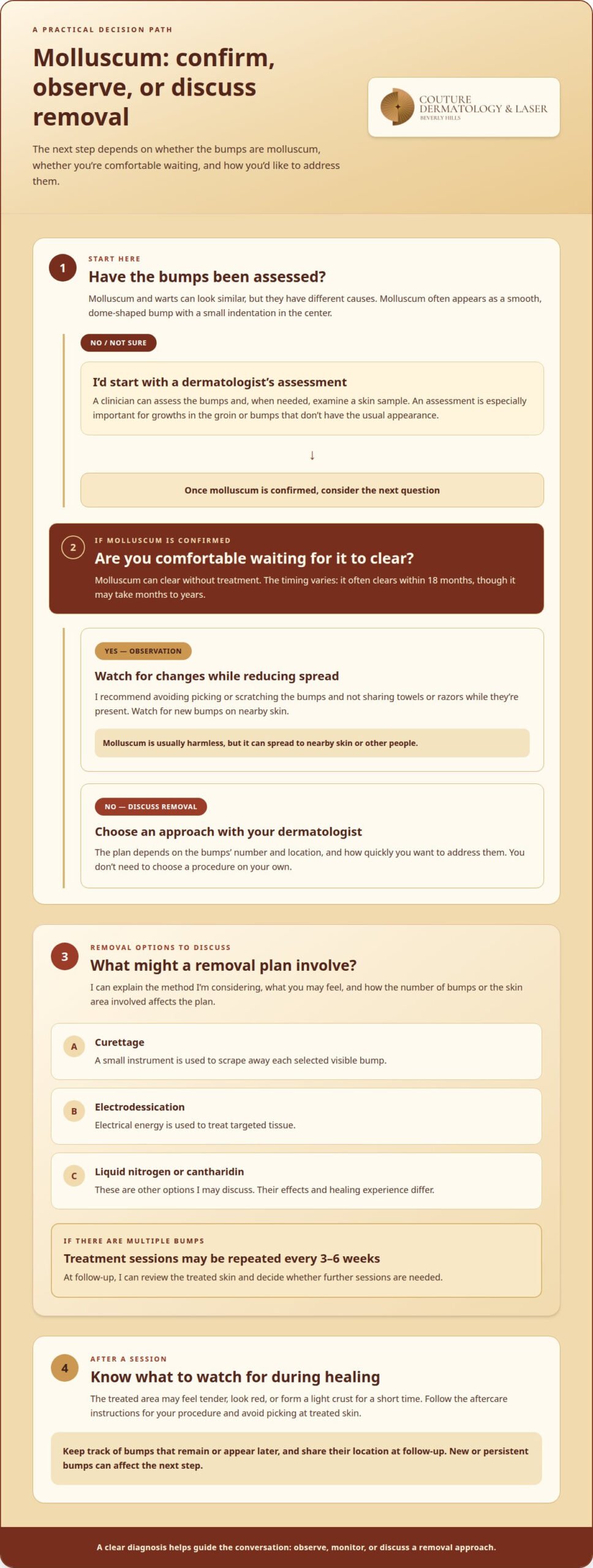
I can help you distinguish molluscum from look-alike growths and discuss removal approaches that may be considered. Molluscum can also clear without treatment, often within 18 months, though it may take months to years. The right path depends on the diagnosis, the bumps’ location and number, and how quickly you want to address them.
Key Takeaways
- In my practice, I distinguish molluscum from warts and other growths by assessing the bumps and, when needed, examining a skin sample.
- I use curettage to remove bumps with a small scraping tool; when there are multiple growths, I may repeat treatment sessions every 3-6 weeks.
- I also discuss liquid nitrogen and cantharidin as removal options, since their effects and healing experience differ.
- I see adult bumps appear in the groin, so I recommend a dermatologist’s assessment if growths develop in that area.
- If you choose to wait for natural clearance, I recommend avoiding picking or scratching the bumps and watching for new growths on nearby skin.
What Are Warts and Molluscum Contagiosum?
I see patients who find it difficult to tell a smooth bump from a wart by appearance alone. Molluscum contagiosum is caused by a poxvirus; warts are caused by human papillomavirus, or HPV. Because the growths can look similar, I can assess them and help identify the cause and appropriate care.
In my practice, molluscum bumps often look smooth, dome-shaped, and flesh-colored or pearly. Many have a small indentation in the center and measure two to five millimeters. They may appear anywhere, including warm, damp areas such as the armpits, groin, behind the knees, and arm creases. I look at their shape and location to help guide diagnosis.
The virus spreads through direct skin contact and contact with contaminated personal items. Sharing a towel or razor can expose another person, while scratching a bump can spread the virus to nearby skin. I also see adults develop molluscum, including in areas touched during intimate contact. The bumps are benign and don’t affect internal organs.
To reduce the chance of spreading molluscum, I advise you to avoid picking or scratching the bumps and not to share towels, razors, or other personal items. These precautions matter at home and during close contact. Treatment may help address visible bumps, but avoid touching them to limit spread to nearby skin or other people. Warts can also spread through contact, though they have a different cause.
Insurance coverage depends on your plan and its terms. In my experience, treatment cost can depend on the number and location of bumps, the assessment needed, and the removal method. There is no single cost for every case.
Before I assess you, keep the bumps visible and avoid scratching or picking them. Tell me where new bumps have appeared and whether any are in a sensitive area. After treatment, skin may feel tender, look red, or form a light crust for a short time. Follow the aftercare instructions for your procedure.
Molluscum can clear without treatment, but this may take months to years. If you notice new bumps after removal, avoid picking them and arrange a dermatology assessment. I can monitor changes with dermatologist-guided follow-up, since molluscum and warts can recur. I can also assess a growth that doesn’t have the usual appearance.
Molluscum bumps can measure 1-6 mm, and the condition rarely causes symptoms. In my practice, I explain that it is benign and does not affect internal organs. Growths may appear anywhere on the skin, but warm, damp areas, including the armpits, behind the knees, the crooks of the arms, and the groin, are common locations. Molluscum and warts can both spread through contact to nearby skin or to other people. Treating molluscum contagiosum can help prevent growths from spreading to other parts of your body and to other people. Genital warts have a different cause: certain strains of human papillomavirus (HPV). Because the causes differ, I can help identify whether a growth is molluscum or a wart and guide decisions about care.
Curettage and electrodesiccation
If molluscum bumps need removal, I may consider curettage or electrodessication. Curettage uses a small instrument to scrape away a visible growth; electrodessication uses electrical energy to treat targeted tissue. The appropriate method depends on the lesions (the bumps on your skin) and the treatment plan, not the procedure name alone.
Before treatment, I assess the bumps and their locations. This helps me determine which areas to address and whether more than one session may be needed. Molluscum procedures can cause discomfort, so I encourage you to discuss your concerns before treatment begins. Mention any sensitive areas when we review the plan.
With curettage, I use a small instrument on each selected bump. Electrodessication applies energy to targeted tissue. These methods differ, and I can explain which one I plan to use and what you may feel. You can also ask how my approach accounts for the number of visible growths and the skin area involved.
How is the treatment plan chosen?
I start with the bumps that are present and the areas they affect. For adults with multiple molluscum growths, I may repeat treatment sessions every 3-6 weeks until the growths disappear. That interval lets me review the treated skin and decide whether further sessions are needed. New or persistent bumps can affect the plan for your next visit.
Before your visit, consider any concerns about discomfort or the area being treated. You don’t need to choose a procedure on your own. Ask me why a particular method may suit your lesions and what the planned steps and follow-up involve.
What happens after a session?
After molluscum treatment, the area may be tender, red, or slightly crusted for a short time. I’ll give you aftercare instructions for your procedure; avoid picking at treated skin. Many people return to normal daily activities shortly afterward. If you’re unsure whether a change is part of healing, ask me.
Keep track of any bumps that remain or appear after treatment, and share their location with me at follow-up. Molluscum may spread to nearby skin, so avoid scratching while the area heals. If you’re considering an assessment to discuss removal and follow-up, you can book an appointment with me.
I may treat molluscum contagiosum with liquid nitrogen, acids, blistering solutions, electrocautery (using an electrical instrument to treat targeted tissue), curettage, or laser therapy. I can discuss which option fits your lesions and treatment goals.
Natural course and time to clearance
Molluscum can resolve without treatment, but clearance is gradual. In my practice, I see bumps disappear over several months for many people; for others, they may persist for months to years. For most people, the skin clears without treatment, usually within 18 months. That timeframe describes a typical course, not a date I can use to predict when an individual bump will fade.
Observation may be an option when the diagnosis is clear and you’re comfortable monitoring the bumps. The tradeoff is that visible spots (lesions) may remain while your body clears the infection, and they can spread to nearby skin or other people. Avoid scratching or picking them, and don’t share towels or razors while bumps remain.
In children, the body clears the infection within 6 to 9 months in many cases. That figure describes children, not a specific clearance timeline for adults. Molluscum most often affects children ages 1 to 10, but adults can develop it too. The presence of bumps in adulthood doesn’t, on its own, tell you how long they’ll last.
For adults, a practical first step is to track changes without disturbing the skin. Note where bumps appear and whether new ones develop near existing spots. A few bumps and a cluster across several areas can raise different practical concerns, particularly if contact could spread them. Share your observations during a dermatology assessment.
Consider an assessment if the bumps are spreading, causing concern, or difficult to leave alone. I can discuss whether removal or another therapy suits the diagnosis and location. Treatment addresses visible growths, but natural clearance can take time. Ask what follow-up is appropriate if additional bumps appear.
A bump that remains visible doesn’t necessarily mean the infection will persist indefinitely. Natural resolution can take months, and spots may clear at different times. Avoid sharing personal items or picking at the skin during this period. If the appearance changes or you’re unsure the diagnosis is molluscum, arrange an assessment rather than trying to remove the bumps yourself.
Choose between observation and treatment by weighing the time involved against the bumps’ number, location, and spread. If you wait, monitor for new bumps and limit direct contact with them. If you pursue removal, ask about healing and follow-up. I can reassess persistent or recurring bumps and help tailor the next step.
Molluscum contagiosum in adults
Adult molluscum can raise questions about privacy, partners, and whether a bump needs attention. In our Los Angeles, CA clinic, we see patients who aren’t sure how to describe an intimate concern, and you can use whatever words feel comfortable. Tell us what prompted you to seek care; you don’t need to arrive with a self-diagnosis. Your observations give us a useful starting point for an assessment.
Seek medical care if a lesion appears on genital skin or you’re unsure what a growth is. Our team can assess whether it’s molluscum or another condition, including genital warts. That distinction matters when we discuss treatment options. If talking about an intimate concern feels difficult, say so at the start and ask what the examination will involve.
Before your appointment, note any diagnosis or treatment you’ve already received for the concern. Bring the names of products or procedures you tried and describe how your skin responded. In our experience, this context helps us understand what’s already been considered instead of relying on memory alone. It can also keep our conversation focused on your next decision.
Some adults feel anxious about what a diagnosis might mean for a relationship. We encourage you to separate the medical assessment from assumptions about a partner or when an infection began. Ask our providers to explain the diagnosis and what it can and cannot tell you. A direct conversation can address your questions without turning uncertainty into blame.
If you’re considering removal, explain what matters most to you. You may be concerned about a sensitive treatment area, discomfort, or how the skin will look as it heals. Sharing these priorities helps us discuss a procedure in terms of your situation. You can also ask about follow-up before deciding how to proceed.
Arrange an assessment if genital lesions appear, the diagnosis is uncertain, or a previous evaluation no longer addresses your concerns. We can review the current skin issue rather than assume it matches an earlier one. If you’ve noticed a change since your last assessment, describe what changed and when you first observed it.
Bring your questions, details of prior treatment, and the concerns you most want addressed. At Couture Dermatology & Laser Beverly Hills, we help adults seeking molluscum contagiosum removal for adults beverly hills clarify the diagnosis before choosing a next step. Ask us about observation, removal, and follow-up in the same conversation, then decide with a clearer understanding of your options.
How effective are curettage, cryotherapy, and cantharidin for molluscum removal?
These three in-office options remove or treat visible molluscum bumps in different ways. Curettage scrapes away a growth with a small instrument. Cryotherapy uses liquid nitrogen to freeze it. Cantharidin creates controlled blistering that helps the bump come off as the skin heals. In my practice, I see patients whose best option depends partly on the number and location of their lesions (individual bumps).
With curettage, I treat each visible bump directly. The procedure can cause discomfort, and adults with multiple growths may need repeat sessions every 3-6 weeks until the bumps disappear. This makes the approach precise, but the number of bumps can affect how many visits are needed. I can explain the plan for the areas being treated.
Cryotherapy applies liquid nitrogen to freeze the bumps. You may feel a brief stinging sensation during application. Molluscum cryosurgery typically requires repeat treatment every 2 to 3 weeks until the bumps clear. The interval and number of visits differ from curettage, so ask how the schedule fits the bumps’ location and response.
Cantharidin works differently: it causes a controlled blister that helps remove the treated bump. It is FDA approved to treat adults and children 2 years of age and older with molluscum contagiosum. Blisters will likely appear within 24 to 48 hours. The bumps usually clear as the skin heals within 2 weeks, and most patients need at least 2 in-office treatments.
Those timelines describe different parts of treatment, not a direct ranking. Cantharidin’s healing period refers to treated bumps, while cryotherapy’s 2 to 3 weeks describes the repeat-treatment interval. Curettage sessions for adults with multiple bumps may be spaced 3-6 weeks apart. I weigh the number and placement of bumps, along with your tolerance for discomfort, when discussing options.
After these procedures, the treated area may be tender, red, or slightly crusted for a short time. Many people return to normal daily activities shortly after treatment. Follow the aftercare instructions for your method and don’t pick at healing skin. If a new bump appears, note its location for follow-up.
Effectiveness also depends on what happens beyond the treated spots. Removal addresses visible growths, but bumps can spread to nearby skin and may recur. Avoid scratching bumps or sharing towels and razors while they remain. Follow-up with a dermatologist can help monitor healing and identify additional growths that may need attention.
If you’re weighing these options, I can assess which approach fits your bumps and what follow-up may involve. Book an appointment to discuss molluscum removal options with a dermatologist.
Couture Dermatology & Laser Beverly Hills: Laser Hair Removal
At Couture Dermatology & Laser in Beverly Hills, I assess persistent or changing bumps and discuss what you’re noticing. Laser hair removal is a separate service, not a treatment for molluscum. I can evaluate the growths and talk through an appropriate next step based on their appearance, location, and spread.
Consider an evaluation if you’re unsure whether bumps are molluscum, notice new lesions, or have growths in the groin. I can help you weigh observation against removal and understand follow-up. You don’t need to choose a procedure before discussing what you’re seeing and what matters most to you.
If you’d like my guidance on your skin concern, contact Couture Dermatology & Laser Beverly Hills.
Choose a Clear Next Step for Your Skin
If you’re considering molluscum contagiosum removal as an adult in Beverly Hills, you may be wondering whether to monitor the bumps or explore care. In my practice, I start by asking what you’ve noticed and what matters most to you. That focused conversation can help you consider your options.
At Couture Dermatology & Laser in Beverly Hills, I can help you think through a next step. Our practice also offers Laser Resurfacing, Laser & Light-Based Treatments, and Botox for separate skin and aesthetic concerns. Each service has its own purpose, so we can keep your care conversation focused on why you came in.
You don’t have to settle on an approach before speaking with a dermatologist. Contact Couture Dermatology & Laser Beverly Hills to discuss your concern and possible next steps. A thoughtful conversation can help you move forward with greater clarity and confidence.
Frequently Asked Questions
How long does treatment take?
In my practice, the length of a treatment visit depends on the method and area being addressed. The appointment itself is different from the time your skin takes to heal or the overall time until all bumps clear. I encourage you to ask your clinician to explain each part separately: what happens during the visit, what to expect afterward, and whether follow-up is part of your care plan.
What is molluscum contagiosum and how does it spread in adults?
Molluscum contagiosum is a skin infection caused by a poxvirus. In adults, I see it spread through close skin contact or contact with shared personal items. A diagnosis does not, by itself, establish when or from whom the infection came. If you’re worried about what it means for a relationship, I recommend asking a clinician to explain what the diagnosis can and cannot tell you.
What are the treatment options for adult molluscum contagiosum?
In my practice, options include clinician-performed procedures such as curettage, cryotherapy, and cantharidin, as well as therapies applied to the skin. During a consultation, ask which options are appropriate for the area and what the plan involves if new bumps appear later. This keeps the discussion focused on your priorities and helps clarify the reasoning behind the recommended approach.
Which dermatologists or clinics in Beverly Hills treat adult molluscum contagiosum?
Couture Dermatology & Laser provides medical dermatology care in Beverly Hills, serving the Los Angeles area. At our clinic, you can discuss an assessment for suspected molluscum and ask how I’ll distinguish it from other growths. Bring any questions about privacy, examination, or treatment planning; discussing these concerns at the start can make the visit more focused and comfortable.
How can adults prevent molluscum from spreading to partners or other parts of the body?
Limit direct contact with affected skin and avoid sharing personal items that touch it. If you have a partner, a calm conversation can explain that you’re seeking medical guidance without making assumptions about when the infection began. I encourage you to ask your clinician what precautions fit the location of your bumps and your circumstances, especially if you’re unsure how to approach close contact.