
Last week, a patient in my Beverly Hills office shared a frustration I hear daily. She’d spent a fortune on serums, yet her makeup still clung to rough patches and stubborn spots. If you’re wondering how to improve skin texture and tone when your current routine has plateaued, you’re in the right place. In my practice at Couture Dermatology & Laser, I see so many people who feel defeated by “orange peel” texture or hyperpigmentation (dark spots) that just won’t fade. It’s frustrating when you do the work but don’t see the glow.
We can agree that a radiant complexion shouldn’t require a thick layer of foundation to look even. I’m going to share the clinical protocols and advanced treatments we use to transform rough, uneven skin into a smooth, light-reflective surface. This isn’t about generic advice. And we’ll dive into the specific ways we tailor treatments like laser skin resurfacing to your unique needs. You’ll finish this guide with a clear understanding of which professional investments are actually worth it for your skin’s long-term health and vibrancy.
Key Takeaways
- Distinguish between physical topography and color distribution to choose the right clinical path for your unique complexion.
- Master the daily protocol on how to improve skin texture and tone by maintaining your skin’s protective barrier with specific low-pH steps.
- Recognize when topical products have reached their limit and why professional laser skin resurfacing is often the best path to deep refinement.
- Discover why precision and safe laser settings are vital for treating melanated skin without the risk of post-inflammatory hyperpigmentation (dark spots).
- And understand why a bespoke, tailored approach is the only way to achieve a truly radiant, light-reflective complexion that doesn’t rely on heavy foundation.
What Is Actually Happening Beneath the Surface of Your Skin?
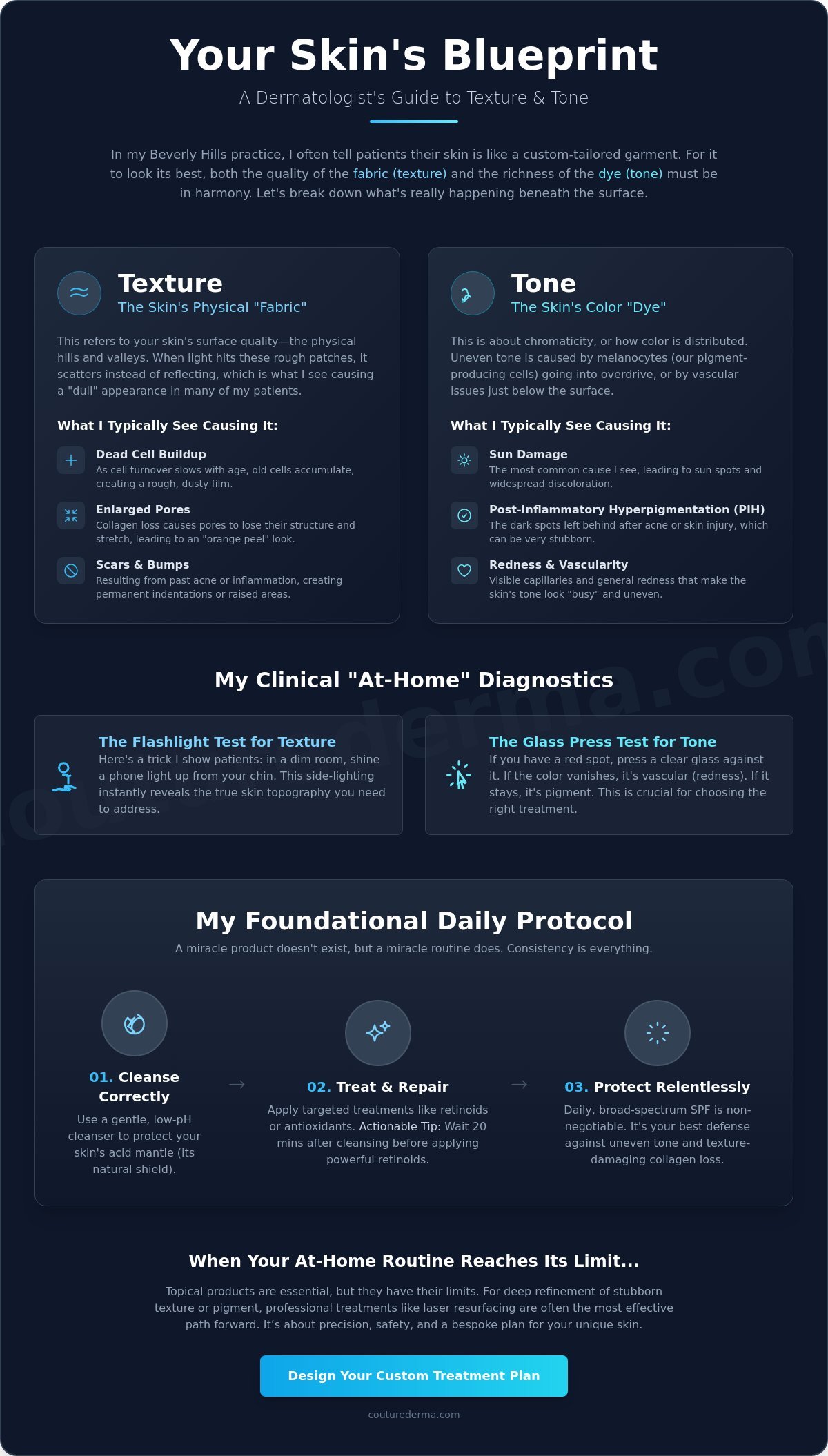
Think of your skin as a custom-tailored garment. To look its best, both the quality of the fabric and the richness of the dye must be in perfect harmony. When patients ask me how to improve skin texture and tone, they’re often frustrated because they’ve treated these as separate problems. In my practice, I view them as a unified canvas. Texture refers to the physical topography, the hills and valleys of your face, while tone is the chromaticity or the way color is distributed across that surface.
To better understand this concept, watch this helpful video:
The secret to that “lit from within” glow isn’t actually a specific cream. It’s physics. Radiant skin is simply a surface that is smooth enough to reflect light evenly. When your skin is rough or bumpy, light hits those imperfections and scatters, creating tiny shadows that make the complexion look dull. Try this: stand in a dimly lit room and hold a flashlight near your chin, pointing upward. This “side-lighting” will reveal the true topography of your skin, showing you exactly where texture issues are hiding.
The clinical reality is that our skin’s ability to stay smooth changes over time. When we’re young, our skin cells turn over rapidly, shedding dead layers to reveal fresh ones. As we age, this process slows down significantly. This lag leads to a buildup of old cells that act like a dusty film over a window. For more on the basics of maintenance, you can check out this comprehensive guide to skin care.
The Anatomy of Texture: Pores, Bumps, and Scars
In my practice, I find that texture is primarily about the structural integrity of the outer layer of skin. When excess sebum (skin oil) mixes with dead skin cells, it creates microcomedones. These are tiny, invisible clogs that eventually turn into the bumps you feel when you wash your face. But it’s not just about oil. As we lose collagen, the protein that gives skin its bounce, our pores lose their “scaffolding.” Without that support, pores stretch out and begin to look like an orange peel. Actionable tip: wait 20 minutes after cleansing before examining your pores; this allows your skin to settle so you can see if the texture is due to oil or a loss of firmness.
The Science of Tone: Melanin and Vascularity
Tone is a bit more complex because it involves both pigment and blood flow. Your melanocytes (cells that produce skin pigment) are like tiny, overprotective guards. When they sense “danger” from the sun or an injury, they pump out extra pigment to protect the area. This results in post-inflammatory hyperpigmentation (PIH), which are the dark spots left behind after a breakout. Here’s a quick tip: if you have a red spot, press a clear glass against it. If the color disappears, it’s a vascular issue (redness). If the color stays, it’s likely pigment-based. Knowing the difference is the first step in choosing the right professional treatment.
And then there is melasma. This is a specific type of pigment issue that is often triggered by hormones and heat rather than just sun damage. It’s much more stubborn than a standard sun spot. When you add in general redness or visible veins, the skin tone starts to look “busy” and uneven. We have to calm the vascularity while simultaneously gently lifting the excess pigment to achieve that bespoke, refined look my patients in Beverly Hills expect. It’s about creating a harmonious, quiet background so your natural features can shine.
The Daily Protocol: My Essential Steps for Lasting Refinement
Let’s talk about the skincare graveyard. I see patients who bring in bags of half-used bottles, each promising a miracle cure for their complexion. But here is the reality: a $500 cream won’t fix your skin if your foundation isn’t solid. Consistency is the real secret behind how to improve skin texture and tone. A miracle product doesn’t exist, but a miracle routine does.
It starts with your wash. You must use a low-pH cleanser to maintain your acid mantle (the skin’s protective barrier). This thin, acidic film keeps bacteria out and moisture in. If you use a harsh, “squeaky clean” soap, you’re stripping that barrier. This leads to the very redness and rough patches you’re trying to fix. Actionable tip: Use a dedicated Vitamin C serum every morning to neutralize free radicals (unstable molecules from pollution and sun) that break down your collagen.
Retinoids are the gold standard for refinement in my practice. But they can be tricky if you’re impatient. I tell all my patients to wait 20 minutes after cleansing before applying tretinoin or retinol. If your skin is even slightly damp, the product absorbs too quickly and causes unnecessary irritation. This simple pause can be the difference between a radiant glow and a peeling mess.
The Evening Refinement: Retinoids and Exfoliation
Skip the physical scrubs with walnut shells or beads. They often create micro-tears in the outer layer of skin. I prefer chemical exfoliants like AHAs (alpha hydroxy acids) or BHAs (beta hydroxy acids) because they dissolve the “glue” holding dead cells together. If your skin is sensitive, try the sandwich method. Apply a thin layer of moisturizer, then your retinoid, then another layer of moisturizer. It doesn’t make the product less effective; it just makes the process more comfortable. But remember, more is not better. Over-exfoliation actually ruins your skin texture by causing chronic inflammation.
The Morning Shield: Protection and Brightening
SPF is your ultimate tone-correcting product. Pigment simply cannot fade if the sun keeps hitting it. I see patients in Beverly Hills who skip sunscreen on cloudy days; this is the #1 mistake you can make. UV rays penetrate clouds and glass, keeping your dark spots active. Niacinamide is another morning powerhouse. It helps in shrinking the appearance of pores and calming redness. If you’ve followed a solid routine for twelve weeks and still feel like you’ve plateaued, it might be time for a professional assessment. You can book a tailored consultation to see if your current protocol needs a clinical upgrade.
Professional Refinement: When Over-the-Counter Options Reach Their Limit
I often see patients who have hit a wall with their home care. You’ve been diligent with your retinoids and Vitamin C, but those deep-set pores or stubborn patches of pigment just won’t budge. This is what I call the topical plateau. It happens because even the most potent over-the-counter creams can only penetrate so far into the outer layer of skin. To truly understand The Art of Skin Rejuvenation: A Couture Guide to Treatments, we have to look deeper. This is the moment where we move from daily maintenance to clinical transformation.
In our practice, we use professional procedures to trigger the body’s natural healing response. We call this “controlled injury.” By creating microscopic channels of heat or physical stimulation, we signal your fibroblasts (the cells responsible for producing collagen and elastin) to get back to work. One of my favorite tools for this is the Fotona laser. It’s a signature technology that allows us to treat multiple layers of the skin in a single session, addressing both deep structural issues and surface-level imperfections. This multi-dimensional approach is a game-changer for those wondering how to improve skin texture and tone when creams aren’t enough.
Which Laser Is Right for My Skin?
When it comes to laser treatment, I generally categorize them into two groups: ablative and non-ablative. Ablative lasers are more intensive; they remove the thin outer layer of skin to reveal the fresh, smooth tissue underneath. Non-ablative lasers are gentler, heating the tissue without removing it to stimulate collagen. For patients with deep scarring or significant texture issues, we often turn to fractional lasers. These target specific microscopic areas while leaving the surrounding skin intact. This “bridge” of healthy tissue allows for much faster healing and less downtime. For a deeper look at these technologies, you can explore The Couture Guide to Laser Skin Resurfacing.
Should I Choose a Chemical Peel or Microneedling?
Let’s be honest, an at-home “peeling” solution is usually just a mild exfoliant. A medical-grade chemical peel, however, uses concentrated acids to reach the deeper layers where pigment lives. It’s a precise, clinical process. If your concern is more about “hills and valleys” like acne scars, I often recommend Microneedling with Radiofrequency (RF). This combines traditional needling with heat energy to tighten the skin from the inside out. It’s a powerful way to learn how to improve skin texture and tone by restructuring the skin’s foundation. Actionable tip: I suggest scheduling these more intensive treatments in the autumn or winter. In Beverly Hills, the sun is a constant factor; reducing your exposure after a laser session is vital for preventing new pigment from forming.
Specialized Care for Diverse Tones and Stubborn Concerns
In my practice, I see patients who have been told that certain lasers or peels aren’t safe for them because of their skin color. This is a misconception that I work hard to correct. When we discuss how to improve skin texture and tone for melanated skin, the priority is always safety and precision. Darker skin has more active melanocytes (cells that produce skin pigment). This means it’s more prone to post-inflammatory hyperpigmentation (dark spots caused by irritation). If a practitioner uses settings that are too aggressive, they risk causing the very discoloration the patient wants to fix.
Safe laser settings are far more important than “strong” settings for deeper tones. We often use a “low and slow” approach. This allows us to achieve beautiful results without triggering a defensive pigment response. Texture issues from old breakouts also require a specific kind of expertise. You can’t simply scrub away a pitted scar; these require structural changes beneath the surface. For my patients in Beverly Hills, I often recommend a combination of subcision (breaking up scar tissue under the skin) and tailored laser treatment. You can find more details on our specific approach to Acne Scar Refinement here.
The Melasma Challenge: A Long-Term Strategy
Let’s be honest: melasma is a marathon, not a sprint. It’s a complex condition triggered by hormones and, surprisingly, heat. Many people think only the sun is the enemy. But even the heat from a sauna or a hot kitchen can flare up those stubborn brown patches. In my practice, I use “cool” lasers that target pigment without overheating the surrounding tissue. I also frequently incorporate tranexamic acid (a medication that slows down pigment production) to help stabilize the skin. It requires constant maintenance and a very gentle touch. Actionable tip: If you struggle with melasma, look for a tinted sunscreen containing iron oxides. These provide an extra layer of protection against visible light, which we now know can worsen pigment issues more than UV rays alone.
Under-Eye Brightening and Texture
The skin under your eyes is incredibly thin and delicate. It’s often the first place where people notice a “crepey” texture or dark shadows that make them look tired. Sometimes that darkness isn’t just pigment; it’s a hollow look that creates a shadow. Addressing Under-Eye Brightening might involve specialized lasers to thicken the skin or precisely placed dermal fillers to smooth out the area. Actionable tip: To test if your under-eye circles are pigment or shadows, look into a mirror and tilt your head up toward the light. If the darkness disappears, it’s a shadow caused by texture or volume loss, not actual skin pigment.
If you are ready for a plan that respects the unique needs of your skin tone, you can schedule your bespoke consultation with our team today. We specialize in creating high-detail, customized journeys for every skin type.
Designing Your Custom Fit: The Couture Dermatology Experience
I often tell my patients that skin rejuvenation is much like high-end dressmaking. You wouldn’t expect a bespoke suit to fit perfectly right off the rack; your skin deserves that same level of meticulous attention. When you search for how to improve skin texture and tone, you’ll find plenty of generic lists. But in my practice, we understand that your skin’s history, from Beverly Hills sun exposure to your genetic blueprint, requires a custom fit. A one-size-fits-all approach fails because it ignores the subtle nuances of your specific biology.
In our practice, we view the clinical experience as a collaborative, transformative journey rather than a series of isolated appointments. We start by listening to your frustrations, whether it’s makeup that won’t sit flat or spots that refuse to fade. Finding the answer to how to improve skin texture and tone isn’t about finding one miracle laser; it’s about designing a sequence of treatments that respect your skin’s biological rhythm. We adjust the plan as your skin evolves, ensuring the “fabric” of your complexion remains resilient and radiant.
The Power of Professional Assessment
Next Steps for Your Transformation
Preparing for your first visit at our Beverly Hills clinic is simple. I want to see the real you, so come with a clean face if possible. Actionable tip: Bring your current skincare products, or at least a clear list of them, to your consultation for a routine audit. I often find that patients are using products that actually work against each other, causing the very texture issues they want to fix. We’ll strip away the fluff and keep only what serves your goals. Or, we might find that your current routine has simply reached its limit and requires a clinical upgrade. If you’re ready to move beyond the topical plateau, you can book a consultation with Dr. Abisogun to begin your personalized journey. Your skin is your most permanent garment; it deserves to be custom-fit.
Your Journey to a Refined, Radiant Complexion
Achieving a smooth, even complexion is a meticulous process that balances daily discipline with clinical precision. We’ve explored how understanding the topography of your skin and the science of pigment allows you to move beyond generic advice. Whether you’re managing the plateau of a home routine or seeking specialized care for diverse skin tones, the path to refinement is always personal. Learning how to improve skin texture and tone is really about understanding that your skin is a unified canvas that deserves a custom fit.
In my practice, I combine my Harvard-trained expertise with a deep commitment to treating all skin types and tones with the highest level of care. We don’t believe in hurried, artificial solutions; we believe in gradual, beautiful transformations that last. If you’re ready to stop guessing and start a collaborative journey in the heart of Beverly Hills, I invite you to take the next step. You can begin your transformative skin journey at Couture Dermatology today. Let’s work together to reveal the most vibrant, confident version of your skin.
Common Questions About Skin Refinement
How long does it take to see improvements in skin texture?
You’ll typically see surface-level smoothing within 4 to 6 weeks. This matches your skin’s natural renewal cycle. But deep structural changes take longer. If we’re using laser treatment to build collagen, the real results often appear between 3 and 6 months after your session. It’s a gradual progression, not a hurried task. Your skin needs time to weave those new fibers into a stronger, smoother foundation.
Can I improve skin tone and texture without professional treatments?
You can certainly make significant progress at home with a disciplined routine. Using retinoids and chemical exfoliants will help you understand how to improve skin texture and tone on a surface level. But let’s be honest. Topical creams have a limit. They can’t reach the deeper layers of skin to fix pitted scars or intense sun damage. That is when a tailored clinical intervention becomes necessary to reach your ultimate goal.
What is the best laser for improving skin texture on deeper skin tones?
In my practice, I often recommend non-ablative fractional lasers or the Fotona system for patients with deeper skin tones. These technologies allow us to treat the tissue without overheating the outer layer of skin. This reduces the risk of post-inflammatory hyperpigmentation (dark spots). It’s all about the precision of the settings rather than the strength of the beam. We prioritize safety to ensure your results are both refined and harmonious.
Will drinking more water actually improve my skin texture?
Drinking water is excellent for your overall health, but it won’t magically fix rough texture or large pores. Hydration happens from the inside, but “orange peel” texture is usually a structural issue caused by collagen loss or sun damage. You’ll see much better results by focusing on topical humectants like Hyaluronic Acid. These ingredients pull moisture into the outer layer of skin where it can actually smooth out fine lines and surface bumps.
Is it possible to shrink my pores permanently?
You can’t actually change the physical size of your pores permanently. Their size is largely determined by your genetics and oil production. However, you can make them look significantly smaller by keeping them clear of debris. When pores are clogged or the surrounding skin loses its “scaffolding” (collagen), they appear much larger. Professional laser skin resurfacing can tighten that surrounding tissue, giving your skin a much more refined, airbrushed appearance.
What should I do if my skin texture gets worse after starting a new routine?
If you see new bumps or redness, you might be experiencing a “purge” or simple irritation. This often happens when you start a potent retinoid or acid. Here’s the thing: you should scale back your application to twice a week until your barrier recovers. If the texture doesn’t improve after three weeks, it’s likely a reaction to a specific ingredient. Don’t push through pain. Your skin’s protective barrier is its most important asset.
Can I treat both hyperpigmentation and rough texture at the same time?
Yes, treating both concerns simultaneously is actually the most effective way to see a total transformation. We often use combination protocols that target melanocytes (cells that produce skin pigment) while also smoothing the physical surface. This is a core part of how to improve skin texture and tone in a single, cohesive journey. By layering different technologies, we create a light-reflective surface that looks vibrant and even without the need for heavy foundation. For those interested in how professional hair and styling can further enhance this aesthetic transformation, click here.
How often should I get a professional skin treatment in Beverly Hills?
Most of my patients find that a maintenance treatment every 3 to 4 months keeps their skin in peak condition. If we’re working on a specific issue like deep acne scars, you might need a series of 3 to 5 sessions spaced closer together. In our Beverly Hills practice, we design a 12-month skin calendar for you. This ensures your treatments are timed perfectly with the seasons and your skin’s natural evolution.