
You’ve worked hard to lose weight, but now your cheeks look hollow in photos. Many people feel proud of their progress and surprised by these facial changes. If you’re considering filler for weight loss face gauntness, the right approach depends on your features and what you’d like to restore.
It’s understandable to want a more rested, balanced appearance without losing the definition you’ve gained. Hyaluronic acid fillers, Radiesse, and Sculptra offer different options, and in my practice, I tailor the discussion to your facial changes, weight stability, and goals.
This guide explains how injectable options work, which areas may be treated, and when to consider treatment after reaching a weight-loss goal. You’ll also learn what filler for weight loss face gauntness may address and what to consider before deciding.
Key Takeaways
- Match the filler approach to the pattern of volume loss and whether you want an immediate change or gradual improvement.
- Consider hyaluronic acid fillers when targeted, adjustable volume is the goal; the right placement matters as much as the product.
- Let your weight settle before planning a lasting facial-volume strategy, since continued weight changes can affect the result.
- Radiesse and Sculptra work differently from hyaluronic acid fillers, so compare their approach to structural support and collagen stimulation.
- Filler can restore volume, but it does not correct substantial loose skin or replace a surgical lift.
Which filler is best for facial volume loss after weight loss?
There isn’t one best filler for every gaunt face. Hyaluronic acid fillers, Radiesse, and Sculptra restore facial volume in different ways, so the choice depends on your features, treatment areas, and goals.
Causes and Appearance of Facial Hollowness
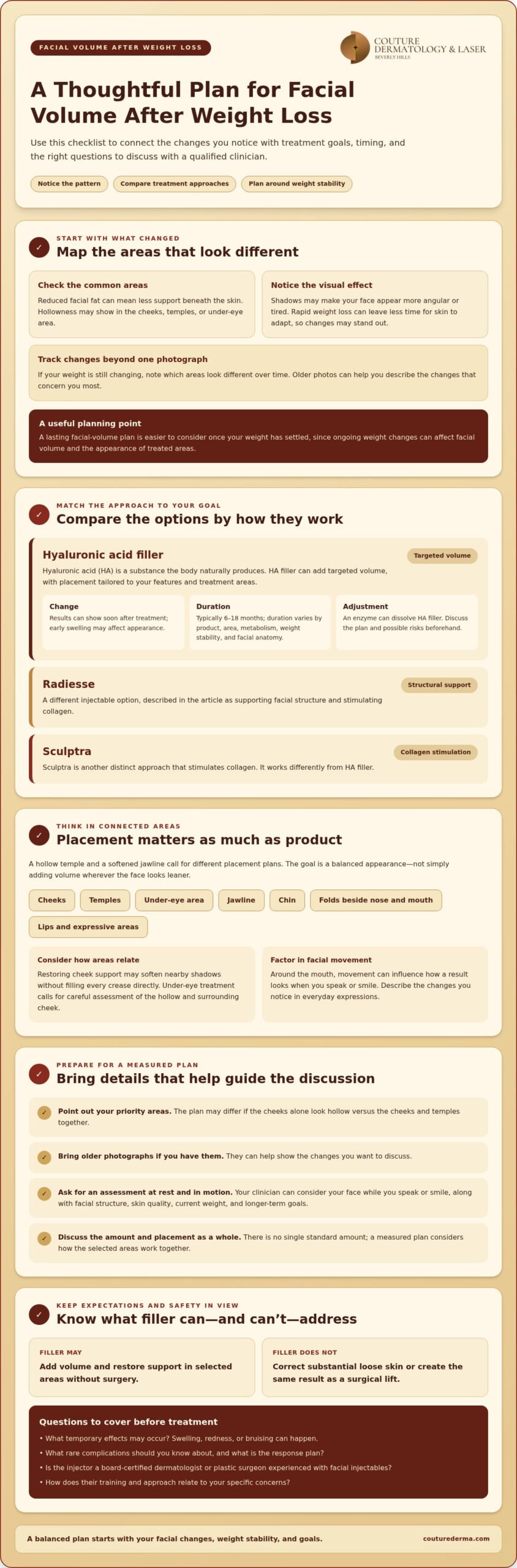
Facial hollowness after weight loss can happen when reduced facial fat leaves less support beneath the skin. Cheeks, temples, and under-eye areas may look hollow, with shadows making the face appear more angular or tired. Rapid weight loss can leave less time for skin to adapt, so these changes may stand out.
Semaglutide is a once-weekly injectable medicine approved by the FDA for type 2 diabetes and obesity. GLP-1 medicines don’t directly damage the face; weight loss can reduce facial fat and reveal hollows. If your weight is still changing, track which areas look different instead of choosing treatment from one photograph.
Hyaluronic Acid Fillers for Volume Restoration
Hyaluronic acid (HA) fillers add volume using a substance the body naturally produces. Restylane is one example. A clinician may place HA filler in the cheeks, temples, under-eye area, or jawline, depending on where support has decreased. Results typically last 6-18 months, and an enzyme can dissolve HA filler.
Hyaluronic acid filler may suit someone seeking targeted volume and a visible change soon after treatment. A dermatologist assesses your facial features, discusses placement, and explains the plan. Results can show immediately, though swelling may affect the early appearance. Temporary swelling, redness, or bruising can occur; rare complications are also possible, so discuss the risks and response plan beforehand.
Fillers Compared With Fat Transfer and Facelift
Fillers add volume without surgery. Fat transfer uses your own fat, often taken from the abdomen, and places it in hollow facial areas. A facelift addresses sagging, jowls, and loose neck skin more directly. Fillers may soften mild looseness by restoring support, but they can’t create the same result as a facelift.
To choose a qualified, board-certified injector, meaning the clinician who gives the injections, look for a board-certified dermatologist or plastic surgeon experienced with facial injectables. Ask about their training, approach to your specific concerns, and how they handle complications.
Typical Filler Amounts for Facial Volume Loss
There isn’t one standard amount for weight-loss-related facial volume loss. The plan depends on how many areas look hollow, your facial structure, skin quality, current weight, and long-term goals. Treating the cheeks alone differs from addressing the cheeks and temples together.
A measured plan can help avoid adding too much volume in one area or too little in another. Bring older photographs if available, and point out the changes that concern you most. Your dermatologist can assess your face at rest and while you speak or smile, then discuss placement in relation to your overall facial balance.
Hyaluronic acid fillers for cheeks, jawline, folds, lips, and expressive areas
Hyaluronic acid fillers can restore selected areas of facial volume after weight loss, with placement tailored to your features. The goal is a balanced appearance, not simply adding volume wherever the face looks leaner.
Where can facial fat loss show, and which areas may be treated?
Facial fat loss can reduce support in the cheeks, temples, and under-eye area, changing how light and shadow fall across your face. Dermal & Lip Fillers may be placed in areas such as the cheeks, temples, jawline, chin, or folds beside the nose and mouth. Choosing areas matters because a hollow temple and a softened jawline call for different placement plans.
For example, restoring cheek support may soften nearby shadows without filling every crease directly. Under-eye treatment also calls for careful assessment of the hollow and surrounding cheek. If jawline definition is your main concern, you can explore jawline contouring as a related treatment area.
How long do fillers last in the cheeks and temples?
Hyaluronic acid fillers typically last 6-18 months, including in facial areas such as the cheeks and temples. The exact duration varies with the product, treatment area, metabolism, weight stability, and facial anatomy. That range helps set expectations, but it doesn’t mean every person will need a touch-up on the same schedule.
Results can appear immediately, while swelling may temporarily affect the final appearance. Keep a record of your treatment date and note changes as swelling settles; this gives you a clearer comparison over time. If your weight is still changing, that can also affect facial volume and the appearance of treated areas.
Restylane and Juvederm are examples of hyaluronic acid filler brands. Different formulas can be selected for specific areas and goals, such as adding cheek support or softening a fold. The treatment plan should consider how the cheeks, temples, and jawline relate to one another, rather than treating each area as a separate feature.
Lips and expressive areas need a different touch from the cheeks. Movement around the mouth can influence how a result looks when you speak or smile, so describe which changes you notice in everyday expressions. Bring a photo that shows the facial appearance you’re hoping to restore, then discuss how it compares with your current features.
ONDA Coolwaves is a separate treatment category, not an injectable hyaluronic acid filler. Its treatment areas, session duration, and fees aren’t interchangeable with a filler plan, which focuses on placing volume in selected facial areas. For facial hollowness after significant weight loss, keep the discussion centered on the areas where volume has changed and the type of result you’re seeking.
Timing filler treatment after reaching a weight-loss goal
If your weight is still changing, your facial contours may change with it. Treatment timing matters because a filler plan should reflect your current facial volume, weight stability, and whether hollowness or loose skin is the main concern.
Why wait after reaching your goal?
After reaching a weight-loss goal, allowing time for your body to stabilize can help you plan facial filler. This pause can make it easier to see which areas remain hollow once weight changes have settled. For example, cheek volume may look different during active weight loss than it does after your weight has stabilized.
Rapid weight loss can outpace the skin’s ability to adapt, contributing to a looser or more sagging appearance. During a consultation, consider how long your weight has been stable, which facial areas concern you, and whether your goal is to soften hollows or address laxity. These details help shape a plan around your present features, not a temporary stage.
What if you’re still losing weight?
If you’re still losing weight, a conservative filler plan can address a specific concern while leaving room for later adjustments. Continued changes in facial fat may alter cheek or jawline contours, so extensive correction during active weight loss can be harder to plan around. The aim is to avoid treating a moving target as though it were your settled result.
Track your weight trend and take a clear facial photograph in consistent lighting before a consultation. Bring it along with examples of the changes you notice, such as deeper cheek hollows or a softer jawline. If weight loss continues, you can reassess the treatment plan after stabilization rather than trying to anticipate every future change at once.
What can fillers address, and where are the limits?
Fillers restore volume and may improve the appearance of mild facial laxity by adding support. They don’t truly tighten loose skin, and they can’t fully correct significant sagging, jowls, or loose neck skin. If loose skin is the central concern, adding volume alone may not create the change you’re seeking.
Skin texture and looseness are also different concerns from facial volume loss. A consultation can separate them: identify whether hollows, uneven texture, or laxity is most noticeable, then discuss which concern a filler plan can address. For substantial excess skin after a 100-pound loss, a surgical opinion may be more appropriate than relying on non-surgical treatment alone.
Radiesse for structural support and collagen stimulation
Radiesse and Sculptra are volumizing fillers that may suit different facial goals. Understanding their distinct roles can help you discuss facial volume, contour, and gradual collagen support more clearly.
Radiesse for Structural Support
Radiesse may be considered when restoring facial structure and supporting contours is a priority. After weight loss, reduced facial fat can make areas such as the cheeks look less supported, changing the balance between neighboring features. A treatment plan focuses on where support has changed, rather than adding volume across the entire face.
In a consultation, describe which contour looks different to you, such as a flatter cheek or a less defined transition between cheek and jaw. Radiesse is one named volumizing filler, but the product choice depends on the facial area and the desired effect. Avoid assuming that every hollow needs the same filler or placement.
Biostimulatory Fillers and Collagen Stimulation
Some injectable treatments encourage the body’s collagen production, rather than relying only on immediate added volume. Collagen supports skin and contributes to a firm, plump appearance. This gradual approach may appeal if you prefer change to develop over time, instead of expecting the full effect at the appointment.
Sculptra is made from poly-L-lactic acid and stimulates natural collagen production. Improvements may develop over 4-12 weeks, and results often take three to six months after injection to reach their final form. Most patients receiving Sculptra have two to three sessions spaced over several months, so it involves a series rather than a single treatment visit.
Age-Related Collagen and Elastin Loss
Collagen declines with age, and reduced support can contribute to looser, sagging, or wrinkled skin. Weight-related facial fat loss can add another change: hollows may become more visible as underlying volume decreases. These processes can overlap, but restoring facial volume and addressing skin laxity are different treatment goals.
Elastin helps skin stretch and return toward its resting shape, while collagen provides structural support. When you assess facial changes, consider both the contour and the skin’s firmness. For example, a hollow cheek may call for a volume-focused discussion, while loose skin may need a different approach. A gradual collagen-building plan like Sculptra also requires patience while changes develop over several months.
Sculptra’s poly-L-lactic acid and collagen stimulation
Sculptra is an injectable made with poly-L-lactic acid, which stimulates your body’s collagen production. It may suit facial volume loss when you prefer gradual change rather than relying only on immediate added volume. The FDA approves Sculptra for facial volume loss and improving overall skin quality.
How does Sculptra build results over time?
After injection, Sculptra works by encouraging collagen production, so visible improvement develops progressively. Some patients notice changes within several weeks, while results often reach their final form three to six months after injection. That timeline matters if you’re hoping for a quick change before a specific event.
Most patients have two to three treatment sessions spaced over several months. Sculptra’s effects last 24 months on average, though results vary with the person and treatment plan. Ask how the session schedule fits your goals, and plan around the gradual process rather than expecting a one-visit transformation.
What should you expect after an injection?
Mild swelling, redness, or bruising at injection sites typically settles without intervention in a few days. After Sculptra injections, avoid strenuous exercise and alcohol for 24 hours. Patients are also instructed to massage treated areas at home for a few days following treatment, according to their aftercare directions.
Before treatment, tell your dermatologist which facial areas look hollow and what kind of change you want. That conversation helps shape a plan around your facial structure, rather than treating every area of volume loss alike. Keep the gradual timeline in mind when deciding whether a collagen-stimulating option matches your preferences.
How does Sculptra compare with hyaluronic acid fillers?
Hyaluronic acid dermal fillers add volume using a substance naturally found in the body. Brands such as Restylane and Juvederm offer options for targeted facial areas, and results are often visible immediately. A key distinction is reversibility: hyaluronic acid filler can be dissolved with an enzyme, while Sculptra’s collagen-building process is not reversed that way.
That difference can guide your discussion. If adjustability is especially important to you, ask about hyaluronic acid; if gradual collagen stimulation appeals, discuss Sculptra’s series of injections. Neither approach replaces surgery for significant sagging or loose skin. A treatment plan should match the concern, whether it’s a hollow cheek, broad facial volume loss, or skin laxity.
If you’re considering Sculptra or another injectable for post-weight-loss facial changes, book an appointment to discuss your treatment goals.
Couture Dermatology & Laser Beverly Hills: Laser Skin Resurfacing
Couture Dermatology & Laser in Beverly Hills offers Dermal & Lip Fillers for patients exploring options for facial volume loss after weight loss. If hollowness is your main concern, a conversation about filler can focus on the areas where support has changed and the kind of result you hope to achieve.
Laser Skin Resurfacing addresses a different aesthetic concern; it doesn’t replace volume lost beneath the skin. During a consultation, you can discuss whether fillers fit your facial goals and whether another concern should be considered separately. The distinction helps keep your plan focused rather than expecting one approach to address every change.
To discuss facial volume concerns and possible filler options, contact Couture Dermatology & Laser in Beverly Hills.
Choose a next step that feels right for you
Choosing filler for weight loss face gauntness is about more than selecting a product. Start by naming the change you hope to see and what you want your face to continue looking like. That gives your discussion a personal focus, rather than making the decision about a trend or a brand name.
For a consultation, write down your priorities and questions about timing, follow-up, and how the approach fits your goals. A thoughtful conversation can help clarify whether filler for weight loss face gauntness aligns with the result you’re seeking. You don’t need to rush the decision.
Schedule a conversation with Couture Dermatology & Laser Beverly Hills to discuss your goals and explore a considered next step.
Frequently Asked Questions
What Is “Ozempic Face” and Why Does It Happen?
“Ozempic face” is a casual term for facial hollowness or a leaner appearance after weight loss, not direct facial damage caused by Ozempic. Rapid weight loss can reduce facial fat, making cheeks or temples look more hollow and shadows more noticeable. The same change can follow weight loss from other causes. If you notice a sudden change, compare photos taken in similar lighting before deciding which areas concern you.
Why does your face look thinner after weight loss?
Your face can look thinner because weight loss may reduce fat beneath the skin, including in the cheeks, temples, and under-eye area. That fat helps support facial contours, so its reduction can make hollows or creases stand out. Skin may also have less time to adapt during rapid weight loss. Look at your face in natural, even lighting, since strong overhead light can exaggerate shadows.
Which treatments restore facial volume?
Hyaluronic acid fillers add volume directly, while Radiesse and Sculptra offer different approaches to facial support and collagen stimulation. The right option depends on the area being treated and whether you prefer immediate volume or gradual change. Fillers address volume, not substantial loose skin. In Los Angeles, a useful consultation should distinguish hollowness from laxity before choosing an injectable approach.
Is dermal filler reversible if I do not like the result?
Hyaluronic acid filler can be dissolved with an enzyme, which offers an adjustment option if the result needs correction. That does not mean every filler works the same way: Sculptra stimulates collagen and cannot be dissolved in the same manner. Before treatment, ask which filler type is planned and what correction options apply to that specific product and area.
Should you wait until you hit your goal weight?
If you’re still losing weight, your facial contours may continue to change, making a final volume plan harder to judge. A conservative approach during weight loss can leave room to reassess after your weight stabilizes. After reaching your goal, allowing time for stabilization can help clarify which hollows remain. Track changes with occasional photos taken from the same angle and in similar lighting.
What Is Sculptra?
Sculptra is an injectable made with poly-L-lactic acid, which stimulates the body’s collagen production. Its effects develop gradually rather than appearing as immediate added volume. Most patients have two to three sessions spaced over several months, and results often reach their final form three to six months after injection. It may suit someone comfortable with a staged process and gradual visible change.
What dermal fillers are used to restore facial volume after weight loss?
Hyaluronic acid fillers include products such as Restylane and Juvederm; Radiesse and Sculptra are other volumizing options. They differ in how they support volume and whether their effects develop immediately or gradually. Product selection also depends on the facial area and your goals. Ask the injector to explain why a particular filler fits the area being treated, rather than choosing by brand name alone.
Which facial areas can fillers treat for a gaunt appearance?
Areas considered for facial volume restoration include the cheeks, temples, under-eye hollows, jawline, chin, lips, and folds beside the nose and mouth. Not every area needs treatment, and placement should reflect how your features relate to one another. For example, cheek support may influence the appearance of nearby shadows. Point out the areas that bother you most when discussing a plan.