
You’re getting dressed when a small bump catches on your necklace, and you start wondering what it is. You may hear the term acrochordons and wonder whether it simply means skin tags or signals something more.
That uncertainty is understandable. Here’s what the terminology means and what a clinician may examine before discussing next steps.
Learn how these growths may look, how they’re assessed, and when removal may be worth discussing, so you can approach the concern with clearer questions.
Key Takeaways
- Learn what a typical skin tag can look and feel like, and where it commonly appears.
- Understand why a clinician may examine an unusual growth before deciding whether a biopsy is needed.
- See how skin tags may relate to diabetes and other metabolic risk factors, without treating one tag as a diagnosis.
- Compare professional removal options and why at-home cutting or freezing can create avoidable risks.
- Get familiar with the medical terms used for skin tags so descriptions of them are easier to understand.
When should I consider skin tag removal?
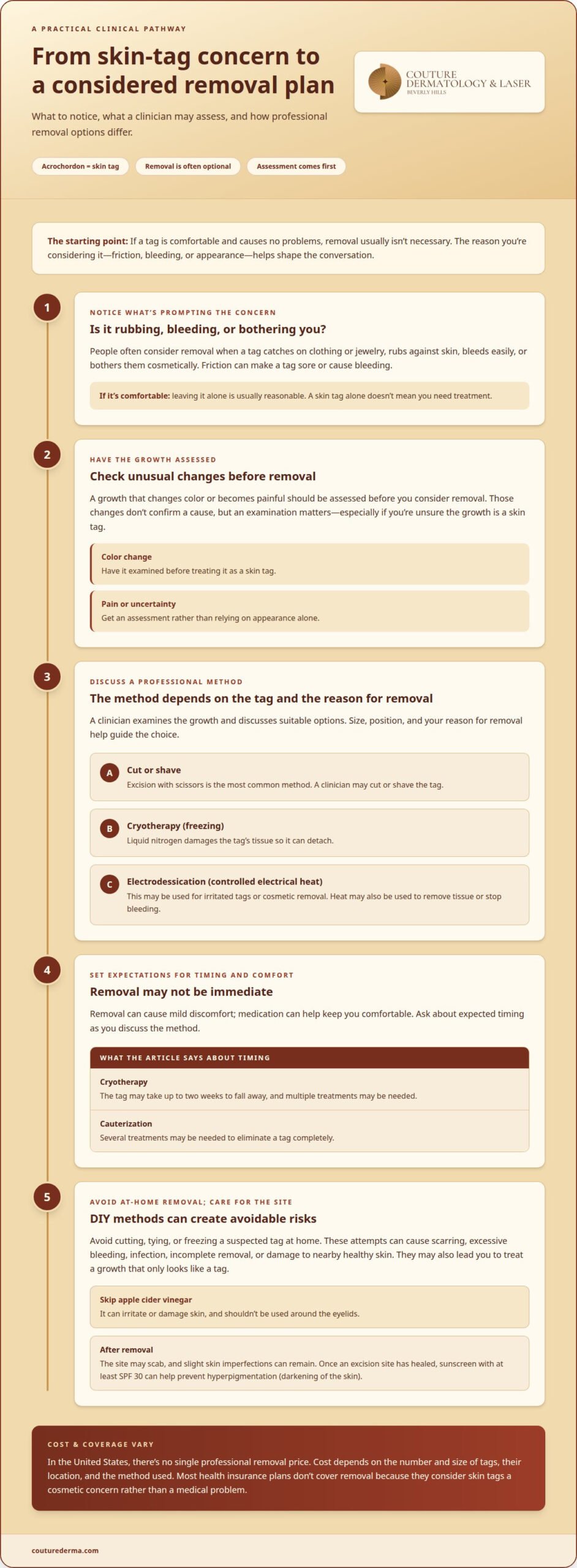
People often consider removal when a tag catches on clothing, rubs against jewelry, bleeds easily, or bothers them cosmetically. If it’s comfortable and causes no problems, removal usually isn’t necessary. The reason for concern matters: friction, bleeding, and appearance can lead to different discussions.
If a growth changes color or becomes painful, have it assessed before considering removal. Those changes don’t confirm a cause, but they make examination important. An assessment is also worthwhile if you’re unsure it’s a skin tag, rather than treating it based on appearance alone.
In the United States, there’s no single professional removal price. Cost depends on factors such as the number and size of tags, their location, and the method used. Most health insurance plans don’t cover removal because they consider skin tags a cosmetic concern rather than a medical problem.
At an office visit, a clinician examines the growth and discusses suitable methods. They may cut or shave it, freeze it with liquid nitrogen, or use heat to remove tissue or stop bleeding. Excision with scissors is the most common method. Removal can cause mild discomfort, and medication can help keep you comfortable.
Freezing is called cryotherapy. Liquid nitrogen damages the tag’s tissue so it can detach. It may take up to two weeks after cryotherapy for the tag to fall away, and multiple treatments may be needed. Ask about the expected timing beforehand, since removal may not be immediate.
Another professional option is electrodessication, which uses controlled electrical heat. It may be used for irritated tags or cosmetic removal. Cauterization may require several treatments to eliminate a tag completely. The clinician considers the tag’s size, position, and reason for removal when choosing an approach.
Avoid cutting, tying, or freezing a suspected tag at home. These attempts can cause scarring, excessive bleeding, infection, incomplete removal, or damage to nearby healthy skin. They can also lead you to treat a growth that only looks like a tag. Cutting one yourself can cause bleeding and potential infection.
Apple cider vinegar can irritate or damage skin, and it shouldn’t be used around the eyelids. After removal, the site may scab, and slight skin imperfections can remain. Once an excision site has healed, sunscreen with at least SPF 30 can help prevent hyperpigmentation, or darkening of the skin.
What are skin tags?
Skin tags are common, benign skin growths. The National Library of Medicine describes acrochordons as common and benign. Acrochordon is the medical term for a skin tag, the name most people use. Knowing they’re the same growth can help when the medical term appears in notes.
Common Locations and Risk Factors
I often assess tags in areas where skin folds or rubs together. Common locations include the armpits, neck, eyelids, groin, thighs, genitals, and skin beneath the breasts. Friction from clothing, jewelry, or skin rubbing against itself can irritate a growth and sometimes cause discomfort or bleeding.
Age, family history, diabetes, obesity, pregnancy, and certain skin disorders are associated with skin tags. Their frequency increases through the fifth decade of life, and risk rises after age 40. I ask about changes such as weight gain or pregnancy because tags may appear around those times, though timing alone doesn’t establish a cause.
Researchers estimate that half of adults develop at least one skin tag during their lifetime. Another estimate reports acrochordons in 46% of the general population. Frequency tends to increase with age, reaching as many as 59% of people by age 70. These figures describe populations, not an individual’s health or diagnosis.
Possible Metabolic Associations
Multiple tags have been associated with insulin resistance, when the body responds less effectively to insulin. A cross-sectional study assessed 98 adult patients and 103 controls; multiple tags were strongly associated with insulin resistance, regardless of other risk factors. I use this as a reason to discuss health context, not as evidence that tags diagnose a metabolic condition.
Skin tags are also more prevalent in people with diabetes and insulin resistance. One study reported type 2 diabetes or impaired glucose tolerance in 40.6% of participants with tags. That result doesn’t mean you have diabetes because you have a tag. I consider the broader clinical picture and encourage you to raise relevant health concerns.
Researchers have also studied insulin-like growth factor, a substance involved in cell growth. One study included 30 nondiabetic people and 30 control subjects. This work examines a possible role; it doesn’t show that the factor caused any one person’s tags.
Harm, Contagion, and Health Significance
Skin tags are benign and noncancerous, and they can’t turn into skin cancer. They aren’t contagious, so touching one doesn’t spread it to another person. Friction may still make a tag sore or cause bleeding, especially where clothing or jewelry rubs.
A skin tag alone doesn’t mean you have a disease or need treatment. If you have multiple tags alongside diabetes or obesity, mention that pattern during a clinical visit. Some studies have explored possible links with cardiovascular disease, but a tag doesn’t establish that risk. Your overall health deserves its own assessment.
Definition and appearance of acrochordons
A skin tag is a small, soft growth attached to the skin, sometimes by a narrow stalk. It may be flesh-colored or darker than nearby skin. Shape and shade can vary, so appearance alone can’t confirm what a growth is.
Most measure about 2-5 mm across. Smaller ones may measure 1-2 mm in both width and height, making them easy to miss until a collar, necklace, or other piece of jewelry catches one. A group can also look different from a single tag.
Location offers another useful clue. Skin tags commonly appear in folds where skin rubs, including the armpits, neck, groin, thighs, eyelids, and beneath the breasts. They can also occur on the genitals. A tag in a fold may become irritated by clothing or repeated movement.
Some growths hang from a stalk, while others sit closer to the skin’s surface. Larger pedunculated tags, meaning growths attached by a narrow base, may measure 2-5 cm and occur on the lower trunk. In rare cases, a skin tag can grow to 18 cm, so size alone doesn’t settle its identity.
Color can range from close to your natural skin tone to brown or another darker shade. A tag may look smooth or slightly wrinkled, and friction can irritate its surface. Note the site and appearance, such as a small, brown growth beneath a necklace, rather than relying on color alone.
Although people sometimes describe a skin tag as a soft polyp, that comparison describes its shape, not a diagnosis. Skin tags are distinct from growths inside the colon. Research has not supported an association between skin tags and colonic polyps, so one should not be taken as evidence of the other.
Skin tags vary in size. Most remain small, but a larger growth may extend beyond the surrounding skin. If you’re tracking one, record where it sits and whether its shape, color, or surface changes. Those details can make a clinical assessment more useful.
And remember, a familiar location or typical appearance doesn’t prove that every similar bump is a skin tag. A clinician can assess the growth before considering excision, which means removing tissue. That distinction matters when a growth looks unusual or differs from other tags you’ve noticed.
Diagnosis and biopsy
A dermatologist can often identify a skin tag through a brief examination. If you’re concerned about a growth, describe changes in its color, shape, or feel, and have it assessed before removal.
Diagnosis and Similar-Looking Growths
During a dermatology visit, the clinician examines the growth’s surface, attachment, color, and location. A typical soft tag in a skin fold may be recognized by its appearance. But other growths can resemble skin tags, so appearance alone isn’t a safe basis for self-diagnosis.
Tell the clinician if the spot is unusually firm, discolored, multicolored, raw, or bleeding. A growth that changes rapidly or becomes painful also needs evaluation. In a study of 1,335 clinically diagnosed skin tags, four were basal cell carcinomas and one was squamous cell carcinoma. That finding supports assessment when a growth looks atypical.
Biopsy and Dermatologist Removal
A biopsy means taking tissue for laboratory examination. If an examination raises concern about another condition, a clinician can send a sample to a lab. This can help distinguish a skin tag from a growth requiring a different diagnosis, rather than relying on appearance alone.
Once a clinician identifies a growth as a skin tag, removal can be considered for irritation, bleeding, or cosmetic concerns. Professional methods include snipping or shaving the growth, freezing it with liquid nitrogen, or using heat. The clinician selects an approach based on the growth’s appearance and location.
Removal and diagnosis are separate decisions. A tag can be assessed without being removed, and a biopsy isn’t needed for every typical-looking tag. If a sample is sent to a lab, ask how the result will be shared and what follow-up is appropriate.
Before an appointment, note when you first noticed the growth and whether it has changed. For example, record new bleeding, tenderness, or a change from one color to several. These details help the clinician assess the concern and decide whether examination alone is sufficient.
Medical history can add context, but it doesn’t identify a growth by itself. Mention conditions such as diabetes and relevant changes such as pregnancy or weight gain. Those details may help frame the discussion, while the growth’s physical features guide its assessment.
Don’t try to confirm a diagnosis by cutting, freezing, or applying a home remedy. That can injure nearby skin and leave tissue unavailable for assessment. If a growth looks different from your other tags, arrange an examination before attempting removal.
Acrochordon terminology and synonyms
Acrochordon is the medical term for a skin tag; acrochordons is the plural form. “Skin tag” is the familiar everyday name. If you see either term in a medical note, both refer to the same kind of growth, not separate diagnoses.
The wording can vary with context. You might tell a clinician, “I have a skin tag,” while a chart describes an “acrochordon.” Neither label, by itself, explains whether the growth needs removal. A clinician considers its appearance, location, and symptoms before recommending an approach.
Some descriptions are broader than these names. “Skin growth” or “lesion” may refer to many different spots, not just a skin tag. A note calling something a growth hasn’t necessarily identified it as an acrochordon. That distinction matters when you’re reading a result or preparing for an appointment.
“Polyp” can also cause confusion. People may use it informally to describe a small growth, but a skin tag and a colon polyp aren’t interchangeable terms. Research hasn’t supported an association between skin tags and colonic polyps. Here, the body location changes what the word means.
Removal terms describe a procedure, not another name for the growth. Excision means cutting tissue away. For example, a clinician may use scissors to remove a skin tag. Cryotherapy means freezing it, while heat-based removal uses controlled heat.
These distinctions can make a treatment discussion easier to follow. If someone says a tag is “irritated,” that describes its condition, not its medical name. A collar rubbing your neck or jewelry catching a growth can explain irritation without changing the diagnosis.
Terminology can also help you describe what you’ve noticed. Name the location, such as your eyelid or armpit, and say whether clothing catches it. Mention changes in color, tenderness, or bleeding. Those observations are more useful than trying to assign a medical label yourself.
A biopsy is different from both a diagnosis term and a removal method. It means tissue is sent to a laboratory for examination when another condition is suspected. A typical skin tag may be diagnosed by examination alone, while a biopsy addresses uncertainty about what the growth is.
The practical takeaway: “skin tag” and “acrochordon” name the same growth, while broader words like “lesion” don’t confirm that diagnosis. If your paperwork uses a general term, ask what the clinician observed and whether follow-up is needed. Understanding the vocabulary can help you have a clearer conversation about your skin.
Couture Dermatology & Laser Beverly Hills: Laser Skin Resurfacing
Couture Dermatology & Laser Beverly Hills offers Laser Skin Resurfacing for skin concerns distinct from diagnosing or removing a skin tag. If you’re unsure what a growth is, or it has changed, Medical Dermatology is the more relevant next step than resurfacing. A clinician can assess the spot and discuss appropriate care; removal decisions depend on what the growth is and why it’s bothering you.
Once a skin tag has been assessed, you can also discuss separate concerns about skin texture or appearance. Laser Skin Resurfacing is not a skin-tag removal method. The right conversation starts with your reason for seeking care and the specific skin concern you want addressed.
For questions about your skin, contact Couture Dermatology & Laser Beverly Hills or visit couturederma.com.
Make your next skin decision with clarity
A skin concern doesn’t need to become urgent to deserve thoughtful attention. If you’re still uncertain about acrochordons or what you’ve noticed on your skin, note what you want addressed and bring that question to a Medical Dermatology visit. A focused conversation can help you decide what matters now and what can wait.
You can also use that visit to distinguish a medical concern from an aesthetic goal. Couture Dermatology & Laser Beverly Hills offers Medical Dermatology Treatments alongside aesthetic services for other needs. Start by describing the change you’ve noticed and the outcome you hope to discuss.
Choose a time to discuss your skin concern, and take the next step at a pace that feels right for you.
Frequently Asked Questions
Do acrochordons need treatment?
Most skin tags don’t need treatment if they’ve been assessed and cause no discomfort. Removal may be worth discussing if a tag repeatedly catches on a seatbelt, shaving tool, or clothing, or bothers you cosmetically. The decision can take its location, irritation, and your reason for removal into account. Avoid home removal, especially if you’re unsure what the growth is.
What symptoms can a skin tag cause?
Most skin tags cause no symptoms. Friction from a bra strap, necklace, or waistband can make one sore or lead to bleeding. Twisting a growth around its stalk can also cause pain. Notice what triggers discomfort and where it happens, then share those details during an assessment. That context can help guide a discussion about whether removal is appropriate.
What else should I know about skin tags?
Removing one tag doesn’t prevent new ones from appearing elsewhere. A completely removed tag is unlikely to return in the same spot, though new tags can develop. Some may fall off on their own. There isn’t a reliable way to prevent them, but you can reduce repeated rubbing where practical, such as by adjusting jewelry that catches on a growth.
Will I need tests?
Usually, a clinician can assess a suspected skin tag through examination without ordering tests. If the growth suggests another condition, a tissue sample may be sent to a laboratory. This biopsy helps identify the growth; it isn’t routine for every tag. Before an appointment, note any changes and bring details of earlier assessments or test results.
What are skin tags, and what do they look like?
Skin tags are soft growths that may hang from a narrow stalk. They can be close to your natural skin tone or darker, and their size and shape vary. A photograph can’t confirm what a new growth is. If a bump looks different from ones you’ve had assessed before, describe its appearance and location rather than assuming it has the same cause.
What causes acrochordons, and who may develop them?
The exact cause of an individual skin tag isn’t established. Skin tags are associated with increasing age, family history, diabetes, obesity, pregnancy, and repeated friction. Weight gain or pregnancy may happen around the time tags appear, but timing alone doesn’t prove a cause. If you have several tags alongside concerns about metabolic health, mention both during a medical visit.
When should you see a doctor about a skin tag?
Arrange an assessment if a growth changes quickly, becomes painful, changes color, or bleeds without an obvious cause. It also deserves attention if it feels unusually firm, looks multicolored, or has a raw surface. These features don’t identify the cause by themselves. An examination can help determine what the growth is before you consider removal or apply a home treatment.
What are the risks, discomfort, healing time, and scarring after removal?
Removal may cause discomfort, bleeding, infection, or a small scar. After excision, a scab usually falls off within three to five days, though slight skin imperfections may remain. After cryotherapy, a tag may take up to two weeks to detach. Once an excision site has healed, sunscreen with at least SPF 30 can help reduce the chance of hyperpigmentation.