
You may feel confident in your shape overall and still notice that the curve between your hips and thighs doesn’t match the contour you want. If you’re considering Sculptra for hip dips in Los Angeles, it helps to understand that the change develops gradually as your body builds collagen. In my practice, I see patients ask whether that gradual approach fits their goals, a personalized consultation can help you decide.
Before discussing a treatment plan, start with the kind of change you hope to see. Sculptra for hip dips involves gradual contour development rather than an immediate, finished result. Your anatomy and aesthetic goals guide the plan, including what a measured change may look like for you.
This article explains how collagen stimulation may affect hip contour, how changes develop, and what to consider after treatment. You’ll also find guidance to help you decide whether this approach aligns with your goals.
Key Takeaways
- Sculptra supports gradual contour changes by stimulating your body’s collagen production rather than creating an immediate, finished result.
- Successive sessions allow the treatment plan to be tailored to your hip shape and desired degree of fullness.
- Knowing what to expect as results develop can help you plan around the gradual timeline.
- Aftercare matters: understand the activity guidance and possible short-term swelling or bruising before treatment.
- Sculptra can add volume to hip dips and the buttocks without surgery, but the approach is best suited to goals that align with gradual change.
Gradual results and successive treatments
Sculptra builds contour gradually, so changes develop over time rather than appearing all at once. During a consultation, I ask what you’d like to refine and how subtle you want the change to feel. In my practice, I see patients considering Sculptra for hip dips in Los Angeles, and this conversation helps connect the treatment plan with your proportions and priorities.
Treatment Benefits and Expected Results
The goal may be to soften the inward curve at the sides of your hips and create a smoother transition toward your thighs and buttocks. Describe the contour you want, not just a desire for more volume. For example, you might want the indentation to look less noticeable while keeping your overall silhouette familiar.
Defining that goal helps clarify what a successful result means to you. In my consultations, I consider how your hips relate to surrounding curves and what degree of change fits your preferences. A gradual approach may suit you if you favor refinement over a dramatic shift, but it takes patience as the result develops.
Results Timeline and Longevity
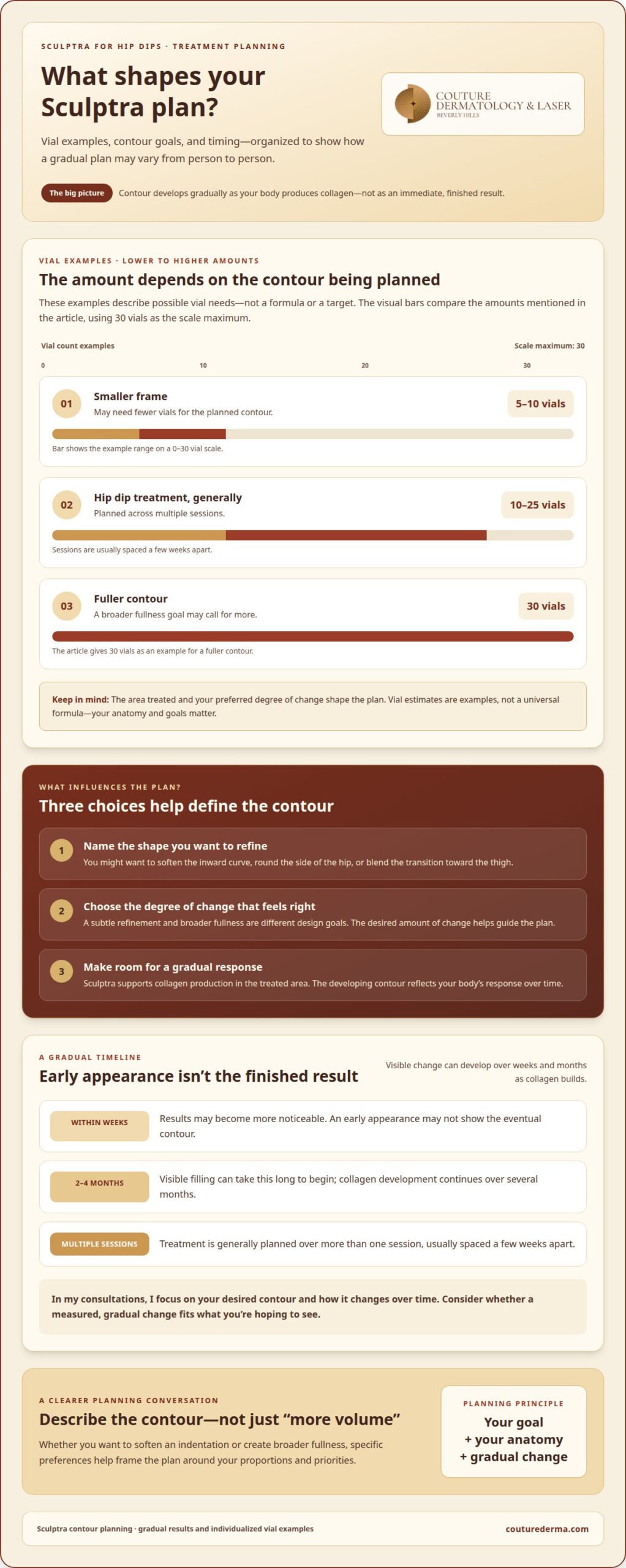
Results may become more noticeable within a few weeks, while visible filling can take 2 to 4 months to begin. I advise patients to consider the timeline before judging an early change, since collagen development continues over several months. An initial appearance doesn’t necessarily show how your contour will look as the process progresses.
How long results last can vary, so it isn’t a personal touch-up schedule. In my consultations, I focus on your desired contour and how it changes over time. If you’re considering Sculptra for hip dips in Los Angeles, discuss what you’d consider a meaningful improvement before planning future refinement.
Treatment Sessions and Vial Needs
Hip dip treatment generally uses 10 to 25 vials across multiple sessions, usually spaced a few weeks apart. Smaller frames may need 5 to 10 vials, while a fuller contour may call for 30 vials. These examples aren’t a universal formula. The area treated and your preferred degree of change shape the plan.
Discuss treatment planning in terms of your desired contour, rather than treating a vial estimate as a goal in itself. If you’re considering Sculptra for hip dips in Los Angeles, explain whether you want to soften the indentation or create broader fullness. That distinction helps frame a personalized plan and gives you a clearer basis for discussing progress.
How Sculptra stimulates collagen
Sculptra is an injectable made with poly-L-lactic acid, a lab-made material that breaks down in the body and supports collagen production in the treated area over time. In my consultations, I explain that this process is different from adding volume all at once. It encourages your body to build support gradually, so the change develops as your body responds.
How Does Poly-L-Lactic Acid Stimulate Collagen?
Poly-L-lactic acid acts as a collagen biostimulator, encouraging your body to produce collagen in the treated area. Collagen is a structural protein that helps support skin and underlying tissue. Sculptra’s intended contour change develops through your body’s response, rather than coming only from the injectable’s initial presence.
This distinction can help set realistic expectations. The treated area may look different at first than it does as collagen develops. Focus on the planned contour and the gradual process, rather than treating an early appearance as the final result.
How Does Biostimulation Support Collagen Production?
A biostimulator supports your body’s own collagen production. With Sculptra, this response unfolds over the following months, allowing the treated contour to change progressively. In my practice, I connect that gradual process to the patient’s specific goal, such as softening an indentation or creating a more blended transition along the outer hip.
The material supports a process, but it doesn’t determine an exact amount of fullness or a fixed shape. The treatment area, existing tissue, and desired aesthetic all inform the plan. Softening a visible dip, for example, is a different design goal from adding broader fullness across the buttocks.
Describe the change you want in concrete terms. You might want to soften the dip, round the side curve, or blend the transition into the thigh more smoothly. These details turn “more volume” into a clearer conversation about proportion and shape.
Collagen develops over time, so consider progress across the treatment process. A gradual response may suit someone who prefers measured contour changes over surgery. If immediate, substantial volume is your priority, discuss that preference before choosing an approach.
If you’d like to explore whether collagen stimulation aligns with your goals, book an appointment to discuss the contour you want and the approach that may suit it.
Los Angeles clinic location and consultation
When you’re considering Sculptra for your hips, you may be wondering whether it can create the contour you want. In my practice, I discuss your anatomy, medical history, and comfort with gradual cosmetic change before we decide whether this approach may suit you.
I see patients who want subtle fullness that develops over time and feel comfortable with a gradual injectable approach. But if you’re looking for an immediate, dramatic change, prefer implants, or feel uneasy about injections, Sculptra may not fit your priorities. Your health history and the treatment area also help guide the conversation.
Before booking, ask how I assess your hip shape, what treatment plan I recommend, and how we’ll review progress between sessions. Ask what changes to expect, what recovery may involve, and which symptoms should prompt follow-up. Those answers can help you understand the process before deciding.
During a body assessment, I look at the indentation’s location, the surrounding curves, and how your hips relate to your thighs and buttocks. A subtle change along the outer hip, for example, calls for a different aesthetic goal than broader volume through the buttocks. Tell me what you’d like to look different in clothing and in profile.
Bring a clear description of your desired result to the consultation. “Soften the dip without changing my overall shape” is more useful than “make my hips bigger.” If you bring reference images, explain which feature appeals to you, such as a smoother side curve, another person’s proportions aren’t a template.
If you’re visiting our Beverly Hills clinic in the Los Angeles area, consider how location affects your plans. Account for travel, appointment time, and the possibility of successive sessions. And if you’re commuting across the city, ask how the proposed schedule might fit your routine.
Use the consultation to clarify whether gradual collagen stimulation matches your priorities. Sculptra’s developing results may suit you if you’re seeking measured change, while other options may be worth discussing if immediate volume is your priority. Summarize your goal and ask how the proposed plan addresses it.
Before deciding, make sure you understand the intended contour, expected progression, and follow-up approach. Raise any concerns about appearance or recovery, along with questions about implants and other options. A considered decision starts with a clear match between your goals and Sculptra’s gradual nature.
Are there any restrictions after treatment?
When I discuss aftercare for Sculptra hip treatment with patients, I recommend following your practitioner’s instructions and taking a short pause from intense activity. I see patients who experience mild swelling or bruising, so keep those possibilities in mind when planning your schedule.
Recovery and Downtime
Sculptra is an injectable, not a surgical procedure, so recovery planning differs from planning for surgery. In my practice, I explain that temporary swelling or bruising around the treated area may occur. These effects usually subside within a few days. If you have an event coming up, allow for possible short-term recovery rather than scheduling treatment immediately beforehand.
Downtime also depends on your routine. For example, if your work involves intense exercise, arrange a lighter activity window after treatment. I advise patients to avoid intense activities for 24 to 48 hours after treatment. Everyday plans may be easier to maintain, but follow the specific guidance provided for your treatment.
Aftercare and Activity Restrictions
For the first 24 to 48 hours, skip intense workouts and other strenuous activities. I discuss this recovery window with patients so you can plan around it, whether you usually exercise after work or have a physically demanding routine. Ask for instructions tailored to your treated area before leaving your appointment.
Your practitioner may recommend gently massaging the treated area for a few minutes several times a day. I tell patients to follow the recommended method and schedule rather than pressing firmly or improvising. Massage is an aftercare step only when your practitioner advises it.
Before treatment, plan the first two days around the activity pause. If you have a regular workout class, move it outside the 24-to-48-hour restriction window. I find this simple scheduling step can make recovery easier without requiring you to rearrange your entire week.
Swelling and bruising are possible after dermal injections, and mild cases usually settle within a few days. I suggest keeping your schedule flexible during that period. For instance, avoid placing an important occasion the day after treatment if visible bruising would concern you.
Use your appointment instructions as your guide to aftercare. If massage is recommended, note how long each session should last and how often to repeat it. I may discuss a few minutes several times daily as general guidance, but your practitioner’s directions should guide your routine.
If you’re unsure whether a symptom fits the expected recovery pattern, contact your treating professional. I ask patients to describe when it began, whether it’s changing, and which area is affected. Clear details help the professional provide relevant guidance instead of relying on a broad description such as “it feels unusual.”
Remember the practical sequence: set aside 24 to 48 hours without intense activity, follow any massage directions, and allow a few days for mild bruising or swelling to subside. I review this measured recovery plan with patients as guidance for a non-surgical injectable treatment, not a substitute for your individual aftercare instructions.
Sculptra injections for hip dips and butt augmentation
In my practice, patients often come in unsure whether they want to soften the hollow along the side of the hips, add fullness across a broader area, or both. Sculptra is also used as a nonsurgical option for buttock contouring. Before discussing the procedure, tell me whether you’re hoping for a softer side curve, added fullness, or both.
Unlike a traditional Brazilian Butt Lift, Sculptra doesn’t use liposuction to transfer fat from the abdomen or thighs. A traditional BBL uses transferred fat to add volume to the buttocks. With Sculptra, I inject the product instead, and your body’s collagen response develops gradually. The approaches involve different procedures and timelines.
A Sculptra hip dip session typically takes 30 to 60 minutes. One described session plan uses 10 vials, with five vials injected per side. In my experience, that example isn’t a fixed formula; the amount and placement relate to your treatment area and the contour you’d like to address.
If you’re considering both hip dips and buttock augmentation, describe the shape you want in specific terms. You might want the side indentation softened while keeping overall projection modest, or seek added fullness across a wider area. Naming your priority helps me focus our discussion on placement and treatment goals.
It’s useful to distinguish “filling a dip” from “increasing overall size.” A focused hip dip plan targets the indentation’s outline, while broader buttock augmentation involves a different distribution of volume. With Sculptra, collagen develops gradually, so your appearance changes over time rather than matching the immediate effect some people expect from a volume transfer.
Consider how you want your contour to look from the front, side, and back. A change that seems subtle in profile may look more noticeable from behind, so tell me which views matter most to you. During a consultation, we can discuss whether your treatment area includes the hips alone or extends into the buttocks.
Exercise planning is part of the procedure’s practical side. I generally advise patients to avoid intense activity for 24 to 48 hours after treatment, so plan around a workout class or demanding training schedule. For a tailored discussion of hip dip injections and butt augmentation, book an appointment.
Couture Dermatology & Laser Beverly Hills
At Couture Dermatology & Laser in Beverly Hills, I can help you discuss your hip contour goals and explore aesthetic options that fit your priorities. A personalized conversation can clarify whether you’re seeking subtle refinement, broader volume, or guidance on how gradual changes may align with your expectations.
Bring questions about treatment planning, your desired appearance, and what recovery may involve. I can help you consider those priorities in a personalized dermatology consultation, so your next step reflects your goals rather than a one-size-fits-all idea of shape.
To discuss your concerns and possible next steps, contact Couture Dermatology & Laser in Beverly Hills.
Choose the Next Step That Fits Your Goals
If you’re considering Sculptra for hip dips in Los Angeles, take a moment to define what feeling comfortable with your result would mean to you. In my practice, I see patients who want clothing to fit differently, a smoother silhouette in photos, or simply a clearer understanding of their options. Naming your personal priority can make our conversation more focused and useful.
It can also help to decide what you don’t want. When I talk with patients, we discuss whether maintaining overall proportions matters more than creating dramatic fullness, or whether they’d prefer to take time before making an aesthetic change. Sharing both your hopes and your boundaries helps me understand what matters to you. You don’t need a perfect plan; curiosity and honest questions are enough to begin.
When you’re ready to talk through your goals, contact Couture Dermatology & Laser Beverly Hills. I can help you consider a next step that feels personal and aligned with the way you want to look.
Frequently Asked Questions
How does Sculptra fill in hip dips and restore volume?
Sculptra supports collagen production in the treated area, helping build volume gradually. It doesn’t fill a hip dip with transferred body fat or create an immediate, finished contour. The change develops as your body responds, so the treatment plan focuses on placement and the shape you want to enhance. Your goal might be to soften the indentation while maintaining your overall proportions.
What causes hip dips?
Hip dips reflect natural body structure, including the shape of your pelvis and how tissue sits around the hip and thigh. Genetics and aging can also affect buttock shape. They’re a variation in contour, not a sign that anything is wrong. If you’re considering treatment, focus on a specific change you’d like, such as a smoother transition between your hip and thigh.
Are results customizable to different body types?
Yes, a treatment plan can be tailored to your anatomy and aesthetic goals. Someone who wants a subtle change to the side curve may need a different approach from someone seeking broader fullness across the buttocks. During an assessment, describe the views that matter to you, such as your profile or how clothing fits. This makes your desired outcome more specific than simply asking for added volume.
Can this treatment be combined with other procedures?
It may be possible to plan Sculptra alongside other cosmetic procedures, but the combination and timing depend on the treatments being considered and your goals. Don’t assume that multiple procedures should happen during one appointment. Bring a complete list of treatments you’re considering, including any recent procedures, so the clinician can discuss how each choice fits into a coordinated plan.
How can I start the process of getting Sculptra for my hip dips?
Start with a consultation focused on your goals, anatomy, and health history. Explain what you’d like to change, such as softening the hip indentation without adding fullness elsewhere. You can bring reference images and point out the specific contour you like. The clinician can assess the area, discuss whether gradual collagen stimulation aligns with your priorities, and outline a personalized approach.
How can you eliminate hip dips?
Hip dips reflect natural body structure, so there isn’t one approach that removes them for everyone. Options may include accepting your natural contour, choosing clothing styles that change how the area appears, or discussing cosmetic treatments designed to soften the indentation. Sculptra is a gradual option, not a way to reshape bone structure. Define the change you want before weighing treatment.
What is Sculptra and how is it used to treat hip dips?
Sculptra is an injectable made with poly-L-lactic acid (a man-made substance that helps stimulate collagen production over time). For hip dips, it’s placed in the treatment area to support gradual contour changes. The clinician considers the indentation’s location and shape when planning placement. Ask how the proposed treatment area relates to your goal, whether that’s softening a dip or blending the side curve.
How effective is Sculptra for hip dips, and what results can patients expect?
Sculptra can support gradual improvement in hip contour, but visible changes vary with your anatomy, treatment plan, and collagen response. Successive sessions may be needed, followed by time for the effect to develop. It may suit someone who prefers measured change rather than immediate volume. If your priority is a dramatic or instant transformation, explain that during your consultation before deciding.