
You’re looking at your profile in a photo and wondering whether a small change could feel more like you, not less. If you’re considering ethnic rhinoplasty with fillers in Beverly Hills, it helps to understand what this nonsurgical approach can address and where its limits are.
Wanting refinement while preserving features that connect you to your heritage is a valid place to begin. Your goals should guide the conversation, not a standard idea of what a nose should look like.
This article explains how filler-based nasal refinement differs from surgery, how cultural identity can inform planning, and which aesthetic goals may suit diverse features. You’ll also learn what to consider before choosing an approach.
Key Takeaways
- Separate the change you want in your nose’s appearance from any concern about breathing; those goals call for different conversations.
- Describe the features you want to preserve as clearly as the ones you hope to refine, so your treatment plan reflects your identity.
- Approaches can differ across African American, Asian, Middle Eastern, and Latinx patients; use individual facial features and goals rather than assumptions about ethnicity.
- Before choosing an injectable approach, consider whether your priorities involve adding definition or changing the nose’s underlying structure.
- Review a provider’s relevant medical training and experience with diverse facial features as part of deciding whether their approach suits your goals.
What is an Ethnic Rhinoplasty?
Ethnic rhinoplasty describes nasal treatment planned around your facial features and aesthetic goals, rather than one standard shape. In my clinical conversations, I start by asking what you want to change and what you want to keep. Surgical planning also considers nasal airflow, with the aim of preserving or improving breathing alongside aesthetic goals.
Surgical and Nonsurgical Approaches
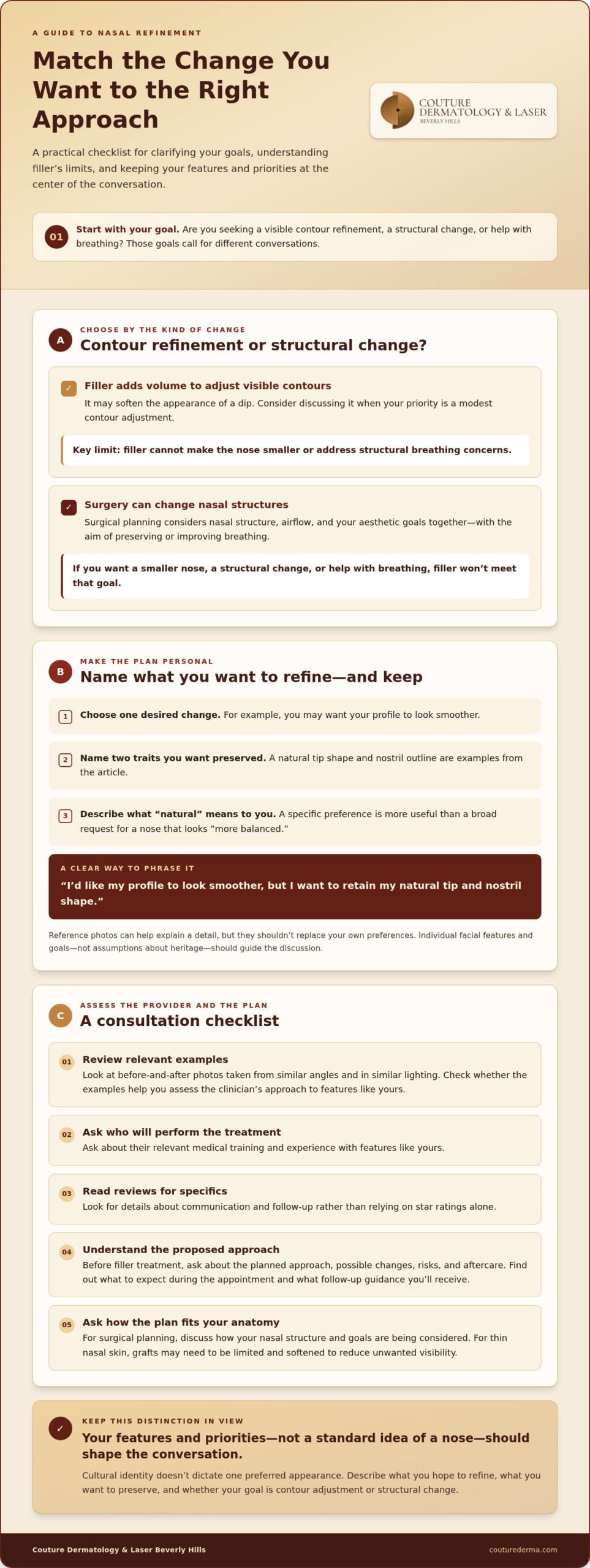
Surgery can change nasal structures, while filler adds volume to adjust visible contours. For example, filler may soften the appearance of a dip, but it cannot make the nose smaller or address structural breathing concerns. If you’re considering ethnic rhinoplasty with fillers in Beverly Hills, frame the decision around your goal: contour refinement or a structural change.
When comparing Beverly Hills providers, review before-and-after photos taken from similar angles and in similar lighting. Look for examples that help you assess the clinician’s approach to features like yours. Read reviews for specific details about communication and follow-up, rather than relying on star ratings alone. During a consultation, ask who would perform the treatment and about their relevant medical training.
If you’re seeking a modest contour adjustment, filler may be worth discussing. If your goal is a smaller nose, a structural change, or help with breathing, filler won’t address it. State those priorities plainly before discussing options. The proposed approach should match the change you want, not simply the word “rhinoplasty.”
Treatment and Recovery
A nose filler consultation typically includes a discussion of your goals, medical history, and nasal features. Before treatment, the clinician should explain the planned approach, possible changes, risks, and aftercare. Ask what to expect during the appointment and what follow-up guidance you’ll receive. These details help you understand the process before deciding whether to proceed.
If you’re considering ethnic rhinoplasty with fillers in Beverly Hills, bring a short written list of the features you’d like refined and preserved. This makes the discussion more specific. Ask the clinician how the proposed contour change relates to your features and what recovery guidance applies to the treatment.
Surgical planning considers nasal structure, airflow, and your goals together. For patients with thin nasal skin, grafts may need to be limited and softened to reduce unwanted visibility. Ask how the plan accounts for your anatomy, then name the features you want to retain, such as your natural tip shape or nostril outline.
Ethnic rhinoplasty and preserving cultural identity
When discussing nasal refinement, start by identifying the features that feel important to preserve. Ethnic rhinoplasty aims to enhance the nose while respecting distinctive ethnic facial traits. For example, you might want to adjust your profile while retaining a familiar tip shape. That creates a personal starting point instead of assuming there’s one ideal nose for everyone.
Consider what beauty means to you, because cultural identity doesn’t dictate one preferred appearance. Two people from the same community may feel differently about a prominent bridge, nostril shape, or nasal tip. Before a consultation, write down the feature you’d like to refine and the features you want to keep. Specific priorities make it easier to discuss the changes you actually want.
A practical way to prepare is to note one desired change and two traits you want preserved. You might say, “I’d like my profile to look smoother, but I want to retain my natural tip and nostril shape.” That is more useful than asking for a nose that looks “more balanced.” Reference photos can help explain a detail, but they shouldn’t replace your own preferences.
Make room in the planning conversation for the feelings behind a requested change. You may feel self-conscious after years of comments, yet still want a particular feature to remain recognizable. Before deciding, consider whether you’d still want the adjustment without outside opinions. This reflection can help distinguish your personal aesthetic goal from pressure from others.
For filler-based treatment, clarify what adding volume can and cannot accomplish. A small contour adjustment may soften the appearance of a dip, but filler cannot make the nose smaller. Bring your priorities to the consultation and ask how the proposed change relates to your features. Aim for a goal specific enough to discuss, rather than relying on a broad label such as “ethnic nose.”
Preserving cultural identity doesn’t mean you must avoid change. It means making choices that feel intentional and your own. Name the feature you’d like enhanced, the feature you want left untouched, and what “natural” means to you. These points can guide a thoughtful conversation about a subtle adjustment or a more structural approach.
African American, Asian, Middle Eastern, and Latinx rhinoplasty
Ethnic rhinoplasty should respond to your individual facial features, not assumptions based on heritage. African American, Asian, Middle Eastern, and Latinx patients may share a cultural label but have different nasal structures and personal goals. In a consultation, describe the feature you want to change, then name the features you want preserved. That gives the plan a specific starting point instead of relying on a broad category.
For African American rhinoplasty, possible surgical planning considerations include bridge augmentation, nostril narrowing, and nasal-tip shaping with cartilage grafts. These are potential techniques, not a standard package for every patient. If you’re considering a narrower nostril shape, explain how much change feels appropriate and how you want the result to relate to your other facial features. A plastic surgery plan should reflect those preferences.
For Middle Eastern rhinoplasty, planning should avoid excessive bridge reduction or raising the nasal tip too high. A prominent bridge or lower tip may be part of the appearance you value, or you may want a measured adjustment. Bring front-view and profile references that show the specific contour you’d like to discuss. Then distinguish between refining that feature and removing it entirely.
For Asian rhinoplasty, planning considerations include avoiding excessive nostril narrowing, pinching the nasal tip, and over-augmenting the bridge. These cautions can frame a conversation, but they don’t define every Asian patient’s anatomy or preferences. Tell the surgeon whether your priority is bridge definition, tip shape, or nostril appearance. A customized plan should address the feature you named without treating cultural identity as a surgical blueprint.
For Latinx patients, there isn’t one nasal shape or single set of ethnic rhinoplasty techniques to apply. Latinx heritage encompasses diverse family backgrounds and facial features, so discuss your own anatomy and goals directly. You might want to adjust your profile while keeping your tip shape, or focus on another feature altogether. The plan should follow your request, not a generalized idea of Latinx beauty.
Across all four groups, use clear language during planning: “I want this area refined, and I want this feature to remain.” Ask how each proposed surgical change affects your overall facial balance, and whether it aligns with the result you described. If you’re exploring filler rather than surgery, discuss the precise contour goal and remember that filler adds volume. Your heritage can inform what feels meaningful, while your individual features and choices guide the treatment plan.
Benefits and aesthetic goals
A useful aesthetic goal describes a visible feature, not a vague wish to look “better.” For example, you might want a smoother profile while keeping your natural nasal tip. Naming both preferences helps shape a plan around your appearance and the facial traits you value. It also gives you and the clinician a clear way to discuss whether filler or surgery fits the change you’re describing.
A potential benefit of filler is that adding volume can adjust the appearance of a contour. A small dip along the bridge, for example, may be the feature you want to soften. But adding volume cannot make the nose smaller. If your goal is a narrower nose or a structural change, describe that distinction plainly instead of expecting filler to deliver it.
Surgical goals can involve structural changes as well as appearance. Surgical planning aims to address aesthetic concerns while preserving or improving nasal airflow. For example, you might discuss bridge shape while also considering breathing. Write down the change you want and any functional concern before your consultation to keep the conversation focused on what matters to you.
Facial harmony doesn’t require making every feature resemble a single ideal. You may prefer a more defined bridge, a subtle profile adjustment, or no change to your nostrils. Use front-view and profile photos to point out the exact area you mean, then describe what should remain unchanged. This practical comparison can make words like “natural” or “balanced” more precise.
Before selecting an approach, sort your priorities into three groups: appearance, function, and identity. For example, “smooth the profile” describes appearance; “preserve my breathing” describes function; “keep my tip shape” describes identity. These aren’t interchangeable goals. A clear list helps you discuss which changes may be possible with filler and which call for a surgical plan.
Keep your desired result modest enough to describe in concrete terms. Instead of asking for a “perfect” nose, identify one feature you want refined and one you want preserved. If your goals shift during planning, discuss your revised priorities with your clinician before proceeding. The final plan should reflect your aesthetic choices, not pressure from a photo, trend, or someone else’s opinion.
Which Beverly Hills providers offer ethnic rhinoplasty with fillers, and what are their credentials?
For filler-based nasal refinement, the relevant clinician is the person who evaluates your nose and performs the injections. A consultation should clarify that role, along with the clinician’s medical specialty, training, and experience with facial injections. In Beverly Hills, distinguish this from surgical rhinoplasty, which involves a different set of surgical skills and planning.
Board certification identifies formal specialty training, but the specialty matters. Dermatologists and plastic surgeons may have different training pathways, so look for credentials relevant to the treatment being discussed. For surgery, focus on a surgeon’s rhinoplasty training and surgical experience. For filler, consider the injector’s medical training, knowledge of nasal anatomy, and experience managing injectable complications.
Ethnic rhinoplasty calls for a conversation about varied facial features, not assumptions based on a patient’s background. During a consultation, notice whether the clinician asks which features you want to preserve, such as your bridge shape or nasal tip. A customized discussion should connect your stated goal with your anatomy rather than treating a cultural label as a treatment plan.
Before-and-after photographs can help clarify a clinician’s aesthetic approach. Compare images with similar angles, lighting, and expressions, and observe whether the results appear consistent with the patients’ original features. Reviews add another perspective: look for specific descriptions of planning, communication, and follow-up rather than relying on a rating alone. Photos and reviews offer context, but don’t replace a discussion of your own goals.
Use the consultation to understand the proposed treatment, not just its expected appearance. Ask what the clinician plans to change, what will remain unchanged, and why filler suits that goal. Smoothing a small bridge contour, for example, differs from wanting a smaller nose. A clear explanation should address that distinction in terms you understand.
Write down your priorities before meeting a clinician: one feature you want refined, one you want preserved, and any breathing concern. This short list helps keep the conversation focused and makes it easier to compare the treatment plan with your goals. If you’re considering nasal filler, a consultation centered on your anatomy and preferences is the practical next step.
After ethnic rhinoplasty, patients are advised to sleep with their head above their heart for two weeks. Patients recovering from ethnic rhinoplasty are advised to avoid bending over or vigorous physical activity until their surgeon clears them. A body temperature above 100 degrees after surgery is a reason to contact a physician immediately or go to an emergency center for assessment. Discussing these instructions with the surgeon can help clarify what to follow during recovery.
Couture Dermatology & Laser Beverly Hills: Laser Skin Resurfacing
Couture Dermatology & Laser in Beverly Hills offers Dermal & Lip Fillers for patients exploring nonsurgical aesthetic options. If your goal is a subtle contour adjustment, a consultation can help clarify whether filler suits the change you have in mind. Filler adds volume; it doesn’t make the nose smaller or replace structural surgery.
Bring your priorities to the conversation: the feature you’d like refined, what you want to preserve, and any breathing concerns. This gives the discussion a personal starting point and helps distinguish a filler goal from a surgical one. To discuss your aesthetic goals, contact Couture Dermatology & Laser in Beverly Hills.
Make Your Next Step a Thoughtful One
Before committing to a change, give yourself room to decide what feels right. Write down the outcome you hope for, the feature you want to preserve, and any questions you still have. This short reflection can keep your next conversation grounded in your priorities rather than someone else’s idea of beauty.
If you’re considering ethnic rhinoplasty with fillers in Beverly Hills, use a consultation to discuss your goals and understand which approach fits them. Filler adds volume, so it’s important to distinguish refining a contour from reducing nasal size. You deserve a clear discussion of that difference before choosing a treatment.
At Couture Dermatology & Laser Beverly Hills, the next step is a personal conversation about your aesthetic goals. Arrange a consultation with Couture Dermatology & Laser Beverly Hills when you’re ready to explore your options. Your features and your choices can guide a considered path forward.
Frequently Asked Questions
How Soon Can I Return to Work?
After surgical ethnic rhinoplasty, some patients may return to work after two weeks. Your recovery plan should account for visible bruising or swelling and the demands of your job, especially strenuous duties. Before scheduling time off, ask your surgeon which activities require clearance and how follow-up visits fit your work calendar. Filler treatment has a different recovery process, so discuss expected downtime for your specific treatment rather than applying surgical timing.
What potential risks or complications should I be aware of?
Surgical rhinoplasty can involve infection, bleeding, scarring, or asymmetry. Ask the surgeon how your medical history and nasal anatomy affect the proposed procedure and what follow-up care includes. You can also ask how changes to the bridge or tip relate to breathing. For any procedure, make sure you understand which symptoms need prompt medical attention and whom to contact if a concern arises during recovery.
Will I still look like others of my ethnic group?
There isn’t one appearance shared by everyone in an ethnic group, so no procedure can define whether you’ll resemble others from your background. A more useful goal is deciding which of your own features you want to keep recognizable. Bring a photo of yourself that reflects how you see your appearance, then explain what you’d change and what should remain. This keeps the discussion personal rather than measuring you against a group stereotype.
What is ethnic rhinoplasty and how does it preserve a patient’s cultural features?
Ethnic rhinoplasty is nasal treatment planned with attention to a patient’s individual features and cultural identity. Tell the clinician which details matter to you, such as your profile, tip shape, or nostril outline, then ask how the proposed plan would affect each one. A useful consultation should turn your preferences into specific treatment goals, rather than assuming your heritage determines what you want changed.
How do dermal fillers reshape the nose compared with surgical ethnic rhinoplasty?
Dermal fillers add volume beneath the skin to adjust the nose’s visible contour; surgery can alter underlying structures. Filler may make a dip appear smoother, for example, but it can’t reduce nasal size or address structural breathing concerns. If you’re choosing between approaches, describe the exact result you want, such as a narrower tip or smoother profile. The key distinction is whether your goal involves adding contour or changing structure.
What are the risks and complications of nose fillers, including vascular occlusion and vision loss?
Nose filler can cause serious complications, including vascular occlusion, a blockage of blood flow, and vision loss. Before treatment, ask the injector how they recognize these problems, what emergency steps they can take, and where you should go if symptoms occur. Sudden vision changes after an injection require immediate emergency medical attention. Make sure you understand the treatment plan and urgent contact instructions before proceeding.