You spent months trying to conceal stubborn acne scars or patchy discoloration, only to leave an aesthetic consultation terrified that an aggressive laser might darken your complexion permanently. When considering laser skin resurfacing for hispanic skin beverly hills patients often sit in my exam chair and share that exact fear. That hesitation makes complete sense. Melanin-rich skin is deeply reactive, and treating it with standard, uncalibrated heat is a recipe for post-inflammatory hyperpigmentation (dark spots triggered by skin trauma).
Here’s the reassuring truth: you don’t have to risk your complexion to smooth uneven texture or clear stubborn pigment. With specialized, melanin-safe laser resurfacing, we can safely refine your tone and stimulate fresh collagen without triggering unwanted discoloration. In our practice, preparation is everything. Start applying a broad-spectrum mineral sunscreen every morning at least four weeks before any laser procedure to calm your melanocytes (cells that produce skin pigment) and protect your skin barrier.
Below, I’ll walk you through the precise wavelengths, tailored physician protocols, and protective recovery steps that deliver smooth, luminous results while fiercely guarding your natural tone.
Key Takeaways
- Understand why reactive melanocytes in olive and brown complexions require specialized, non-ablative wavelengths rather than aggressive surface peeling.
- Discover why seeking laser skin resurfacing for hispanic skin beverly hills specialists ensures your care is led by a board-certified dermatologist rather than an uncalibrated medspa protocol.
- Learn the essential four-to-six-week pre-treatment priming regimen using pigment suppressors that calm melanin production before energy touches your face.
- Find out how fractional microscopic treatment zones preserve healthy skin bridges to stimulate collagen while dramatically reducing healing downtime.
- Master the precise post-procedure recovery steps, from pure bland emollients to mineral sun protection, that safeguard vulnerable tissue against unwanted hyperpigmentation.
Why Does Hispanic Skin Require a Specialized Laser Resurfacing Approach?
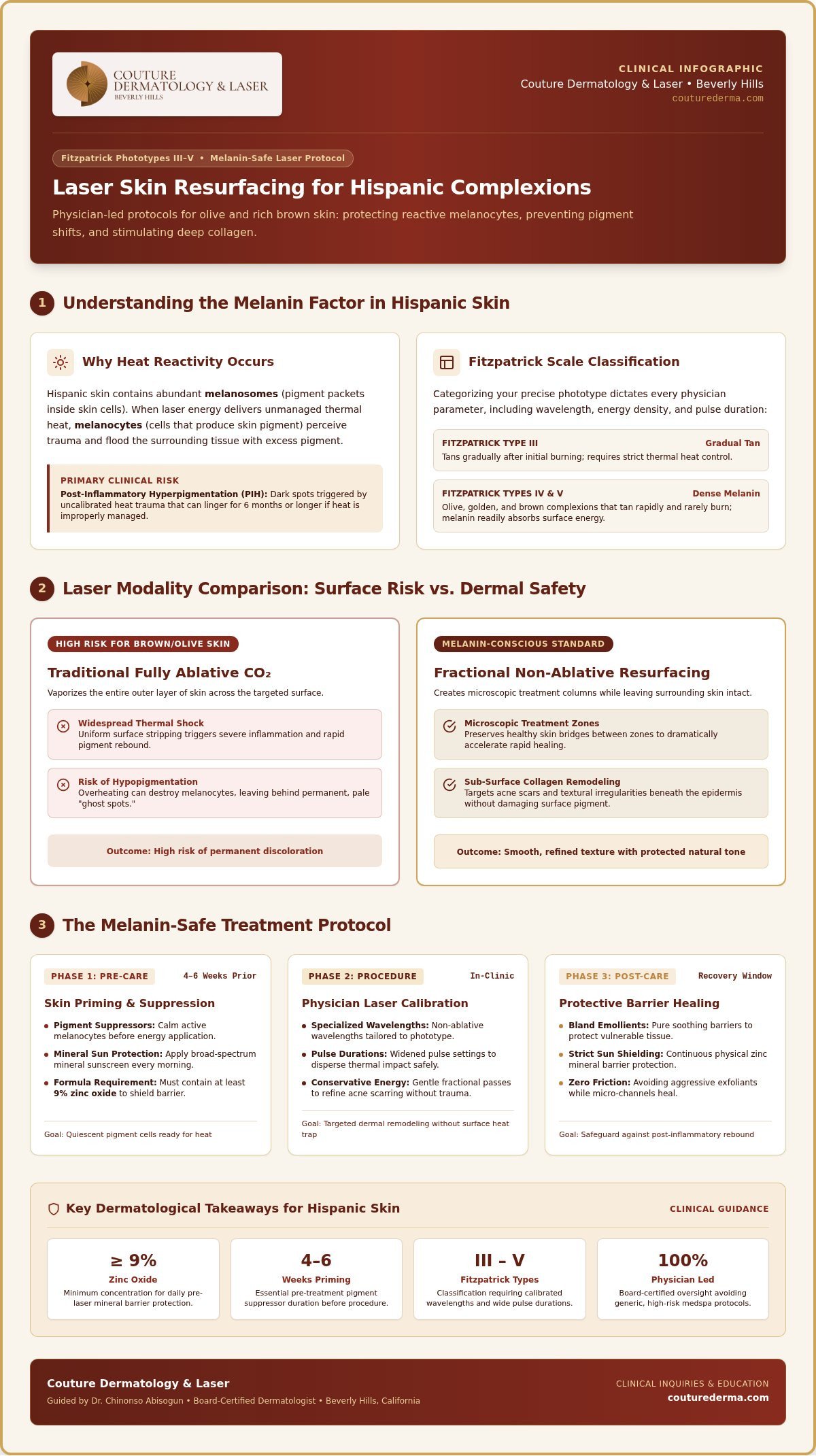
In my practice, Hispanic skin spans diverse cultural backgrounds and genetic lineages, reflecting a wide spectrum across the Fitzpatrick scale. Most Hispanic patients present with Fitzpatrick Types III through V. Because olive and rich brown complexions contain melanocytes (cells that produce skin pigment) that are active and easily provoked, standard laser treatments can quickly backfire. Uncalibrated heat triggers post-inflammatory hyperpigmentation (dark spots triggered by skin trauma), leaving behind dark patches that can take months to fade. Here’s the thing: laser skin resurfacing for hispanic skin beverly hills patients is deeply transformative, but only when guided by melanin-conscious clinical expertise.
To better understand how energy-based devices interact with facial contours and skin tissue, watch this helpful video:
If you have struggled with textural irregularities or residual blemishes, explore our clinical approach to acne scar refinement to see how we restore smooth skin without triggering pigment rebound.
What makes Hispanic skin uniquely reactive to laser heat?
Hispanic complexions house abundant melanosomes (pigment packets inside skin cells). When laser energy delivers unmanaged thermal heat, these cells treat it as an injury and flood the area with pigment. Mild epidermal trauma can trigger pigment shifts that linger for half a year or longer. I see patients whose previous medspa visits left grid patterns or hyperpigmented rings because the provider chose inappropriate settings. To protect your skin barrier before any laser consult, apply a mineral sunscreen containing at least 9% zinc oxide every morning.
How do dermatologists classify Fitzpatrick skin types III through V?
In our clinic, categorizing your precise phototype dictates every treatment parameter:
- Type III: Skin that tans gradually after initial burning, requiring careful heat control.
- Types IV and V: Olive, golden, and brown complexions that tan rapidly and rarely burn, possessing dense melanin that readily absorbs laser energy.
Accurate classification allows a physician to adjust wavelengths, widen pulse durations, and choose conservative energy levels. When you tailor these settings correctly, laser skin resurfacing for hispanic skin beverly hills protocols deliver radiant texture while completely protecting natural melanin.
Which Laser Resurfacing Technologies Are Truly Safe for Hispanic Complexions?
Walk into a high-volume medspa, and you’ll likely be offered a standard, fully ablative carbon dioxide treatment under the promise of a single-session fix. But aggressive surface vaporizing carries severe risks for olive and brown complexions. When performing laser skin resurfacing for hispanic skin beverly hills patients, safety rests on choosing technologies that protect surface pigment while remodeling tissue underneath. We frequently pair gentle resurfacing passes with tailored acne scar refinement to smooth indented texture without destabilizing your natural complexion.
Why can traditional ablative CO2 lasers cause permanent damage?
Traditional ablative devices operate by vaporizing the outer layer of skin across the entire targeted area. In melanin-rich complexions, this widespread thermal shock triggers intense inflammation, which frequently sparks severe dark patches. Worse, overheating can permanently destroy melanocytes, resulting in hypopigmentation (loss of skin color) that leaves behind pale, irreversible ghost spots. In our practice, we avoid aggressive fully ablative passes on Fitzpatrick Types III through V entirely.
Why do fractional non-ablative and picosecond lasers work best?
Safety comes down to microscopic architecture and energy delivery. Fractional non-ablative lasers create microscopic thermal treatment zones deep in the dermis while leaving the surrounding surface tissue intact. These untreated tissue bridges act as biological bandages, accelerating skin repair in two to four days rather than two weeks. Picosecond lasers take safety a step further by using photoacoustic shockwaves instead of sustained thermal heat. By shattering stubborn pigment clusters without baking adjacent tissue, picosecond systems clear irregularities while guarding your complexion.
Just as dermatological guidelines confirm patients of color can safely have laser hair removal when using the right physics and conservative cooling, resurfacing requires that same melanin-first precision. If non-prescription brightening serums haven’t resolved your textural concerns after eight to twelve weeks, you can schedule a personalized skin evaluation with a board-certified physician to explore conservative clinical modalities.
Can the Fotona laser address texture and melasma simultaneously?
Yes, especially when using dual-wavelength platforms. The 1064 nm Nd:YAG wavelength bypasses melanin in the outer layer of skin, penetrating deeply to break down melasma patches while remodeling collagen matrices. Because its absorption by pigment is naturally low, it generates gentle tissue remodeling rather than surface burning. It provides a secure, clinically validated option for complex, hyperpigmentation-prone Hispanic skin.
How Should You Prepare Hispanic Skin Before Undergoing Laser Treatment?
If a provider tells you that you can walk in off the street for a same-day laser resurfacing session on olive or brown skin, walk away. In my practice, the real work begins long before the laser ever touches your face. When executing laser skin resurfacing for hispanic skin beverly hills patients achieve luminous, complication-free outcomes because we invest time in methodical pre-conditioning. Skipping this foundational phase is the single most common reason patients experience post-inflammatory hyperpigmentation.
Here is the rigorous five-step preparation protocol I prescribe to every patient:
- Step 1: Clinical mapping. We assess individual pigment depth, skin barrier resilience, and vascular redness under polarized light.
- Step 2: Pigment suppression. You will apply prescription tyrosinase inhibitors (topicals that stop pigment-producing enzymes) nightly for four to six weeks. Wait 20 minutes after cleansing before applying tretinoin or active brighteners to minimize irritation.
- Step 3: Active suspension. Pause all exfoliating alpha hydroxy acids, salicylic acid, and retinoids exactly seven days before your appointment.
- Step 4: Strict photoprotection. Apply mineral sunscreen 15 minutes before sun exposure every single morning, rain or shine.
- Step 5: Jawline test spots. We perform conservative test pulses in a discreet area along the jawline to verify your tissue response before treating the full face.
Why is a four-to-six week pre-conditioning regimen non-negotiable?
Melanocytes in Hispanic skin act like armed security guards; if you startle them with sudden laser energy, they immediately fire off excess pigment. Pre-treating your face puts these pigment factories into a calm, dormant state. Clinical observations show this step reduces post-procedure dark spots by more than half. Patients who rush into quick-fix treatments without this chemical buffer face a steep, unnecessary risk of blotchy pigment flares.
Which active ingredients suppress melanocyte activity most effectively?
Prescription 4% hydroquinone or cysteamine serves as our gold standard to block tyrosinase, the foundational enzyme responsible for melanin synthesis. Azelaic acid at 15% to 20% calms inflammatory background tone while gently smoothing existing marks. We also incorporate topical tranexamic acid, which stabilizes microscopic blood vessels that often feed stubborn melasma patches. This bespoke medical cocktail ensures your complexion remains stable throughout your laser journey.
What Should You Expect During a Beverly Hills Consultation at Couture Dermatology?
Stepping into our Beverly Hills office at Couture Dermatology & Laser Beverly Hills means leaving the rushed atmosphere of a standard medspa behind. Laser resurfacing should never resemble an impulse purchase or an assembly-line service. When consulting on laser skin resurfacing for hispanic skin beverly hills patients quickly see that we treat medical aesthetics like haute couture. Every parameter is measured, cut, and tailored to the unique physics of your complexion.
During your visit at Couture Dermatology & Laser Beverly Hills, I personally examine your dermal thickness, previous scar patterns, and pigment stability. We frequently evaluate complementary zones at the same time, pairing full-face resurfacing with specialized under-eye brightening to lift shadows and create seamless harmony across your entire face.
Why does board certification in dermatology matter for ethnic skin?
Non-physician spa operators often rely on pre-set machine defaults that cannot read subtle clinical shifts. A board-certified dermatologist who completed fellowship training at Harvard brings deep diagnostic expertise to every pulse at Couture Dermatology & Laser Beverly Hills. We understand how cellular structures react to thermal pulses in real time. If immediate redness shows signs of overheating during a pass, a physician can adjust fluences, change cooling parameters, or pause immediately to prevent cellular trauma.
How does diagnostic test spotting protect your facial skin?
Before treating larger facial areas, our team at Couture Dermatology & Laser Beverly Hills places one or two discreet test pulses along the posterior jawline or behind the ear. Then we wait. We evaluate that site after two full weeks to monitor for delayed pigment responses. If your skin reveals even faint darkening, we modify your settings or extend your pre-conditioning topical regimen. This simple, methodical safeguard prevents widespread discoloration across your cheeks and forehead.
What warning signs suggest a clinic is unsafe for Hispanic skin?
Keep these red flags in mind when interviewing any practice for your laser journey:
- Same-day aggressive procedures: Anyone offering immediate high-intensity passes without a medical history review is gambling with your skin barrier.
- Guarantees of flawless skin: Promises of poreless, porcelain results in a single 20-minute lunchtime visit ignore basic wound healing biology.
- Vague pigment protocols: Providers who cannot identify your Fitzpatrick type or dismiss pre-treatment suppressors do not possess specialized ethnic skin training.
Your complexion deserves precise, physician-led artistry. If you’re ready to explore an individualized plan built to protect your natural tone, you can book your private Beverly Hills consultation today at Couture Dermatology & Laser Beverly Hills.
What Does Proper Aftercare Involve to Guarantee Safe, Radiant Healing?
You leave the treatment suite with smooth laser pulses complete, but your final outcome depends entirely on what happens during the next seven to fourteen days. Melanin-rich complexions remain in an ultra-sensitive window where careless friction or ambient sunlight can quickly undo your clinical gains. When executing laser skin resurfacing for hispanic skin beverly hills standards require an equally disciplined recovery protocol to ensure glowing, even-toned rejuvenation.
To keep healing calm and predictable, adhere to these non-negotiable guidelines:
- Shield with pure bland emollients: Apply medical-grade plain white petrolatum three times daily. Avoid fragrant botanicals, essential oils, or heavy organic nut butters that trigger contact dermatitis.
- Block direct UV rays: Wear a wide-brimmed UPF 50 hat outdoors and coat freshly healed skin with pure zinc oxide physical sunscreen 15 minutes before stepping near a window.
- Zero picking or manual exfoliation: Allow microscopic epidermal crusts (tiny bronzed tissue specks) to slough off naturally during gentle cleansing. Scrubbing fresh tissue guarantees post-inflammatory dark marks.
- Resume pigment inhibitors at day fourteen: Once the outer layer of skin has completely resealed, restart your prescription tyrosinase suppressors to prevent rebound hyperpigmentation.
How do you protect your fragile skin barrier in the first 72 hours?
Cleanse twice daily using tepid water and a soap-free, non-foaming hydrating wash, lightly patting dry with a clean cotton towel. Keep treated areas coated in a thin protective layer of ointment to trap vital cellular hydration and lock out airborne bacteria. And skip intense cardio, steam rooms, or scalding showers for three full days. Elevating your core body temperature dilates blood vessels, which can awaken dormant melanocytes and cause unwanted pigment flares.
When will you see noticeable improvements in texture and tone?
Mild bronzing and initial pinkness typically fade within five to seven days, unveiling a noticeably smoother, fresher epidermal surface. Real structural change, however, is a biological marathon. Collagen synthesis continues beneath the outer layer of skin over the next three to six months. Rolling acne indentations lift, pore margins tighten, and stubborn hyperpigmentation melts away into a seamless, radiant finish. Take the definitive first step toward glowing skin by booking an appointment with Dr. Abisogun at our Beverly Hills practice.
Begin Your Journey to Melanin-Safe Skin Renewal
Achieving smooth texture and clear tone should never come at the expense of your skin’s natural pigment. By respecting cellular biology through medical pre-conditioning, selecting conservative non-ablative wavelengths, and committing to barrier-focused aftercare, you can revitalize your complexion without fear. At Couture Dermatology & Laser, I combine 15 years of clinical expertise with Harvard cosmetic fellowship training to deliver bespoke care engineered specifically for skin of color.
When seeking laser skin resurfacing for hispanic skin beverly hills patients deserve an elevated, physician-led experience that honors their heritage. Let’s work together to design an artisanal treatment path that smooths texture, fades stubborn marks, and fiercely protects your natural tone. Take the next step in your transformation and book a bespoke laser consultation with Dr. Abisogun at our private boutique practice today.
Frequently Asked Questions
Is laser skin resurfacing painful for patients with Hispanic skin?
Most patients experience minimal discomfort rather than sharp pain during the procedure. In our Beverly Hills practice, we apply a strong prescription topical numbing cream for 45 to 60 minutes before we begin. During treatment, we pair modern fractional non-ablative devices with continuous epidermal cooling that blows chilled air onto the skin. You will typically feel a warm, prickling sensation similar to tiny rubber bands snapping, followed by a mild sunburn feeling that dissipates within two hours.
How many sessions are typically required to see significant texture improvement?
In most cases, patients achieve noticeable texture refinement in three to four planned sessions spaced four to six weeks apart. Because safe laser skin resurfacing for hispanic skin beverly hills protocols prioritize conservative energy over single-session aggression, steady cumulative remodeling is the gold standard. Spacing appointments allows deep collagen synthesis to mature while giving your melanocytes (cells that produce skin pigment) ample time to rest. You will typically notice improved skin firmness, tighter pores, and softer scar edges after your second visit.
Can laser resurfacing make my melasma worse if I have olive skin?
Yes, inappropriate or overly aggressive lasers can easily trigger melasma flare-ups in olive skin. Uncalibrated heat provokes inflammation, prompting hyperactive melanocytes to surge and darken existing patches. That’s why we avoid broad-spectrum heat devices like intense pulsed light and fully ablative lasers on melasma-prone tissue. Instead, we use sub-millisecond, photoacoustic picosecond technology or low-fluence Nd:YAG wavelengths, combining them with strict topical tyrosinase inhibitors (pigment-blocking topicals) to break down pigment without heating surrounding tissue.
How much downtime should I plan for after fractional laser resurfacing?
You should plan for approximately three to five days of mild social downtime. Unlike old-school ablative treatments requiring two full weeks of raw peeling, modern fractional non-ablative technologies preserve your surface barrier. During the first 48 hours, your skin looks and feels like a moderate sunburn with mild swelling. By day three or four, microscopic bronzed crusts slough off naturally during gentle cleansing, allowing you to return to normal daily routines without taking extended time off work.
Can I get laser resurfacing done during the sunny Los Angeles summer?
You can safely undergo treatment during a Los Angeles summer, provided you commit to strict sun discipline. If your lifestyle involves frequent beach outings or intense outdoor athletics, I advise scheduling your sessions between October and April instead. However, for urban routines with careful shade-seeking, laser skin resurfacing for hispanic skin beverly hills patients remains safe year-round. You must apply a broad-spectrum mineral sunscreen containing zinc oxide every morning and wear a UPF 50 wide-brimmed hat whenever stepping outdoors.
What happens if I develop dark spots after my laser procedure?
If post-inflammatory hyperpigmentation develops, we treat it promptly with physician-directed medical topicals. In our clinic, early intervention prevents temporary discoloration from settling into deep tissue. We immediately introduce prescription azelaic acid, topical tranexamic acid, or low-dose hydroquinone under close monitoring to calm pigment pathways. We also examine your daily barrier routine to eliminate friction or irritating botanical ingredients. With consistent medical support, post-laser pigment spots typically resolve within eight to twelve weeks without lasting marks.
Are non-ablative lasers as effective as traditional ablative lasers for acne scars?
Non-ablative fractional lasers produce comparable, long-term scar improvement to ablative lasers when completed as a planned series. While an ablative laser removes surface tissue in one aggressive step, it carries unacceptable scarring and hypopigmentation (loss of skin color) risks for Hispanic skin types. Fractional non-ablative passes stimulate collagen remodeling in the deep dermis over several months. You achieve beautifully lifted rolling scars and refined skin texture through a gentle sequence, eliminating the severe risks associated with traditional ablation.