
You’ve tried every brightening cream on the shelf, but treating hyperpigmentation on south asian skin remains a challenge because those stubborn spots around your mouth or cheeks just won’t budge. In my practice at Couture Dermatology & Laser Beverly Hills, I often see patients who feel defeated by this cycle of trial and error. Here’s the thing; clearing pigment isn’t about finding a stronger bleach. It’s about understanding how your melanocytes (the cells that produce skin pigment) react to the world around them.
I know it’s exhausting to feel like you’re constantly fighting your own complexion, especially when there’s so much cultural pressure to have “flawless” skin. But you don’t have to settle for ineffective creams or live in fear of post-inflammatory hyperpigmentation; which is the darkening that can happen after a skin injury or a harsh treatment. I’m going to show you how a board-certified dermatologist uses a bespoke, low-heat approach to safely clear your pigment. No more guesswork.
We’ll explore the science of South Asian tones and why a “one size fits all” laser can actually do more harm than good. You’ll learn about the specific protocols we use in our clinic to help you achieve a glow that feels both natural and refined. It’s time to move past the frustration and start a transformative journey toward the even, healthy skin you deserve.
Key Takeaways
- You’ll learn why your melanocytes (cells that produce pigment) act like over-active security guards and how to calm them down for a clearer complexion.
- We explain the specific risks of high-heat treatments and how treating hyperpigmentation on south asian skin requires a specialized, couture-level approach.
- Discover why your daily sunscreen needs iron oxides to protect against blue light and prevent new dark spots from forming.
- Identify the differences between melasma and other pigment issues so you can stop wasting time on products that don’t work for your specific type.
- Learn how a professional diagnosis helps us reach deep pigment safely, giving you the confidence to finally go makeup-free.
Why does South Asian skin struggle with stubborn dark spots?
You’ve likely noticed that even a tiny blemish can leave a dark mark that lingers for months after the actual bump is gone. This is the most common frustration I hear when treating hyperpigmentation on south asian skin at my Beverly Hills practice. Your skin is naturally rich in melanocytes (cells that produce skin pigment), and while this provides some natural protection against the sun, it also makes your skin incredibly reactive. If you’re dealing with a breakout, try not to pick or squeeze; this physical trauma is the fastest way to trigger a dark spot.
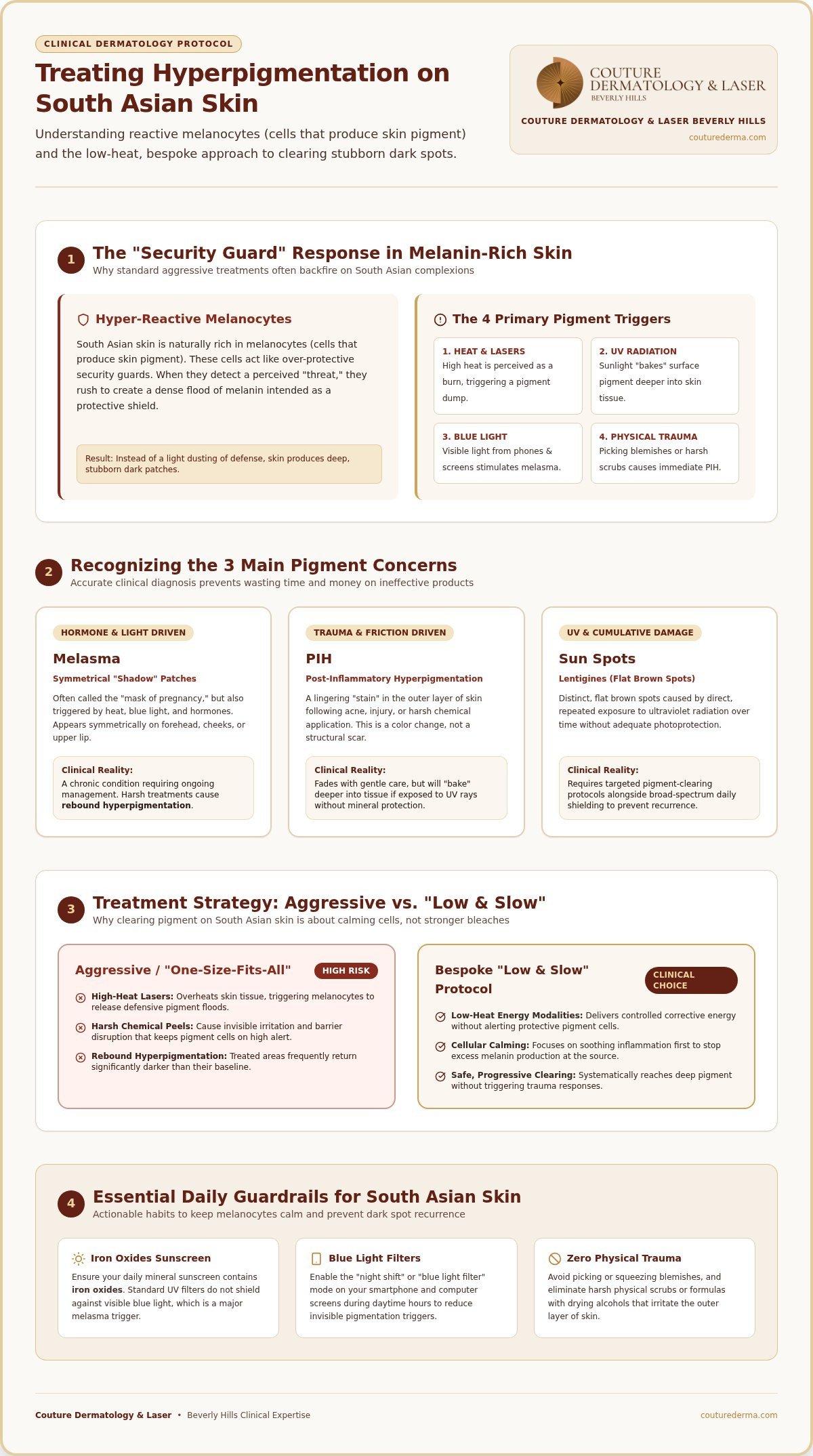
Think of these pigment cells as over-protective security guards for your skin. When they sense any kind of “threat,” such as a scratch, heat, or UV rays, they rush to the area to provide cover. This excess melanin production is meant to be a shield, but in South Asian tones, the guards often overreact. Instead of a light dusting of protection, they create a dense flood of pigment that is difficult to clear with standard products.
To better understand how this process works on your specific skin type, watch this helpful video from Dr. Vanita Rattan:
Is my skin naturally more prone to scarring?
I see patients who are worried they have permanent scars, but there’s a big difference between a change in texture and a change in color. Most of the spots you see are actually post-inflammatory hyperpigmentation (PIH). This isn’t a true scar, but a lingering “stain” in the outer layer of skin. But if you don’t use proper sun protection, the sun’s rays will “bake” that pigment deeper into your tissue. If you’re looking for professional help with texture and tone, our acne scar refinement options can help restore a smooth finish.
What is the ‘security guard’ response in my skin?
In my practice, I see patients who are surprised that heat, not just sun, triggers spots. If you use aggressive scrubs or high-heat lasers, those security guards see the heat as an attack. They respond by dumping more pigment into the skin to protect it from the “burn.” This is why treating hyperpigmentation on south asian skin requires a “low and slow” philosophy. We use gentle, consistent methods rather than aggressive “quick fixes” that usually backfire. Check your daily products for harsh alcohols; these can cause invisible irritation that keeps your pigment cells on high alert.
Which pigment concerns are most common in my practice?
You look in the mirror and see a patch that looks like a smudge of dirt or a persistent shadow that won’t wash away. In my practice, I find that many people confuse different types of dark spots, which leads to frustration and wasted money on the wrong products. Understanding exactly what you’re looking at is the first step in treating hyperpigmentation on south asian skin effectively. We typically see three main culprits: Melasma, PIH, and Sun Spots (also known as lentigines or flat brown spots caused by UV exposure).
Melasma is often called the “mask of pregnancy” because it’s so closely tied to hormones, but it’s not just for those who are expecting. Heat and blue light from your computer or phone are huge triggers I see here in Beverly Hills. It creates a symmetrical “shadow” on the forehead, cheeks, or upper lip that can feel quite heavy. The emotional weight of these shadows is real. It can make you feel like your face is never truly “clean” or bright, even after a long skincare routine. Here’s a tip: check your smartphone settings and turn on the “blue light filter” or “night shift” mode during the day to reduce one of these invisible triggers.
Why is my melasma coming back even after treatment?
Melasma is a chronic condition. Let’s be honest; it’s a management game rather than a one-time fix. If you use a harsh lightener or an aggressive peel, you might experience “rebound hyperpigmentation,” which is when the spot returns even darker than before because the skin felt attacked. This is especially true for delicate areas that show fatigue easily. If you’re struggling with darkness around the lids or under the eyes, you might find our under-eye brightening approach helpful for those specific shadows.
Are these spots from old acne or the sun?
Sun spots are usually small and defined, while PIH is the ghost of a past breakout or a scratch. It’s vital to clear active acne first because if we don’t stop the “fire” of a breakout, we can’t effectively clean up the “soot” of the pigment. This is a very common form of postinflammatory hyperpigmentation in darker skin tones that requires a gentle touch. For those with lingering texture or pitted marks, we often transition to acne scar refinement once the color has stabilized. If you’ve been trying to clear these spots for more than 12 weeks without success, it might be time to book a professional consultation to identify the depth of your pigment.
Is laser treatment safe for South Asian skin tones?
You’ve probably heard the warning that lasers and brown skin just don’t mix. In my practice at Couture Dermatology & Laser Beverly Hills, I see many patients who were told by other clinics that they aren’t candidates for laser therapy. That’s a myth. While it’s true that the wrong device can cause a burn or hypopigmentation (permanent pigment loss), treating hyperpigmentation on south asian skin is safe when we use the right technology. It’s all about how we manage heat and light.
The danger with older lasers is that they can’t tell the difference between your natural skin color and the dark spot we want to remove. If the laser is too aggressive, it heats up the outer layer of skin (the epidermis) and triggers a defensive response. When we look at evidence-based hyperpigmentation treatments, we see that professional lasers offer a level of precision that creams simply can’t match. But that precision depends on using a wavelength that bypasses the surface and targets only the pigment sitting deeper down.
Will a laser burn my skin or make spots darker?
Here’s the thing; your skin needs time to cool down between every pulse of light. We call this “thermal relaxation time,” and it’s the secret to keeping your skin safe. In our Beverly Hills clinic, we use specific protocols to keep the skin cool, often using a “non-ablative” approach. Unlike ablative lasers that remove the top layer of skin, non-ablative lasers leave the surface intact. This reduces the risk of your pigment cells feeling “attacked” and creating even darker spots in response. It’s a delicate balance that requires an expert hand to ensure the heat doesn’t linger too long.
What is the Fotona laser and how does it help?
In my practice, I prefer the Fotona laser because it offers a “couture” level of customization. It’s what we often call a “cold” laser approach for melasma. Instead of using high heat to burn away a spot, it uses very short, powerful bursts of energy to “shatter” the pigment into tiny particles. Your body’s natural cleaning system then carries those particles away. This is much safer than standard IPL (Intense Pulsed Light), which uses a broad beam of heat that can be very risky for South Asian tones. By choosing a targeted laser, we can clear the pigment without the drama of a long, painful recovery or the risk of permanent ghosting.
What does a daily couture routine for pigment look like?
You’ve spent a small fortune on serums that promise a “glow” but end up leaving your face red and stinging. Here’s the thing: treating hyperpigmentation on south asian skin doesn’t require a cabinet full of products. It requires a few high-quality, targeted ingredients applied with precision. In my practice, I see patients who over-exfoliate, which just wakes up those “security guard” cells we discussed earlier. A minimalist, sophisticated routine is almost always more effective than a 10-step process that irritates the skin.
The absolute “Golden Rule” is wearing sunscreen every single day, even if you’re staying indoors. But for South Asian tones, standard protection isn’t enough. You need iron oxides, which are often found in tinted sunscreens. These minerals specifically block blue light from your screens and windows, which we now know can worsen melasma and other pigment issues. Wait 20 minutes after cleansing before applying tretinoin (a Vitamin A derivative) to reduce the risk of irritation and unwanted peeling.
When choosing your serums, look for “brighteners” rather than “bleachers.” Ingredients like Tranexamic acid, Kojic acid, and Niacinamide (Vitamin B3) work by gently slowing down the pigment-making process. They don’t strip your skin; they just quiet the noise. These ingredients are much safer for long-term use than harsh lighteners that can cause permanent damage if used incorrectly. If you are also interested in professional body contouring and wish to learn more about Brazilian Medical Center, their specialized expertise in aesthetic care ensures results that prioritize natural harmony.
Many of my patients find traditional Vitamin C too acidic. If it tingles or burns, your skin is telling you it’s irritated, and irritation leads to more pigment. I recommend looking for THD Ascorbate, a more stable and oil-soluble form of Vitamin C that penetrates deeper without the sting. If your skin feels tight or looks red after applying your actives, apply a soothing barrier cream immediately to lock in moisture and calm the surface. This prevents the inflammatory response that triggers new dark spots.
Which sunscreen won’t leave a white cast on my face?
I know the struggle of finding a mineral sunscreen that doesn’t make you look like you’re wearing a chalky mask. Chemical filters absorb UV rays, while mineral filters (like zinc or titanium) sit on top to reflect them. For South Asian skin, tinted mineral sunscreens are the “holy grail” because the tint hides the white residue and provides the iron oxides you need. Apply sunscreen 15 minutes before sun exposure to ensure it forms a complete protective seal on your face. If your current routine isn’t giving you the results you want after 8 weeks, let’s create a personalized plan and schedule your consultation today.
How do we tailor a professional treatment plan for you?
You might feel like you’ve been on a treadmill of facials and peels that promise the world but deliver very little. Here’s the thing: a “one-size-fits-all” facial often fails because it only treats the surface. When treating hyperpigmentation on south asian skin, we have to look much deeper than the outer layer of skin. In my practice, I see patients who have spent years trying to scrub away pigment that is actually sitting in the deeper layers of their tissue.
A board-certified dermatologist uses specialized tools to diagnose exactly where your melanocytes (cells that produce skin pigment) are overworking. We don’t just guess. We create a custom fit, much like a couture garment, by combining prescription-strength creams with advanced laser technology. This collaborative journey ensures that your treatment is as unique as your heritage. And it means we can address the root cause without causing unnecessary irritation.
What happens during a couture skin consultation?
We start by examining your skin under different lights to reveal “hidden” pigment that isn’t visible to the naked eye yet. I’ll ask you about your family’s heritage and how your skin typically reacts to the sun. This tells me how sensitive your pigment cells are to heat and light. It’s about setting realistic expectations for a gradual, safe transformation. We don’t rush the process because we want results that look natural and last for years.
Is it time to see a professional for my dark spots?
I usually recommend my patients follow the 8-12 week rule. If you’ve used over-the-counter options for three months without seeing a change, it’s time for a prescription approach. We often manage complex cases, such as shadows that settle along the lower face, by combining skin refinement with jawline contouring to create a crisp, even look. Or we might use the Fotona laser to target deep melasma while keeping the surface cool and protected. If you are ready for a plan that is designed specifically for your skin, you can book your bespoke consultation at our Beverly Hills clinic.
Your Path to a Clearer, More Radiant Complexion
You’ve spent years hiding under heavy foundation and trying products that weren’t built for your unique biology. But now you know that treating hyperpigmentation on south asian skin isn’t about aggression; it’s about artistry, patience, and medical precision. By calming your melanocytes (cells that produce skin pigment) and choosing technology that bypasses heat, you can finally break the cycle of rebound dark spots. No more hiding.
In my practice, I provide specialized care for melanin-rich skin, helping patients transform their confidence by moving from guesswork to a tailored, professional plan. My Harvard-trained expertise and our cutting-edge Beverly Hills technology, like the Fotona laser, are here to support your journey. We don’t just treat spots; we refine your skin’s natural harmony. It is a collaborative process that respects your skin’s integrity.
Begin your skin transformation: book your couture consultation today.
You deserve to feel comfortable in your own skin. And with the right approach, that even-toned glow is often well within your reach.
Frequently Asked Questions
Is hydroquinone safe for South Asian skin to use long-term?
Hydroquinone isn’t meant for long-term use. In my practice, we usually cycle it for three to four months because using it longer can lead to ochronosis (a rare, permanent blue-black darkening of the skin). We prefer to transition patients to non-hydroquinone brighteners to maintain results safely. If you live in Los Angeles CA, the intense sun makes long-term use even riskier without perfect protection.
Can I use natural remedies like lemon juice or turmeric for my dark spots?
I strongly advise against using lemon juice on your face. It’s highly acidic and often causes phytophotodermatitis (a skin reaction caused by citrus and sun). This irritation almost always leads to more pigment. Turmeric has anti-inflammatory properties, but raw kitchen mixes won’t reach the deep layers where most stubborn spots live. For those who value holistic botanicals, curated brands like Aroota provide Ayurvedic-based skincare to support daily balance, though addressing deep pigment still requires refined, medical-grade ingredients that won’t burn your skin.
How long does it take to see results when treating deep hyperpigmentation?
You should expect to see initial changes in about eight to twelve weeks. Treating hyperpigmentation on south asian skin is a marathon, but surface-level spots might fade faster than deep pigment which requires several skin cycles to clear. In our Beverly Hills clinic, we monitor your progress monthly to adjust your couture plan and ensure the skin remains healthy. Patience is key to a safe result.
Does blue light from my phone really make my melasma worse?
Yes, blue light from your devices is a proven trigger for melasma. It penetrates deeper than UV rays and keeps your melanocytes (cells that produce skin pigment) in a state of high alert. This is why I insist my patients use sunscreens with iron oxides. These minerals act as a physical shield against the light from your phone and computer screens, which is vital for long-term pigment management.
Is chemical peeling a better option than laser for brown skin?
Neither is “better” in a general sense; it’s about what fits your specific pigment depth. Peels are excellent for surface exfoliation, but lasers like the Fotona offer deeper, more targeted energy. In my practice, I often find that lasers provide more predictable results for South Asian tones because they don’t rely on a chemical reaction that can sometimes be unpredictable. We tailor the choice to your skin’s unique needs.
What should I do if a treatment makes my skin turn red or itchy?
Stop using your active products immediately and focus on repair. Redness and itching are signs of inflammation (the primary cause of post-inflammatory hyperpigmentation). Apply a thick barrier cream with ceramides to soothe the area and protect the outer layer of skin. If the irritation doesn’t settle in forty-eight hours, contact our clinic so we can help you calm the “security guard” cells before they dump more pigment.
Can I treat hyperpigmentation while I am pregnant or breastfeeding?
You can treat pigment during pregnancy, but you must avoid retinoids and hydroquinone. These are typically not recommended by doctors during this time. Instead, we use safe alternatives like azelaic acid or Vitamin C to manage the “mask of pregnancy.” And once you finish breastfeeding, we can transition you back to more potent, medical-grade options in our Los Angeles CA office.