You spent weeks researching and finally took the plunge, but now you’re staring in the mirror at a forehead that feels like lead and eyebrows that just won’t move. It’s incredibly stressful to feel unrecognizable, and in my Beverly Hills practice, I frequently help patients who are panicking about what to do if I hate my botox after a treatment elsewhere went wrong. You wanted to look refreshed and refined, not frozen or perpetually surprised, and it’s completely normal to feel anxious when your face doesn’t reflect your true spirit.
But here’s the thing: while we can’t technically “dissolve” a neurotoxin (the medicine that relaxes muscles), we can absolutely take steps to mask the results or help the process feel less heavy. I’ll guide you through how to manage physical discomfort like ptosis (a drooping upper eyelid), how a master injector can sometimes use “counter-injections” to fix an uneven brow, and the realistic timeline for when you’ll feel like yourself again. We’ll look at this as a collaborative journey to get your confidence back on track, using a clinical approach that treats your face like the unique masterpiece it is.
Key Takeaways
- Understand the “two-week rule” and why waiting for the toxin to fully bind to your nerve endings is the first step in assessing any results you don’t love.
- Discover what to do if I hate my botox by learning how we use “compensatory units” (small amounts of toxin) to balance out asymmetry or an overly arched brow.
- Explore how prescription options like Upneeq (oxymetazoline 0.1%) can help lift a heavy eyelid until the treatment naturally wears off.
- Learn how to manage the “frozen” phase with clinical strategies that support your body’s natural metabolism of the product over the typical 12 to 16 week cycle.
- See how our “Couture” approach to muscle mapping ensures your future treatments are a custom fit for your specific facial anatomy and movement.
Why Do You Hate Your Botox? Identifying the Common Culprits
I see patients who walk into our Beverly Hills clinic feeling “heavy” or “frozen” after a treatment elsewhere that didn’t go as planned. It’s frustrating when you expected a refreshed look but ended up with a face that feels stiff. To understand how botulinum toxin works, you have to realize this medicine, which relaxes muscles, temporarily blocks signals from your nerves. This process is usually seamless, but when the placement isn’t tailored to your anatomy, you might find yourself searching for what to do if I hate my botox.
To better understand this concept, watch this helpful video:
One of the most frequent issues I see is the “Spock Brow,” where the outer tail of your eyebrow kicks up too high. This happens when the middle of your forehead is relaxed but the sides are still pulling up. It creates an unbalanced, villainous look that can feel very unsettling in social situations, especially if you have an important event coming up. But don’t panic, because this is often the easiest “bad” result for a dermatologist to fix.
Is it a heavy brow or a droopy eyelid?
Many people confuse a heavy forehead with a truly droopy lid. Brow ptosis (a lowered forehead) occurs when the frontalis (the muscle that lifts your eyebrows) receives too many units. In contrast, eyelid ptosis is a medical skin symptom that happens when the toxin migrates to the levator palpebrae (the muscle that lifts the eyelid). In my practice, I find that distinguishing between these two is the first step to feeling better.
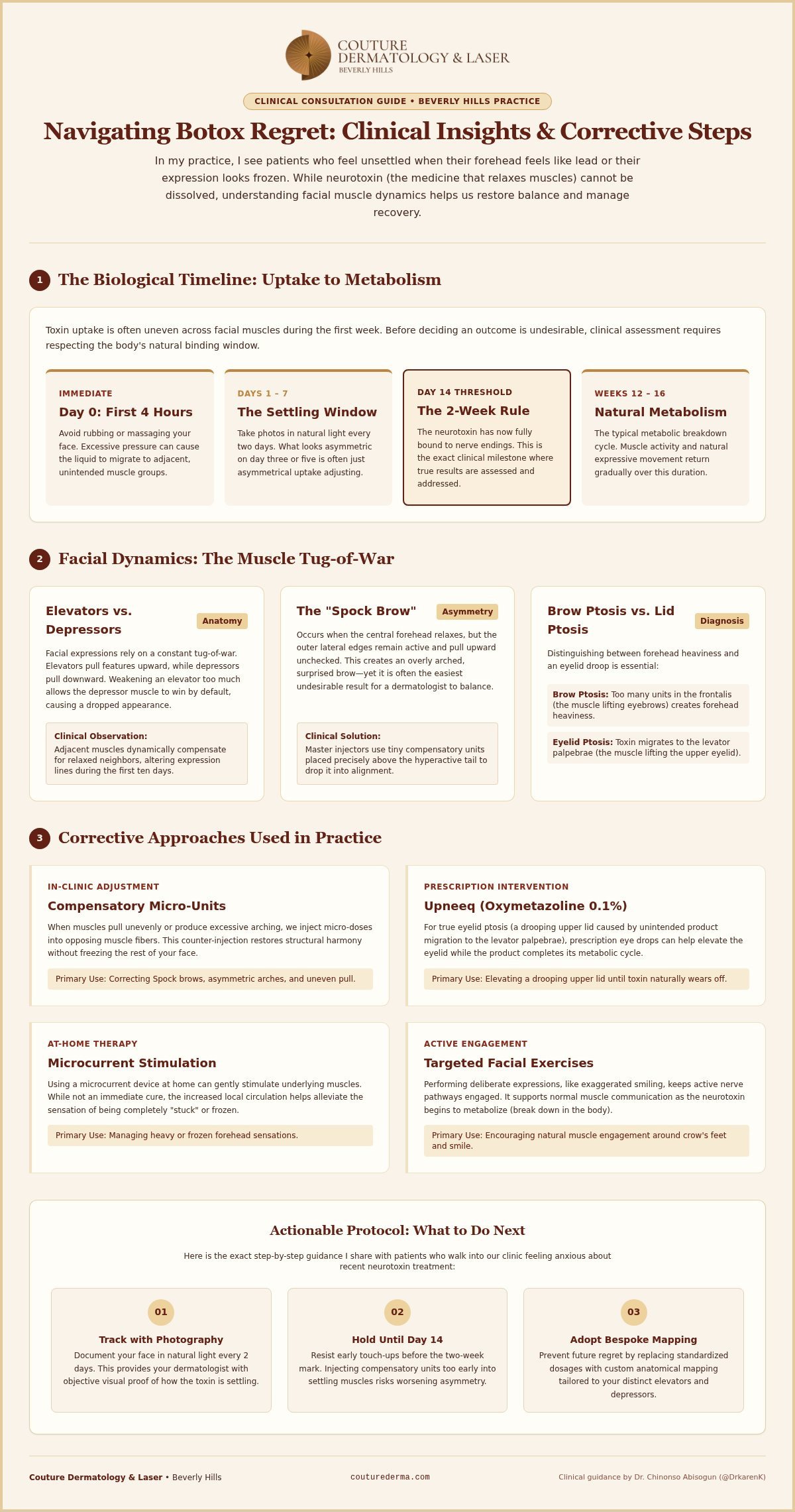
In my practice, I always tell patients to wait exactly 14 days before making a final judgment. Toxin uptake can be uneven during the first week, and what looks like a mistake on day five often settles by day fourteen. Take photos of your face in natural light every two days to track how the product is settling so you can show your doctor exactly what you’re seeing.
Why does my face look frozen?
You might feel like you’ve lost your signature smile or that your eyes look “smaller” when you laugh. This usually stems from a one-size-fits-all approach rather than the bespoke, Couture results we prioritize. It is a common skin concern for those who value natural movement over a perfectly smooth but motionless face, and it often occurs when too much product is placed in the crow’s feet area.
If you are currently wondering what to do if I hate my botox, try using a microcurrent device at home to gently stimulate the muscles. While not a cure, increased circulation can sometimes help you feel less “stuck” while the product naturally wears off. Or, you can focus on facial exercises like exaggerated smiling to keep the muscles engaged as the toxin begins to metabolize (break down in the body).
The Science Behind the ‘Bad’ Result: Muscle Dynamics Explained
Your facial expressions are actually the result of a constant tug-of-war between two groups of muscles. On one side, you have elevators (the muscles that pull your features up) and on the other, depressors (the muscles that pull them down). When we inject a neurotoxin, we are essentially taking one player out of that game. If we weaken an elevator too much, the depressor wins by default. This is often why people experience a heavy, dropped appearance in their forehead or brows.
I see patients who are distressed by these shifts, but it helps to know that unwanted Botox results and side effects are usually caused by this delicate balance being slightly off. Muscles are dynamic. They often try to compensate for their neighbors, which is why a “bad” result can sometimes look different on day three than it does on day ten. If you are panicking about what to do if I hate my botox, remember that your facial anatomy is still adjusting during those first few days.
Why migration happens after your appointment
Toxin migration occurs when the liquid moves from the specific injection site to an unintended muscle nearby. This is why I tell my patients to avoid rubbing or massaging their face for at least 4 hours after their treatment. Applying too much pressure, like during a professional facial or even by wearing a tight hat, can push the toxin toward the eye area. This might accidentally affect the levator palpebrae superioris (the muscle that lifts your eyelid), leading to a temporary droop.
And here’s the thing about your anatomy. The liquid follows the path of least resistance. If you lie down flat immediately after your appointment, you might inadvertently encourage the product to spread. I recommend staying upright for at least 4 hours to ensure the product stays exactly where it was placed. It’s a simple step, but it’s one of the most effective ways to prevent a result that feels “off.”
The role of dosage vs. placement
In many cases, the number of units used was perfectly fine, but the placement was just a few millimeters too low or too high. In my practice, I map each patient’s face like a custom-fit garment to account for these tiny variations in muscle size and strength. We look at how your muscles pull when you frown, smile, and look surprised. If you’re unhappy now, you might consider scheduling a consultation to see if a small “tweak” can restore harmony to your features.
Wait at least 14 days before you judge the final look. The toxin needs this time to fully bind to the nerve receptors (the areas where nerves and muscles communicate). If you try to fix it on day five, you’re shooting at a moving target and risk making the asymmetry worse. Patience is the hardest part of this journey, but it’s the most important for a refined outcome.
Can Bad Botox Be Fixed? Corrective Strategies in My Practice
Let’s be honest: you can’t “erase” Botox like you can dissolve dermal fillers with hyaluronidase (an enzyme that breaks down hyaluronic acid). But that doesn’t mean you’re stuck with a result that makes you feel uncomfortable for months. In my practice, I see patients who feel desperate for a solution, and we often add “compensatory units” (small, strategic doses) to balance out a Spock brow or asymmetry. If you’re asking what to do if I hate my botox, remember that a master tailor can often alter the fit of a garment even if they didn’t sew the original seams.
Strategic jawline contouring can sometimes help rebalance facial harmony if the lower face feels “off” or heavy. The American Society of Plastic Surgeons notes that while complications are rare, they are manageable when you work with an expert. If you notice a “peak” in your brow, wait until day 10 to 14 before seeking a touch-up. This ensures the initial treatment has fully settled before we make any corrections.
Fixing the Spock Brow and Asymmetry
A few units in the lateral frontalis (the outer forehead muscle) can drop a peaked brow. This is a 5-minute fix that can completely change how you feel about your reflection. And it’s much better than waiting three months for the “peak” to settle on its own. I see patients who walk in looking like a cartoon villain and walk out feeling like themselves again. It’s all about restoring the natural balance of your features.
But you have to be careful not to over-correct. Adding too much to the outer forehead can lead to a heavy brow, which is why I use a meticulous muscle mapping approach. If you are dealing with asymmetry where one side of your face moves more than the other, we can typically add 1 or 2 units to the stronger side. This creates a more uniform, “Couture” look that feels intentional rather than accidental.
Managing Eyelid Ptosis with Clinical Drops
If your actual eyelid is drooping, we use alpha-adrenergic drops (medication that stimulates the eyelid muscle) to lift it 1 to 2 millimeters. I see patients who find these drops to be a total lifesaver during the first 6 weeks. It doesn’t fix the Botox, but it hides the symptom while the toxin wears off. It’s a bridge to get you through the most visible phase of the complication.
For the best results, apply one drop of oxymetazoline 0.1% to the affected eye once daily. You will typically see a noticeable lift within 5 to 15 minutes that lasts for about 6 to 8 hours. This is a prescription treatment, so you’ll need to consult with a board-certified dermatologist to ensure it’s safe for you. But it’s a powerful tool for regaining your confidence while your body naturally metabolizes the product.
How to Speed Up Botox Recovery: What Actually Works?
You’re likely counting down the days until your face feels like yours again. While there is no magic eraser for neurotoxins, understanding your body’s metabolism (the process of breaking down and clearing substances) is the first step toward relief. If you are searching for what to do if I hate my botox, you have probably realized that patience is your primary tool. Typically, the body naturally metabolizes the toxin over a period of 12 to 16 weeks.
But we can sometimes nudge that process along by focusing on circulation. Increased blood flow to the treated area may help the nerves recover their function slightly faster. I often suggest my patients engage in gentle facial exercises. Literally making the expressions you are trying to regain can help “wake up” the muscles as the product begins to wear off. Your health comes first.
One thing to watch out for is your supplement routine. Many people take zinc with phytase (an enzyme that helps with mineral absorption) because it is known to make Botox last longer. If you want your results to fade quickly, you should avoid high doses of these specific supplements. It’s a small change, but it ensures you aren’t accidentally extending the lifespan of a look you don’t love.
The role of heat and circulation
In my practice, I see patients who are high-level athletes “burn through” their results much faster than those with a more sedentary lifestyle. This is because high-intensity exercise increases your overall metabolic rate and local blood flow. Frequent sauna use or hot yoga may also slightly shorten the duration of the effect. But please don’t overdo it. Your overall health and hydration are far more important than shaving a few days off a treatment cycle.
You can also apply a warm (not hot) washcloth to the treated area for 10 minutes twice a day to encourage blood flow. This gentle warmth is much safer than a heat lamp and helps support the local circulation without risking a burn. It is a simple, soothing way to stay proactive while you wait for the “frozen” feeling to lift.
What NOT to do: Avoiding dangerous DIY ‘fixes’
It is tempting to try and “rub out” the toxin, but this is a significant risk. Aggressive massage can cause the product to migrate (move to unintended areas), which might lead to new issues like a droopy eyelid. Or you might be tempted by “home remedies” like using heat lamps. These can easily cause skin burns and won’t reach the muscle depth needed to change the result.
Instead, focus on protecting your skin while you wait for the muscles to recover. Apply sunscreen 15 minutes before sun exposure to prevent UV damage and inflammation. If you’re wondering what to do if I hate my botox, the best thing is to let your body heal without adding extra stress. If the wait feels unbearable, you can book a corrective assessment at our Beverly Hills clinic to discuss professional strategies.
Preventing Future Regret: The Couture Approach to Injectables
The best way to love your results is to ensure they are tailored to your unique anatomy from the very first needle poke. In our Beverly Hills clinic, we treat every face like a bespoke garment that requires a precise fit. I start every new patient journey with a “Couture” consultation where we perform meticulous muscle mapping (the process of identifying exactly how your specific muscles move and pull). This prevents the guesswork that often leads people to search for what to do if I hate my botox. Always ask your injector to perform a dynamic assessment (watching your face move while you talk or smile) before they begin.
Expertise in facial anatomy is the difference between a tailored fit and a “ready-to-wear” disaster. I see patients who have been to “med spas” (facilities that offer aesthetic treatments often without on-site physician supervision) and realize too late that medical authority matters. A dermatologist spends years studying the layers of the skin and underlying musculature. You can read our guide on how to choose the best dermatologist in Los Angeles to find a partner you can trust.
What is my long-term rejuvenation plan?
Botox is just one thread in the larger tapestry of skin rejuvenation treatments. Sometimes, the “heaviness” people try to fix with toxin is actually a loss of volume or skin laxity (looseness). In these cases, under-eye brightening or laser work provides the “lift” you were actually looking for. Our goal is a refined, timeless look that makes you feel like the best version of yourself without looking like you’ve had “work” done. We focus on natural harmony rather than chasing every single line.
Restoring Your Confidence and Facial Harmony
You don’t have to hide away while your treatment settles. While waiting for the product to wear off is often the hardest part, knowing exactly what to do if I hate my botox gives you the power to manage your aesthetic journey with confidence. Whether we are using clinical drops to lift a heavy lid or adding a few units to balance a “Spock brow,” solutions exist that respect your unique anatomy. We’ve explored how muscle dynamics (the way your facial muscles work together) play a role and how strategic “tweaks” can restore balance.
In our Beverly Hills practice, we view every face as a masterpiece that deserves a custom fit. My Harvard-trained expertise and bespoke muscle mapping (the process of identifying your unique movement patterns) ensure that we prioritize natural movement for every skin type. If you are ready for a refined approach that honors your signature expressions, you can Book a Couture consultation with Dr. Abisogun in Beverly Hills. You deserve to look in the mirror and see a reflection that feels like home.
Frequently Asked Questions
Can I dissolve Botox if I don’t like the results?
No, you can’t dissolve Botox like you can with dermal fillers. While fillers use hyaluronidase (an enzyme that breaks down hyaluronic acid) for reversal, neurotoxins bind to your nerve receptors. Once that bond happens, it’s permanent until your body naturally grows new receptors. In my practice, I focus on managing your expectations while we wait for the product to wear off, typically over a few months, as the nerves regain function.
How long does it take for ‘bad’ Botox to start wearing off?
You will typically start to see the “frozen” feeling lift within 6 to 8 weeks. While the full effect usually lasts 3 to 4 months, the peak intensity often begins to fade after the second month. If you are wondering what to do if I hate my botox, remember that movement returns gradually rather than all at once. Your individual metabolic rate (how fast your body processes substances) will determine your specific recovery timeline.
Is it possible to fix a ‘Spock’ brow after Botox?
Yes, a “Spock brow” is one of the easiest issues to fix in our Beverly Hills clinic. This happens when the outer part of the frontalis (the muscle that raises your eyebrows) is still active while the center is relaxed. I typically add 1 or 2 compensatory units to that active area to relax the peak. It’s a quick, five minute adjustment that restores a much more natural, horizontal brow position for a refined look.
What are the drops called that fix a droopy eyelid from Botox?
The most common prescription option is Upneeq (oxymetazoline 0.1%). These are alpha-adrenergic drops that stimulate Müller’s muscle (a small, involuntary muscle in the eyelid) to lift the lid by 1 or 2 millimeters. They provide a temporary lift for about 6 to 8 hours. In my practice, I see patients who use these as a bridge to feel more confident until the toxin naturally metabolizes and the droop resolves on its own.
Will exercising more make my Botox go away faster?
It might help, but the effect is usually subtle. I see patients who are professional athletes in Los Angeles “burn through” their results faster because of their high metabolic rates. Frequent high-intensity exercise or sauna use increases circulation, which can speed up the recovery of nerve function. But I don’t recommend overexerting yourself just to clear the product; your overall health and safety are always the priority in any aesthetic journey.
Can I get more Botox to fix a result I already hate?
Sometimes adding a small amount is exactly what to do if I hate my botox. If the issue is asymmetry or an overly arched brow, a few extra units can balance the face. But if you already feel too “heavy” or “frozen,” adding more will only make the problem worse. This is why a consultation with a board-certified dermatologist is vital. We use muscle mapping to decide if a “tweak” is safe for you.
What should I tell my next injector to avoid another bad result?
Be very specific about what you disliked, such as feeling “heavy” or looking “surprised.” Ask your injector to perform a dynamic assessment (watching your face move during different expressions) before they start. In our practice, we recommend a conservative “Couture” approach for new patients. This means starting with fewer units and having you return in 14 days for a touch-up if you want more movement reduction after the initial set.
Is a heavy forehead after Botox a sign of a bad injection?
A heavy forehead often means the frontalis (the muscle responsible for lifting your eyebrows) received too high a dose. When this muscle is overly relaxed, it can’t hold the weight of the brow up, leading to a “caveman” look. It is a common sign that the injection placement or dosage wasn’t tailored to your specific anatomy. In most cases, this heaviness will start to feel better after 4 to 6 weeks as movement returns.