
You’ve tried three different brightening serums this month, but that stubborn patch of melasma (a common type of skin darkening) on your cheek hasn’t budged. It’s exhausting to feel like you’re guessing. If you’ve been searching for an ethnic skin specialist beverly hills residents trust, you likely know that your skin requires a bespoke fit rather than a one-size-fits-all solution.
In my practice, I see patients who are rightfully scared of laser burns or dark spots left behind by generic treatments. Here’s the thing: skin with more melanin (the cells that give your skin its color) reacts differently to heat and light. But you shouldn’t have to choose between safety and the clear, glowing results you want.
I promise that a tailored, pigment-aware approach can give you the radiant skin you’ve been searching for while keeping your heritage respected. And we’re going to walk through how specialized tools like the Fotona laser safely treat stubborn pigment to transform your skin journey from stressful to self-assured.
Key Takeaways
- Learn why skin with more melanin reacts differently to irritation and how a bespoke approach protects your melanocytes (the cells that produce skin pigment) from unintended damage.
- Discover how modern technology like the Fotona laser allows us to treat melasma and scarring safely by targeting pigment without overheating the outer layer of skin.
- Understand why finding an ethnic skin specialist beverly hills expert is vital for avoiding common medical mistakes like laser burns or permanent discoloration.
- See how a “couture” consultation maps your unique heritage and treatment history to create a collaborative, personalized path toward clearer skin.
- Gain actionable advice on building a home routine that maintains your clinical results, including why sunscreen is a non-negotiable step for every skin tone.
Why does ethnic skin require a bespoke dermatological approach?
You’ve likely spent a small fortune on ‘brightening’ creams that did nothing but irritate your skin. Or maybe they made your dark spots worse. In my practice, I see patients who feel defeated by products that weren’t built for their specific needs. As an ethnic skin specialist beverly hills patients trust, I know that true care begins with understanding your melanocytes (cells that produce skin pigment).
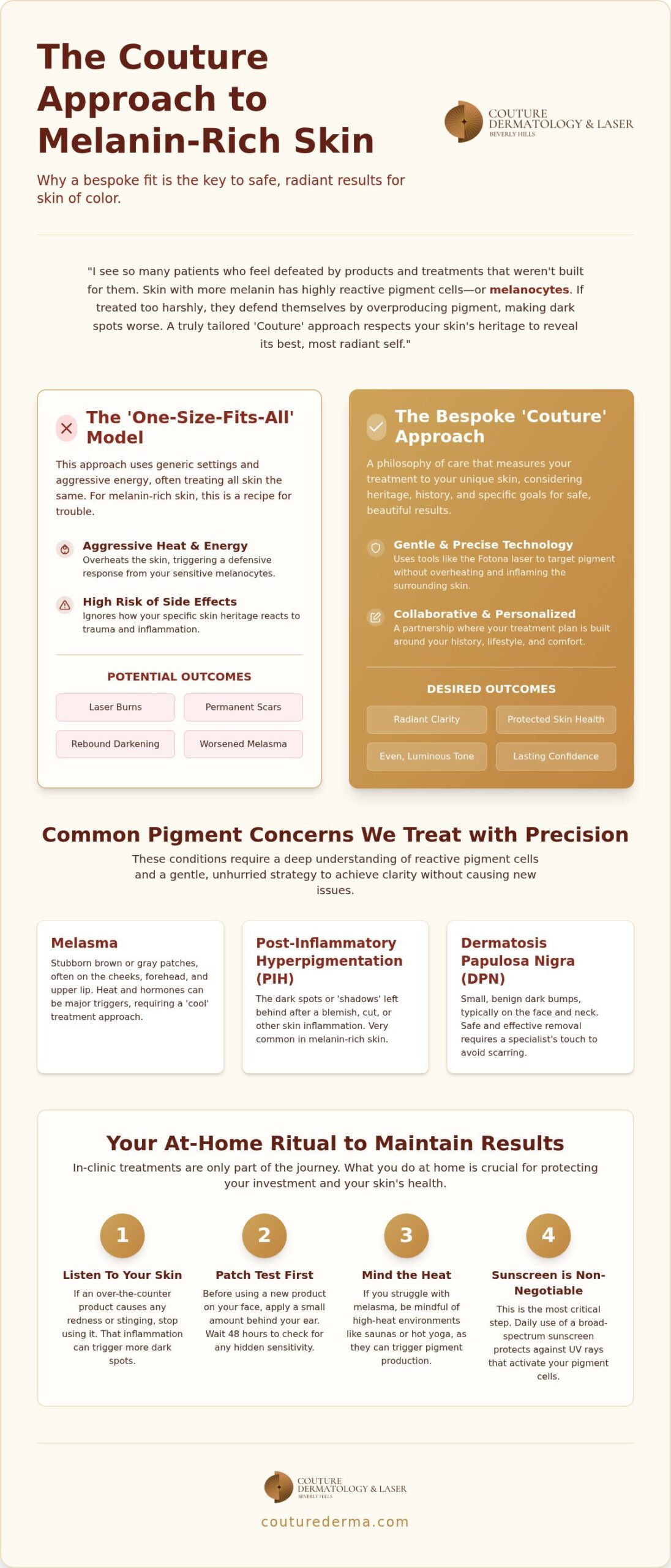
These cells are the architects of your skin’s beautiful tone, but they’re also highly reactive. If you treat them too harshly, they defend themselves by overproducing pigment. That’s why I use a “Couture” philosophy. Just as a bespoke suit is measured to the millimeter, your skin treatment must account for your specific heritage and history.
Actionable Tip: If you’re using an over-the-counter brightening cream, stop immediately if you notice redness or stinging. This inflammation can actually trigger your pigment cells to create more dark spots.
We often talk about the Fitzpatrick Scale, which categorizes skin by how it reacts to the sun. But in our clinic, that’s only a starting point. It doesn’t tell me how your skin heals or how it has responded to past traumas. A truly tailored approach looks beyond a simple number to see the person underneath.
What makes melanin-rich skin unique?
Melanin acts as a natural shield against sun damage and premature aging. It’s why many of my patients look years younger than their biological age. But here’s the thing: that same protection makes your skin prone to post-inflammatory hyperpigmentation (dark spots that appear after an injury or inflammation).
I see this skin symptom daily, whether it’s from a simple blemish or a more complex condition like Dermatosis papulosa nigra (small, benign dark bumps often found on the face and neck). Because your pigment cells are so active, even minor irritation can lead to long-lasting shadows. This requires a gentle, unhurried strategy to clear the skin without causing new issues.
Actionable Tip: Before starting a new skincare product, wait 48 hours after a small patch test behind your ear to check for hidden irritation or sensitivity.
The dangers of the ‘one-size-fits-all’ model
In my practice, I often see patients who suffered burns or permanent scarring from clinics that used the same laser settings on everyone. They were told an “aggressive” treatment would get faster results. But with reactive pigment, aggressive is often the enemy of excellence. It can lead to deeper damage that takes months to correct.
Choosing the right expert means finding someone who understands specific issues like acne scar refinement for deeper skin tones. We prioritize safety and steady progress to ensure your results are as radiant as they are safe. It’s about a collaborative journey where your skin’s health is never compromised for a quick fix.
What are the most common pigment concerns I treat in Beverly Hills?
In my practice, I see patients who have tried every peel under the sun. Many come to me frustrated because their melasma (a condition causing brown or gray patches on the face) returned even darker after a generic treatment. As an ethnic skin specialist beverly hills patients trust, I know that these concerns require a cooler, more patient approach than standard protocols suggest.
It’s vital to understand that common skin conditions in people of color often stem from highly reactive pigment cells. While lighter skin might handle aggressive heat, your skin is sensitive to temperature shifts. Treating these issues isn’t about a quick fix; it’s about a long-term, gentle strategy that respects your skin’s heritage.
Actionable Tip: If you struggle with melasma, try to avoid high-heat environments like saunas or hot yoga. Heat can trigger pigment production just as much as direct sunlight does, making your dark spots more stubborn.
How do we manage stubborn melasma?
I often see patients who think they are “resistant” to treatment. Usually, they’ve just been treated with the wrong tools. In our clinic, we focus on ‘cold’ technologies or fractional lasers that don’t overheat the skin. This prevents the rebound darkening that happens when the skin feels attacked by excessive energy.
The Fotona laser is one of our signature tools for melasma refinement. It allows us to target the pigment precisely without disrupting the surrounding tissue. This bespoke method ensures we break up the dark patches while keeping the rest of your skin calm and radiant. If you’re tired of the cycle of fading and darkening, you can book a consultation to discuss a plan tailored to your needs.
Can acne scars be refined without irritation?
For many of my patients, the dark spots left behind after a breakout are more distressing than the acne itself. We call this post-inflammatory hyperpigmentation (discoloration that follows skin injury). It’s important to distinguish between these pigment issues and actual changes in skin texture, like pitted or raised scars.
Effective acne scar refinement requires treating both the color and the texture simultaneously. We also look at preventatives, such as keloid management (thick, raised scars) for those prone to over-healing. Early intervention with specialized injection protocols can often stop a small bump from becoming a permanent concern. We also address uneven skin tone, which often presents as a general “muddiness” rather than clear spots.
Actionable Tip: Wait 20 minutes after cleansing before applying tretinoin (a vitamin A derivative used for skin renewal). Applying it to damp skin increases absorption too quickly, which often leads to irritation and new dark spots.
Are lasers safe for darker skin tones?
Let’s be honest. The fear of lasers in the Black and Brown community is rooted in real medical mistakes. I’ve seen the results of those mistakes in my office, and they’re often heartbreaking. But as an ethnic skin specialist beverly hills patients rely on, I want you to know that the technology has evolved. A laser doesn’t actually see your skin as a whole. Instead, it looks for specific “targets” like pigment, hair, or water.
The secret to safety is choosing the right wavelength. For my patients with deeper tones, the Nd:YAG laser is the gold standard. This specific light wavelength passes through the melanin in your outer layer of skin without being absorbed, which protects you from burns. In our clinic, we also use a “Couture” protocol to prepare your skin. This involves pre-treating with specific creams to “quiet” your melanocytes (cells that produce skin pigment) for several weeks before your procedure.
Actionable Tip: If you’re considering a laser treatment, ask your provider which specific wavelength they plan to use. If they aren’t using an Nd:YAG for hair removal on dark skin, it’s a sign they may not have the specialized equipment your skin requires.
The truth about CO2 and Fractional lasers
I often get asked about the difference between ablative and non-ablative options. Ablative lasers essentially “vaporize” the top layer of skin to force new growth. Non-ablative lasers, however, leave the surface intact and heat the tissue underneath. In my practice, I prefer a non-ablative, “low and slow” approach. This builds collagen and smooths texture without the risks of significant downtime. For a deeper look at these options, you can explore our guide to laser skin resurfacing.
Laser hair removal safety for ethnic skin
Using the wrong device for hair removal can cause “ghosting” or white spots (hypopigmentation). This happens when the laser’s energy is too high or the wavelength is too short, causing it to accidentally damage the pigment in your skin. I prioritize the Nd:YAG wavelength for permanent hair removal because it targets the hair follicle while leaving your skin’s natural color untouched.
Similarly, specialized practices such as Quttainah Medical Center utilize these advanced Nd:YAG lasers to provide safe and effective laser hair removal for diverse skin tones.
Actionable Tip: Always request a “test patch” 48 hours before a full laser session. At our Beverly Hills practice, we treat a small, hidden area first to ensure the settings are a perfect fit for your unique tone. This simple precaution prevents unexpected reactions and ensures your results are as radiant as you deserve.
How can you build a tailored skincare regimen at home?
You’ve likely spent years curating a shelf of products, but it’s hard to know if they’re actually serving your needs. Your home routine is the “maintenance” that protects your clinical investment. As an ethnic skin specialist beverly hills patients trust, I see how a daily regimen can either support or sabotage the results we achieve in the office.
Let’s talk about the non-negotiable: sunscreen. Even if you have high-melanin skin, you need protection from UVA rays (long-wave ultraviolet light that causes aging). These rays trigger your melanocytes (cells that produce skin pigment) to create uneven tones and dark spots. Without consistent protection, any clinical work we do will be temporary.
Cleansing is also vital. If you strip your skin’s natural oils with harsh soaps, you damage the outer layer of skin. This leads to irritation, which your pigment cells interpret as a signal to produce more color. Using active ingredients like Vitamin C and retinoids (vitamin A derivatives) also requires a careful touch. It’s better to start with a lower concentration twice a week to build tolerance without the risk of new inflammation.
The SPF struggle: Finding the right fit
I hear from patients all the time that they hate sunscreen because it looks “ashy” or purple on their skin. This is usually caused by physical blockers that don’t blend well with deeper tones. I often recommend tinted mineral sunscreens or high-quality chemical filters that vanish into the skin without leaving a trace.
Actionable Tip: Apply your sunscreen 15 minutes before sun exposure, even on cloudy days in Los Angeles. UV rays pass through clouds easily, and consistent protection is the only way to prevent hyperpigmentation (dark spots) from returning.
Addressing under-eye concerns
Dark circles in ethnic skin are often caused by excess pigment rather than just a lack of sleep. While under-eye brightening creams can help, they often have limits. Sometimes we need to address the “hollows” or volume loss with fillers for a truly refreshed look. This combination of home care and clinical precision is the heart of a bespoke approach.
If your current home care feels like guesswork, you can book a consultation to create a routine that respects your skin’s unique chemistry. We’ll work together to find the exact products that protect your heritage while enhancing your natural glow.
What should you expect from a couture-level consultation?
Walking into a new clinic can feel intimidating, especially if you’ve been dismissed by doctors who didn’t understand your unique needs. A consultation at our Beverly Hills clinic isn’t just an appointment; it’s a collaborative journey. As an ethnic skin specialist beverly hills, I ensure we take the time to map your skin’s entire history.
We look at everything from your heritage to how your skin reacted to that “miracle” cream you tried last year. This long-view plan is essential because we don’t just treat the spot you see today. We work to prevent the one coming tomorrow by stabilizing your pigment cells (the cells that give your skin its color).
Actionable Tip: Before your visit, make a list of every product that has caused your skin to sting, redden, or darken. This history helps me understand your skin’s sensitivity levels before we even begin a physical exam.
Elite credentials provide the foundation of our partnership. My 15 years of experience and Harvard training allow me to combine scientific rigor with an artistic eye. You aren’t just getting a treatment; you’re getting a specialized focus designed for your specific chemistry and heritage.
The tailoring process: From assessment to transformation
During your exam, I use specialized lighting to see deep pigment that hasn’t even reached the surface yet. We often start with medical-grade topicals (creams applied to the skin) for 8 to 12 weeks before moving to lasers. This “quiets” your melanocytes (cells that produce skin pigment) to ensure any future procedure is as safe as possible.
And we’ll always be realistic about your progress. Transformation is a gradual progression rather than a hurried task. While some changes happen quickly, most significant improvements require a series of sessions to maintain the health of your skin’s outer layer of skin. For those exploring professional skin-care and permanent-makeup options, Synergy Beauty provides specialized expertise and training that aligns with these high standards of care.
We apply the same pigment-safe principles to every inch of your body. Whether we’re treating discoloration on your back or looking at jawline contouring, your safety is the priority. These non-invasive procedures are tailored to enhance your natural structure without risking your skin’s tone or causing dark spots.
Actionable Tip: Take clear photos of your skin in natural light from different angles before your appointment. These “baseline” images are incredibly helpful for tracking your transformation over the first few months of our journey together.
If you’re ready to stop guessing and start glowing, let’s talk about a plan that’s actually made for you. Our Beverly Hills practice is here to guide you through a safe, sophisticated path to the skin you’ve always wanted.
Your path to radiant, safe transformation
You’ve seen that treating melanin-rich skin is an art that requires a deep understanding of your heritage and unique chemistry. It’s about moving away from generic protocols and toward a bespoke plan that respects your melanocytes (the cells that produce skin pigment). By combining Harvard-trained expertise with a specialized focus on Skin of Color, we ensure your journey is as safe as it is effective.
Finding an ethnic skin specialist beverly hills expert means you don’t have to fear the “one-size-fits-all” treatments that often lead to irritation or dark spots. We use advanced, pigment-safe laser technology and unhurried consultations to build a foundation of trust. Your results are a collaborative effort between our clinical precision and your dedicated home care.
Experience a couture-level consultation with Dr. Abisogun at our Beverly Hills practice.
I’m here to help you move past the frustration of stubborn spots and into a new chapter of self-assurance. Your skin’s most radiant days are just beginning, and I look forward to guiding you through every step of this transformation. Let’s work together to reveal the clarity you deserve.
Frequently Asked Questions
Is it true that people with dark skin don’t need sunscreen?
Everyone needs protection from the sun, regardless of their melanin levels. While deeper tones have a natural defense, it isn’t enough to block UVA (aging rays) or UVB (burning rays) entirely. In my Los Angeles practice, I see how sun exposure triggers melanocytes (cells that produce skin pigment) to create uneven tones. You should apply a broad-spectrum sunscreen 15 minutes before heading out into the California sun to keep your results clear and safe.
Which laser is the safest for Black or Brown skin tones?
The Nd:YAG laser (a specific long-wavelength light) is widely considered the safest option for deeper skin. Its wavelength bypasses the melanin in your outer layer of skin to reach targets like hair follicles or deeper vessels without causing burns. As an ethnic skin specialist beverly hills, I prioritize this technology because it offers precision while protecting your natural color. It’s often the best choice for safe, effective hair removal or skin rejuvenation in my clinic.
How do I get rid of dark spots from old acne without making them worse?
Clearing dark spots from old acne requires a patient, multi-step strategy. We focus on treating PIH (discoloration that follows skin injury) with gentle medical-grade topicals (creams applied to skin) before considering any procedures. It’s vital to avoid picking at blemishes, as this trauma signals your pigment cells to produce more color. In our Beverly Hills clinic, we typically start with a bespoke home routine to quiet the skin before moving to more advanced clinical options.
Can chemical peels cause more hyperpigmentation in ethnic skin?
Chemical peels can be very effective, but they often cause more darkening if the acid is too strong for your tone. This reaction is called post-inflammatory hyperpigmentation (dark spots that appear after skin irritation). In my practice, I prefer light to medium depth peels that use specific acids designed for reactive skin. We always perform a patch test first to ensure your skin can handle the treatment without triggering a defensive pigment response.
What is the best way to treat melasma if I have a deeper skin tone?
Treating melasma (hormonal pigment patches) in deeper tones requires a “low and slow” approach to avoid heat-triggered darkening. I often utilize the Fotona laser because it targets the pigment without overheating the surrounding tissue. This helps break up the “mask of pregnancy” while keeping your skin calm. We combine this with specific inhibitors (ingredients that block pigment production) to ensure the dark patches don’t return once the treatment series is complete.
Why do I get keloids and can a dermatologist help remove them?
Keloids (thick, raised scars that grow beyond the original injury) are often a result of your skin’s genetic tendency to over-heal. While they can be stubborn, a dermatologist can help by using specialized steroid injections to flatten the tissue. In my practice, we also use specific laser protocols to reduce the redness and itching associated with these scars. Early intervention is key, so I typically recommend starting a plan as soon as you notice a scar thickening.
How long does it take to see results from an ethnic skin treatment plan?
You should typically expect to see meaningful results within 3 to 6 months of consistent care. Your melanocytes (cells that produce skin pigment) need time to stabilize and stop over-reacting to daily stressors. Skin transformation is a gradual progression rather than a hurried task, especially when we are working with deeper pigment concerns. While some brightness often appears within the first few weeks, the most significant and lasting changes require patience and a unhurried clinical strategy.