Last Tuesday, a patient called my Beverly Hills office in a quiet panic because her skin looked like a “cracked desert.” She was terrified of permanent scarring during her laser skin resurfacing recovery, which is a fear I hear often in my fifteen years of practice. You’ve likely spent weeks researching the perfect laser. But now that the procedure is over, the “raw” phase feels far more intimidating than the brochures suggested.
It’s completely normal to feel a bit of anxiety when your reflection doesn’t match your goals yet. In my practice, I view this time as the “setting phase” of a custom-fit garment. Your aftercare determines the final elegance of the result. And let’s be honest, the conflicting advice you find online only makes the process feel more uncertain.
I’m going to help you manage this journey with clinical precision so you can stop worrying about PIH (post-inflammatory hyperpigmentation, or dark spots). This guide provides a day-by-day roadmap and the bespoke skincare rituals you need to maximize your results. For an immediate win, keep your recovery balms in the refrigerator to soothe heat during those first 24 hours. We’ll break down exactly what to expect from the moment you leave the clinic until your final glow is revealed.
Key Takeaways
- Map your transformation from the initial “Intense Sunburn” stage to the final reveal with our precise day-by-day healing timeline.
- Master the clinical art of “moisture sandwiching” to support your laser skin resurfacing recovery while keeping your skincare ritual elegantly simple.
- Learn the specific safety protocols for returning to the gym and applying makeup so you don’t risk your aesthetic investment.
- Recognize the difference between normal milestones like “grid marks” and issues that require a professional check at our Beverly Hills practice.
What does laser skin resurfacing recovery actually feel like?
In my Beverly Hills practice, I describe the days following your treatment as the moment a master tailor begins reweaving the very fabric of your skin. It’s a transformative period. We call this the remodeling phase. During the initial stage of laser resurfacing, your body is effectively replacing older, sun-damaged tissue with fresh, organized collagen. This isn’t just about surface-level healing; it’s a deep structural renovation that takes time to settle.
Many sources claim it feels like a mild sunburn, but in my experience, the sensation is more complex. I see patients who describe an intense, radiant warmth and a rhythmic pulsing for the first few hours. Your skin will feel incredibly tight, almost like a custom garment that’s a size too small. This is a physical sign that your laser skin resurfacing recovery has begun. Your body is rushing fluids to the area to start the repair work, which creates that characteristic “full” feeling in the face.
To better understand this concept, watch this helpful video:
Downtime isn’t a one-size-fits-all term. It exists on a spectrum depending on the energy we used. If we utilized an ablative laser like a CO2, you’re looking at a raw phase where the outer layer of skin is removed to reveal a new surface. This requires significant care. If we opted for a fractional approach, which creates thousands of microscopic treatment zones while leaving surrounding tissue intact, you might just have a deep pink glow for a few days. Both paths lead to radiance, but the “social downtime” varies significantly.
The inflammatory response: Why redness is your friend
Redness, or erythema (skin flushing), is actually a signal that growth factors are hard at work. It means blood flow is increasing to deliver the nutrients your cells need to rebuild. In my practice, I differentiate between the raw, weeping look of a traditional CO2 laser and the “bronzed” pink glow of fractional treatments. Both are healthy signs of progress. But you must be gentle during this peak inflammatory window.
Actionable Tip: Keep a clean, silk pillowcase ready to minimize friction during the first 48 hours. The smooth surface prevents snagging on sensitive skin and helps keep the area cool while you sleep.
Healing across the Fitzpatrick scale
I see many patients with melanin-rich skin who worry about scarring or permanent marks. It’s a valid concern because heat can trigger melanocytes (cells that produce skin pigment) to overreact. This can lead to PIH (post-inflammatory hyperpigmentation), which are dark spots that linger after the skin has healed. In my practice, I often use a specialized pre-conditioning protocol for these cases. This typically involves using specific topical lighteners for four weeks before the procedure to “quiet” those pigment cells. This ensures your laser skin resurfacing recovery is safe and effective, whether we are addressing sun damage or focusing on acne scar refinement.
Your couture recovery timeline: From Day 0 to the final reveal
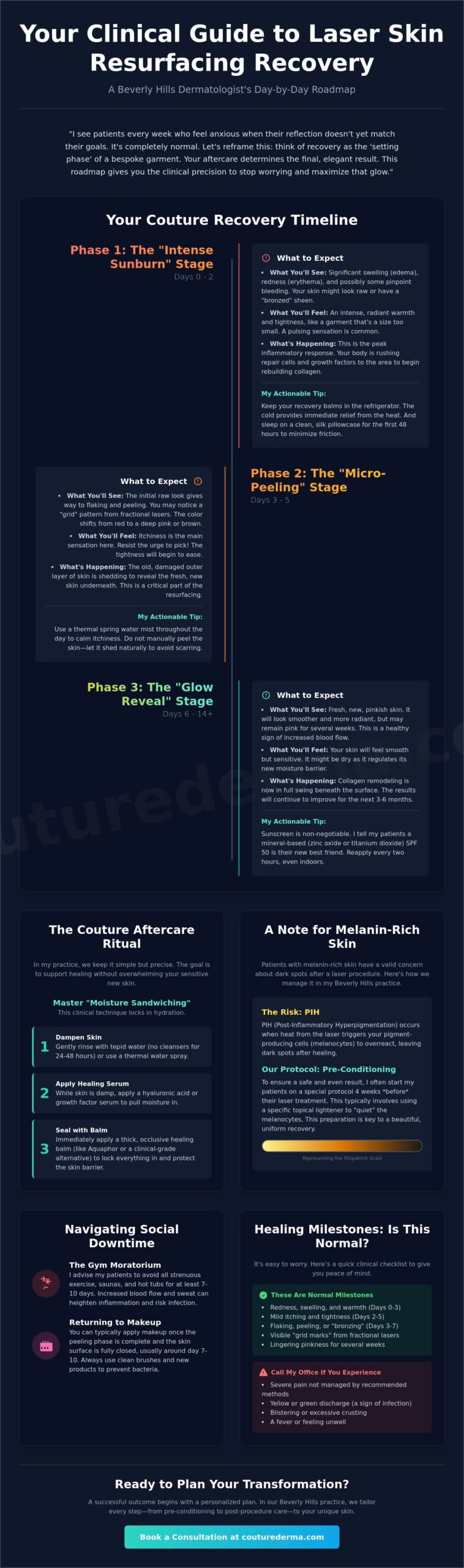
Think of your laser skin resurfacing recovery as the “setting” phase of a bespoke gown. It’s not a mystery. It’s a structured, predictable sequence. In my practice, I find that patients feel much more confident when they know exactly what to expect in the mirror each morning. This isn’t a vague 5 to 21 day window like some textbooks suggest. It’s a transformative journey that unfolds in specific, manageable stages.
Days 0 and 1 are what I call the “Intense Sunburn” stage. You’ll see significant swelling (edema) and perhaps some pinpoint bleeding. This is your skin’s way of rushing repair cells to the surface. It’s the most physically active part of the healing process. While it looks intense, it’s a sign that the reweaving of your skin’s fabric has officially begun.
The first 24 hours: Managing the “heat”
Managing the “heat” is your primary goal during this initial window. In my practice, I insist on using tepid water only. Please avoid all cleansers tonight. You might see some clear oozing. This is just serous fluid (a natural healing liquid) being released as your barrier resets. It’s completely normal.
Actionable Tip: Use a fan or cool air to soothe the skin. Avoid placing ice packs directly on your face, as these can cause “cold burns” on your delicate, new tissue.
The sandpaper phase: Resisting the urge to pick
By days 2 to 4, you’ll enter the “Bronzing” stage. Your skin will darken and start to feel like fine-grit sandpaper. This is the old, damaged tissue preparing to depart. You must resist the urge to pick. Picking at these flakes leads to “micro-scarring” and ruins the bespoke finish we’ve worked so hard to achieve. I tell my patients that if a flake is not ready to fall off, it’s still protecting the new skin underneath. If the itching becomes bothersome, I often suggest a simple over-the-counter antihistamine rather than scratching.
During days 5 to 7, the “Peeling” stage reveals fresh, pink “baby skin.” By days 10 to 14, your social downtime usually ends. You are now in the “Refinement” stage. While you look great, the American Society of Plastic Surgeons notes that recovering from laser skin resurfacing is a process that continues beneath the surface for weeks.
Long-term remodeling: The 3-month mark
The “final fit” of your treatment isn’t truly visible for 90 days. This is especially true for acne scar refinement, where collagen takes months to build and lift the skin. It’s a journey, not a sprint. If you want to discuss a customized plan for your own transformation, you can explore our online booking options to find a time that works for you. Patience is the ultimate luxury here. Your results will continue to improve as that new collagen matures and settles into place.
The Couture aftercare ritual: Protecting your skin investment
In my practice, I see patients who are eager to return to their luxury serums immediately after a procedure. But here is the truth: your skin is currently a delicate, open canvas. Your standard 10-step routine is officially on hiatus. We prioritize a “Less is More” philosophy during your laser skin resurfacing recovery to prevent irritation and ensure the new barrier forms without interruption. Think of this as the final pressing of a bespoke suit. You would not use harsh chemicals on fine silk, and you should not use them on your healing face.
Bland is better. You must avoid fragrances, essential oils, and active acids like Glycolic or Salicylic. These ingredients can cause unnecessary inflammation or even chemical burns on compromised skin. I often tell patients that the goal is to keep the skin “quiet” so the internal remodeling can happen undisturbed. One clinical protocol I insist on is waiting 20 minutes after a gentle cleanse before applying any prescribed healing balms. This allows the skin’s pH to stabilize and ensures the balm sits on a calm surface rather than reacting with residual water.
The “Sandwich” method for hydration
Hyaluronic Acid (HA) is the star of your recovery ritual. It is a molecule that holds up to 1,000 times its weight in water, which makes it essential for rehydrating new skin cells. In my practice, we use a “sandwich” method. You apply a pure HA serum and immediately seal it with a thick, occlusive barrier cream like Aquaphor or EltaMD Post-Procedure balm. This locks the moisture into the deeper layers where it is needed most. It effectively creates an artificial barrier while your own skin is still under construction.
Stay away from Retinol and Vitamin C for at least 7 to 10 days. These are powerhouses for anti-aging, but they are too aggressive for skin that is still reweaving its fabric. Actionable Tip: Mist your face with thermal spring water before applying HA for better absorption. This provides the HA with immediate moisture to grab and pull into your skin, rather than drawing moisture out from the deeper tissue.
Beverly Hills sun strategy: Beyond SPF
Living in Beverly Hills means we deal with year-round UV damage. During your laser skin resurfacing recovery, the sun is your greatest adversary. New skin lacks the natural defenses of mature tissue, making it highly susceptible to new dark spots or hyperpigmentation. Physical (mineral) sunscreens containing Zinc Oxide or Titanium Dioxide are mandatory. Chemical filters often sting or burn raw skin, whereas mineral options sit on top to reflect light away safely without causing a reaction.
Remember the “Hat and Shade” rule. SPF is your second line of defense. Physical shade, such as a wide-brimmed hat and staying under an umbrella, is your first. If you are driving, be mindful of the sun coming through the side window. Your new skin is an investment that deserves the highest level of protection while it settles into its final, radiant form. Let’s be honest, skipping the hat for just ten minutes can undo weeks of careful healing.
Navigating social downtime: Makeup, exercise, and the “Gym Moratorium”
The most challenging part of laser skin resurfacing recovery often isn’t the physical sensation. It’s the sudden shift in your lifestyle. In my Beverly Hills practice, I see patients who are eager to return to their Pilates classes or high-profile social events within forty-eight hours. But let’s be honest, rushing this phase is like wearing a bespoke silk gown before the final seams are even sewn. Your skin needs a period of undisturbed refinement to ensure the best possible outcome.
Your diet also plays a silent role in how quickly you heal. High salt intake and alcohol are recipes for prolonged swelling. They cause your body to retain fluid, which keeps your face looking “puffy” far longer than necessary. If you want to see the sharp results of your treatment, such as improved jawline contouring, you must prioritize anti-inflammatory choices for the first week. Think of it as a internal support system for your external transformation.
When can I wear makeup again?
While some sources suggest you can camouflage redness after a day or two, I recommend a strict “Makeup Moratorium” for at least 72 hours. In my practice, I suggest waiting until the peeling process is at least 90% complete. Applying heavy foundations too early can trap bacteria in the delicate, healing tissue. I also insist on the “Clean Brush” rule. If you must use tools, they have to be brand new or deep-cleaned. Old makeup sponges are a breeding ground for infection and can ruin your skin investment.
Actionable Tip: Use a mineral-based tinted sunscreen as your first “makeup” step. This provides a touch of coverage while offering the physical UV protection your skin desperately needs without the risk of irritation from chemical dyes.
Why exercise is on hiatus
The “Gym Moratorium” is a non-negotiable part of the protocol. When you exercise, the salt in your sweat can seep into the micro-channels created by the laser, causing intense stinging and inflammation. There is also a significant risk of “miliaria” (heat rash). This occurs when sweat gets trapped under the heavy healing balms we’ve applied, leading to tiny, itchy red bumps. This can be particularly problematic if we’ve focused on delicate areas, like during under-eye brightening treatments.
Raising your core temperature through hot yoga or steam rooms can re-trigger redness and swelling even days after you think you’ve healed. Instead, I encourage my patients to embrace a “rest and refine” weekend. Treat this time as a luxury staycation for your skin. If you are unsure if your skin is ready for the treadmill, you can book a quick check-in with our team to ensure your recovery is on the right path. True radiance requires a bit of patience, but the final reveal is always worth the wait.
Is this normal? Identifying the milestones of healthy healing
I see patients who call my Beverly Hills office around Day 4 or 5 feeling a bit of “healing fatigue.” The initial excitement of the procedure has worn off, and you are staring at tiny white bumps (milia) or feeling an intense, nagging itch. Let’s be honest, this stage of laser skin resurfacing recovery can be frustrating. But here is the good news: itching is actually a sign that your nerves and skin barrier are successfully repairing themselves. It means the “reweaving” process is in full swing and your new skin is becoming active.
Think of our practice as your collaborative partner during this transformation. We are not just here for the laser session. We are here for the entire journey. I view your follow-up appointment as the “final fitting” of your skin rejuvenation. It is where we ensure every detail has settled perfectly and adjust your long-term skincare ritual to maintain that new, bespoke glow. If you find the itching is keeping you awake, try a clean, cold compress for five minutes before bed to quiet the skin.
Normal side effects vs. Warning signs
It’s important to distinguish between the natural “purging” of healing and true complications. I often see mild bruising, particularly when we perform under-eye brightening treatments. The skin there is thin, and a little shadow is typical. Swelling and deep redness are also part of the course. But you should stay vigilant for warning signs. If you notice honey-colored crusting, extreme pain that doesn’t respond to Tylenol, or a fever, please call us immediately. While complications are rare when you are in the hands of a board-certified expert, clinical realism is always better than blind optimism.
The “Grid Mark” mystery
If you see tiny “dots” on your face that look like a fine mesh, don’t panic. These are grid marks. They are a hallmark of fractional lasers, which leave microscopic pillars of treated tissue surrounded by healthy skin to speed up healing. In my practice, I explain that these marks are proof of the bespoke precision of our laser settings. They show exactly where the energy has been delivered to stimulate new collagen. They will naturally fade as your skin sheds its old layers and reveals the fresh fabric underneath.
Actionable Tip: If grid marks linger beyond the first two weeks, a gentle lactic acid wash can help. Wait until at least Day 14 before introducing this. It provides a very mild exfoliation that helps those last few “dots” move along without compromising your new, delicate barrier. Remember, your laser skin resurfacing recovery is a collaborative process. We are always a phone call away to ensure your path to radiance is as smooth as your final results will be.
Begin your journey toward lasting radiance
Your laser skin resurfacing recovery is not a passive waiting period. It is the active reweaving of your skin’s fabric into a more refined and luminous version of itself. By following a bespoke day-by-day timeline and embracing a “bland is better” aftercare ritual, you ensure that every microscopic channel created by the laser translates into a flawless result. Let’s be honest, the “raw” phase is temporary; the confidence of healthy, restored skin is permanent.
In my practice, I combine my Harvard-trained expertise with specialized protocols designed for all skin types and tones. This ensures your healing is safe and your results are exceptional. We don’t believe in one-size-fits-all solutions. Instead, we offer personalized Beverly Hills aftercare plans that reflect the meticulous care your skin deserves. If you are ready to navigate your transformation with clinical precision, I invite you to Book a Couture Recovery Consultation with our team today. Your most radiant reflection is waiting just beneath the surface.
Frequently Asked Questions
How long does laser skin resurfacing redness last?
Redness typically lasts between 5 to 14 days, depending on the intensity of the energy we used. For fractional lasers, you might see a deep pink glow for about a week. With deeper ablative lasers, that flushing can linger for several weeks as the skin remodels. In my practice, I see patients whose redness fades faster when they strictly follow our cooling and hydration protocols.
Can I wash my face the night after laser resurfacing?
I recommend avoiding all cleansers and even splashing water on your face the night after your procedure. Your skin is in its most vulnerable state and needs to remain undisturbed to start the reweaving process. Typically, you can begin very gentle tepid water rinses the following morning. In our Beverly Hills practice, we provide a specific timeline for when it’s safe to reintroduce a soap-free cleanser.
When can I use Retinol or Tretinoin again after my laser treatment?
You should wait at least 7 to 10 days before reintroducing Retinol or Tretinoin into your ritual. These active ingredients are too aggressive for skin that is still repairing its barrier. I often tell patients to wait 20 minutes after cleansing before applying tretinoin once they do restart. This helps prevent unnecessary irritation during the final stages of your laser skin resurfacing recovery.
Is it normal to have small white bumps (milia) after laser?
Yes, tiny white bumps called milia are a very common and temporary part of the healing journey. They often occur when thick healing balms trap dead skin cells in the newly forming pores. In my practice, I see these resolve on their own as you transition to lighter moisturizers. Please resist the urge to squeeze them, as your skin is still too delicate for any manual extraction.
Can I go in the sun if I wear a high SPF after laser?
You must avoid direct sun exposure for at least two weeks, even if you are wearing a high SPF. Sunscreen is your second line of defense; physical shade from a wide-brimmed hat is your first. In the bright Beverly Hills sun, UV rays can easily penetrate through mineral filters on compromised skin. This can lead to permanent dark spots or hyperpigmentation if you aren’t meticulous.
How many days of work will I need to miss for CO2 laser recovery?
Most patients require 7 to 10 days of social downtime after a full CO2 laser treatment. During the first few days, you’ll likely have significant swelling and peeling that makes office work or high-profile meetings impractical. If we use a less intense fractional setting, you might only need 3 to 5 days. It really depends on the bespoke settings we chose for your specific skin concerns.
Will laser resurfacing cause my skin to purge or breakout?
It is common to experience a minor “purge” or a few small breakouts as your skin sheds its outer layers. This happens because the laser stimulates rapid cell turnover, pushing existing congestion to the surface. In my experience, these breakouts are short-lived. But if you see honey-colored crusting or feel extreme pain, that’s a sign of infection rather than a simple purge and requires immediate attention.
When is it safe to get Botox or fillers after my laser session?
I typically suggest waiting at least 2 to 4 weeks after your laser skin resurfacing recovery is complete before getting Botox or fillers. Your skin needs to be fully healed and the internal swelling must subside so we can accurately place injectables. Rushing into these treatments can lead to unpredictable results or increased bruising. It’s better to let the “canvas” settle before we add the finishing touches.