
You’ve likely spent months layering expensive serums on those stubborn sunspots only to see them stay exactly where they were. In my practice, I see patients who feel defeated by “miracle” creams that don’t deliver. If you’re looking for an effective laser treatment for hyperpigmentation beverly hills offers plenty of options, but the real secret isn’t just the machine; it’s the personalized protocol.
It’s completely normal to feel a bit anxious about lasers, especially if you’ve heard horror stories about post-inflammatory hyperpigmentation (PIH). This is simply a medical term for new dark spots caused by skin irritation. Here’s the thing: your skin is like a fine silk or a heavy wool, and it requires a unique “fit” to respond safely.
Today, you’ll discover how a couture approach to laser therapy can safely lift pigment and restore your natural glow without the guesswork. We’ll explore the specific technologies we use at our practice to ensure every pulse is tailored to your unique skin tone and history.
Key Takeaways
- Learn how the intense Beverly Hills sun affects your melanocytes (pigment cells) and why identifying your specific spot type is the first step to clear skin.
- Discover the “couture” method of selecting the perfect laser wavelength for your skin’s unique “fabric,” utilizing versatile technologies like the Fotona laser.
- See why laser treatment for hyperpigmentation beverly hills is safe for all skin tones when using “long-pulse” settings that bypass the surface.
- Walk through the entire transformation journey, from deep-layer skin analysis to the actual sensation of the laser during your session.
- Understand why choosing a board-certified expert ensures your treatment is a precise medical art rather than a risky, one-size-fits-all approach.
Understanding Hyperpigmentation in the Beverly Hills Sun
In my practice, I see patients who feel like they’ve tried every brightening serum on the market with little to show for it. They’ve worn the wide-brimmed hats and spent a fortune on luxury skincare. But those stubborn patches remain. Hyperpigmentation is essentially the overproduction of melanin (the pigment that gives skin its color) by your melanocytes (cells that produce pigment). It’s your skin’s way of reacting to a perceived injury, but it leaves behind an uneven tone that can be difficult to hide. When you’re seeking a laser treatment for hyperpigmentation beverly hills provides a unique challenge because our sun is constant. This makes pigment management a year-round commitment rather than a seasonal fix.
To better understand how these treatments work for different skin tones, watch this helpful video:
Why dark spots are so stubborn in Los Angeles
Living in Southern California means we’re always exposed to the elements. I often tell my patients that incidental sun exposure is the biggest culprit. It happens while you’re driving down Wilshire or simply walking to a lunch meeting. And it isn’t just the light that’s the problem. Heat itself can trigger your pigment-producing cells. If you’re prone to spots, even a hot yoga session or a steam room can wake up those melanocytes. I see this lead to “skin memory,” where the pigment seems to have a roadmap to return to the same spot. Without the right maintenance, those cells stay in a state of high alert.
The difference between sun damage and melasma
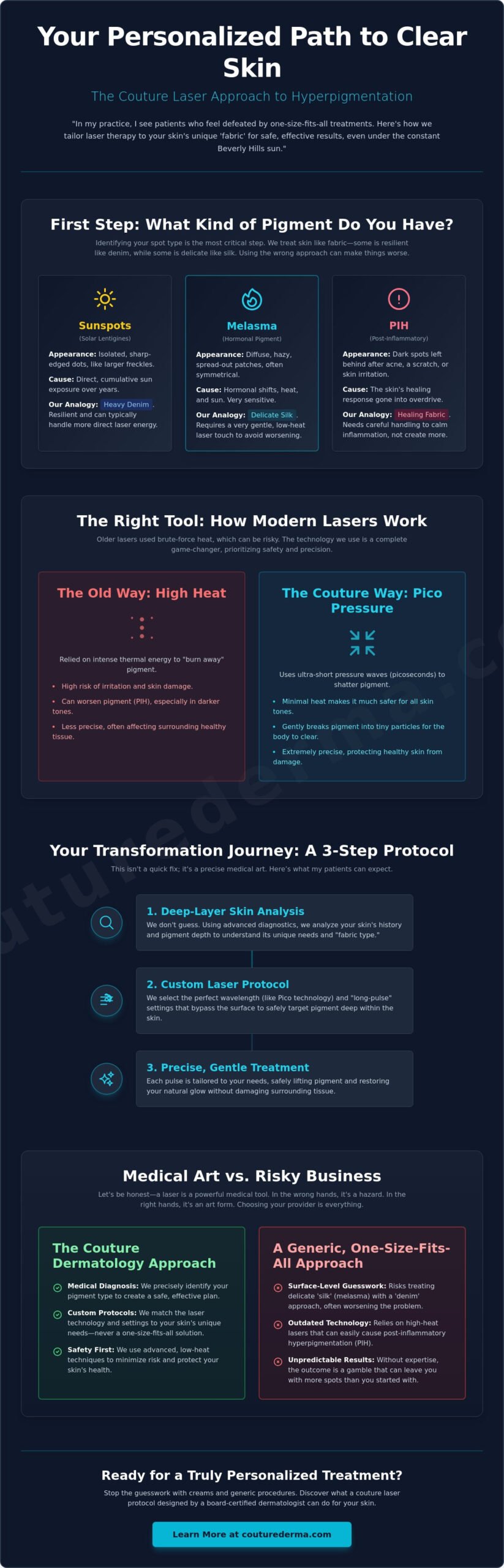
Identifying the specific type of pigment is the most critical step. I typically see three main types: sunspots, melasma, and post-inflammatory hyperpigmentation (PIH). PIH often follows an injury or a breakout; you can learn more about managing the resulting texture on our acne scar refinement page. Melasma is much more complex because it’s often driven by hormones. In our “Couture” approach, we treat melasma like a delicate silk fabric. It requires a very soft, low-heat laser touch. Standard sunspots are more like heavy denim; they’re resilient and can handle more aggressive settings. If a provider uses a “denim” setting on “silk” skin, the pigment will often get much worse. This is why a medical diagnosis matters more than the machine itself.
Actionable Tip: Before your consultation, take a hand mirror to a window with bright, natural light. Check if your spots are “focal,” meaning they look like isolated, sharp dots, or “diffuse,” which look like hazy, spread-out patches. This simple observation helps us determine if we’re dealing with straightforward sun damage or a deeper hormonal issue.
The Couture Laser Suite: Choosing the Right Technology for Your Tone
In my practice, I see patients who worry that a laser might be too aggressive for their specific skin tone. This fear is understandable because the wrong setting can lead to more trouble than you started with. That’s why we utilize a couture approach to every session. We don’t just pick a machine off a shelf; we select the exact wavelength that fits your skin’s unique “fabric.” For example, the Fotona laser is a staple in our practice because its versatility allows us to adjust the energy to match your specific needs. Whether we are using fractional lasers, which treat a tiny fraction of the skin at a time to encourage healing, or targeting deep pigment, the focus is typically on precision and safety.
Actionable Tip: During your consultation, ask your provider if they are using a “picosecond” or “nanosecond” laser. Picosecond lasers are typically much faster and use pressure rather than heat to shatter pigment, which is a vital distinction for many skin types.
Which laser is best for removing my dark spots?
Pico technology has completely changed how we handle stubborn spots. Older lasers often relied on heat to “burn” away pigment, but that heat can be risky for sensitive or darker skin. Pico lasers work by using ultra-short pulses of pressure to break the pigment into tiny, dust-like particles. It’s a “lunchtime” favorite for my busy patients because the downtime is so minimal. You might feel a sensation like a quick rubber band snap, but it’s over in a flash. Clinical reviews of cutaneous lasers for melasma and PIH confirm that this “photo-acoustic” effect is often safer for those prone to irritation.
Can you treat my redness and sunspots at the same time?
Let’s be honest, most of us aren’t just dealing with one single brown spot. Often, sun damage shows up as a mix of “reds and browns,” including tiny broken vessels and muddy patches of pigment. We frequently use Vbeam or BBL to target both issues simultaneously. If your pigment is mostly concentrated in the delicate area around your lids, we might suggest under-eye brightening to ensure a seamless, refreshed look. Layering these treatments is like tailoring a suit; we adjust each layer until the fit is perfect. If you’re ready to see which technology is right for you, schedule a personalized skin analysis with our team.
When you’re searching for the right laser treatment for hyperpigmentation beverly hills specialists often prioritize the health of your skin barrier. I’ve found that by combining the right technology with a patient, artistic eye, we can achieve results that look entirely natural. We aren’t just erasing spots; we’re restoring the vibrant, healthy glow that the California sun tried to take away.
What to Expect During Your Skin Transformation Journey
In my practice, we start by looking deep into the layers of your skin. This isn’t just a surface-level glance; we use specialized imaging to see exactly where that stubborn pigment is hiding. If you’re searching for an effective laser treatment for hyperpigmentation beverly hills offers many choices, but the prep work is what defines a couture result. On the day of your session, we apply a high-grade numbing cream and let you rest for about 30 minutes while it takes effect. Once we begin, you’ll feel a quick “zing” or a snapping sensation. We follow the clinical safety principles outlined in the Laser Treatment of Pigmented Lesions to ensure our energy levels are precise. After the treatment, you’ll enter the MENDS (microscopic epidermal necrotic debris) phase. This is where the magic happens as the laser pulls the pigment to the surface.
Will I have downtime after my session?
Let’s be honest about the social downtime. You’ll likely be red, and those “coffee grounds” (the pigment rising to the surface) will be visible. In almost all cases, picking or scrubbing the flaking skin is a recipe for trouble. If you force the shedding, you risk creating the very PIH we’re trying to fix. Stick to a simple 3-step routine: a gentle cleanser, a bland moisturizer, and a physical SPF. In my practice, I see patients who try to rush the process, but patience is typically your best aesthetic asset here.
Actionable Tip: Wait at least 20 minutes after cleansing before applying any post-procedure actives to avoid irritation. Your skin barrier is temporarily compromised, and this pause allows your natural pH to stabilize and provide a tiny bit of protection.
How long before I see my results?
When will you see the glow? Some patients see a difference in as little as a week. But the real “wow” factor usually arrives after a series of 3 to 5 sessions. This is a collaborative journey, not a one-and-done appointment. We adjust the “fit” of the laser as your skin changes over time. For a broader look at how we renew the skin, you can explore The Couture Guide to Laser Skin Resurfacing. We’re here to guide you through every step of this transformation. It’s about gradual, refined progress that lasts.
The Safety First Approach: Lasers for All Skin Types
I often meet patients who are terrified of lasers. They’ve been told that if they have a deeper skin tone, a laser will leave them with permanent burns or even darker spots. Let’s be honest; in the wrong hands, that’s a real risk. But in our practice, we use a different approach. We utilize specific “long-pulse” settings. These allow the energy to bypass the surface and target the deep pigment safely. It’s about being intentional. I often start my patients on a pre-conditioning regimen four weeks before the laser even touches their skin. This “quiets” the cells so they don’t overreact to the treatment.
Actionable Tip: If you have a darker skin tone, it’s often wise to ask for a “test patch” behind the ear before treating the whole face. It’s a reliable way to see how your unique “fabric” reacts to the energy before we proceed with a full session.
Will this treatment cause more dark spots to form?
PIH (post-inflammatory hyperpigmentation) is basically your skin’s over-reaction to heat or trauma. If you’ve ever had a breakout that left a stubborn dark mark behind, you’ve experienced this. In my practice, I use a “cool and slow” philosophy for anyone prone to these marks. We take our time. We don’t rush the results. For those whose pigment started with a blemish, our acne scar refinement protocols often work hand-in-hand with our laser settings to smooth both tone and texture simultaneously. It’s a gradual progression toward brilliance.
Do I really need to use special creams before my laser?
Medical-grade topicals are an essential part of the journey. I might prescribe hydroquinone or specialized non-HQ brighteners to prepare the skin. These are much more potent than anything you’ll find at a department store. Over-the-counter options often fail for deep-seated Beverly Hills sun damage because they simply can’t reach the necessary depth. And let’s be clear: SPF is not negotiable. It is the insurance policy for your laser investment. Without it, the California sun will simply undo all our hard work. We want to protect your transformation at every stage.
If you’ve been told you aren’t a candidate for laser treatment for hyperpigmentation beverly hills experts like our team can often find a safe, couture path for your specific skin type. Book your safety-first consultation today to start your personalized journey.
Why a Beverly Hills Dermatologist is Your Best Aesthetic Asset
In my practice, I see patients who come to me after a “quick fix” at a local med-spa has gone wrong. It’s tempting to walk into a boutique for a discounted session, but choosing a laser treatment for hyperpigmentation beverly hills requires more than just a functional machine. It requires a board-certified dermatologist who understands the complex biology of your skin. Being a Harvard-trained expert means I don’t just “fire a laser.” I look at the underlying causes, from hormonal shifts to cumulative sun damage, to create a medical plan that protects your health while enhancing your beauty. Couture care is about having a doctor who can manage the unexpected, ensuring your journey is as safe as it is transformative.
Actionable Tip: Start a “skin diary” for one week before your visit. Note when your spots seem darkest, such as after a workout or a long drive, to help us identify if heat or light is your primary trigger.
The value of a clinical consultation
A “quick fix” often leads to more pigment and more spending in the long run. When you choose an expert, you’re investing in a personalized blueprint. During a pigment check, I look at your face holistically. We might discuss how jawline contouring or under-eye care can complement your newly even tone to create total facial harmony. If you’re feeling overwhelmed by options, I recommend reading our couture guide on how to choose the best dermatologist in Los Angeles. We believe that a thorough medical assessment is the only way to ensure your results are both beautiful and lasting.
Your collaborative journey to timeless skin
Let’s be honest; your skin is a living, breathing fabric that changes with age, stress, and the environment. We don’t view your treatment as a one-off appointment but as a collaborative journey. This process-as-transformation concept means we adjust your protocol as your skin improves. Clear skin isn’t just about the spots you lose; it’s about the confidence you gain when you no longer feel the need to hide behind heavy makeup. By treating your skin as a long-term investment, we achieve a level of brilliance that looks entirely natural. When you’re ready to stop guessing and start glowing, our practice is here to tailor your transformation and help you reclaim your radiance.
Reclaiming Your Radiance with Precision Care
Living with stubborn spots doesn’t have to be your permanent reality. In my practice, I see patients who have finally found relief by moving away from one-size-fits-all solutions and embracing a truly personalized protocol. We’ve explored how identifying your specific pigment type and choosing the right technology are the foundations of safety. Whether we’re utilizing the Fotona laser or prepping your skin with medical-grade topicals, the goal is always a refined and natural result.
Finding the right laser treatment for hyperpigmentation beverly hills shouldn’t feel like a gamble. It’s a medical art that requires a deep understanding of how different wavelengths interact with your unique skin tone. As a Harvard-trained, board-certified dermatologist, I’m committed to providing that level of expertise in a bespoke clinical environment designed for your comfort. I specialize in treating all skin types and tones, ensuring that every patient receives a safe and effective transformation.
Your journey to an even, glowing complexion is a collaborative transformation. It’s about more than just fading spots; it’s about the confidence that comes with healthy, resilient skin. When you’re ready to start your custom-fit path to brilliance, Schedule your Couture Consultation with Dr. Abisogun today. Let’s reveal the skin you were always meant to have.
Frequently Asked Questions
Is laser treatment for hyperpigmentation permanent?
Laser results are long-lasting but not strictly permanent because your skin is a living organ that continues to react to the sun. In my practice, I see patients who maintain their glow for years, but new spots can form if you don’t protect your investment. Think of it as clearing the canvas; you still have to prevent new paint from splashing on it. Maintenance sessions and daily SPF are essential for keeping those results.
How much does laser hyperpigmentation treatment cost in Beverly Hills?
The cost of your transformation depends on the specific laser technology used and the size of the area we’re treating. In Beverly Hills, you’ll find a range of options, but remember that you’re paying for the expertise of the provider, not just the machine. We provide a detailed estimate after your skin blueprint is created. Investing in a board-certified expert often saves you money by avoiding the need to fix complications later.
Can I get laser treatment if I have a tan?
You should typically wait at least four to six weeks for a tan to fade before starting your session. When your skin is tanned, your melanocytes (pigment cells) are in an active, “angry” state. Laser treatment for hyperpigmentation beverly hills requires a stable skin base to avoid accidental burns or worsening the pigment. I often see patients who try to rush their treatment after a vacation, but waiting is the only way to ensure a safe result.
Which laser is best for melasma vs. sunspots?
Melasma usually requires a “cool” laser like a Pico or a low-energy Fotona setting, whereas sunspots can handle more robust energy. Melasma is hormonally driven and very sensitive to heat. If you use too much energy on melasma, it will often bounce back darker. Sunspots are more straightforward and respond well to wavelengths that target the pigment directly. In my practice, we tailor the wavelength to the specific “fabric” of your spots.
How many sessions will I need to see clear skin?
Most patients require a series of 3 to 5 sessions to achieve significant clearance. While you might see a brighter tone after just one visit, hyperpigmentation often lives in multiple layers of the skin. We need to lift it gradually to keep the skin healthy. I see patients who get discouraged after one treatment, but the real “wow” factor happens as we build on each previous session. It’s a progression, not a sprint.
What happens if the laser makes my spots darker?
It is actually quite common for spots to look darker for a few days as the pigment rises to the surface. This is part of the “coffee ground” effect we discussed earlier. However, if they stay dark or turn a new color, it could be post-inflammatory hyperpigmentation (PIH). This is why I emphasize a “cool and slow” approach. If PIH occurs, we adjust your medical-grade topicals to quiet the skin and get you back on track.
Is there a ‘best’ time of year to start laser treatments in Los Angeles?
Late fall and winter are the most popular times to start because the sun’s intensity is slightly lower. But let’s be honest; in Southern California, we have sun year-round. You can start your laser treatment for hyperpigmentation beverly hills journey at any time, provided you are committed to strict sun avoidance. I tell my patients that their wide-brimmed hat and physical SPF are just as important as the laser itself during the treatment months.
Can I wear makeup immediately after my laser session?
I recommend waiting at least 24 hours before applying traditional makeup to allow your skin barrier to begin closing. If you absolutely must cover redness, a mineral-based tinted SPF is often a safer alternative. In my practice, I see patients who want to hide the “social downtime” immediately, but your skin needs a little breathing room. Stick to your bland moisturizer for the first day to ensure the best possible healing environment.